The Bookmakers Already Knew: How Polymarket Called Belgium's Win Before the Whistle
A prediction market pegged USA's elimination from the 2026 World Cup at decisive odds hours before kickoff. That's not a sporting story — it's a media story.
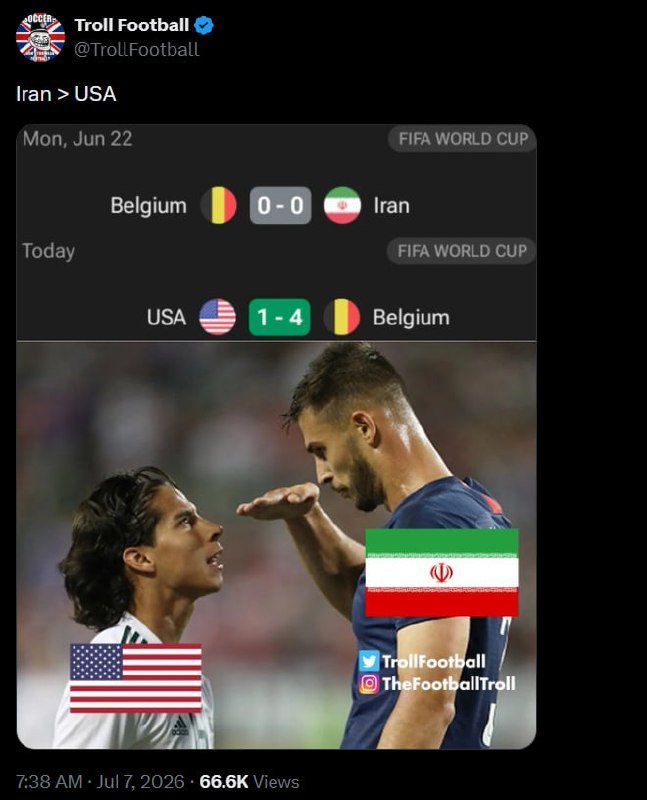
At 02:16 UTC on 7 July 2026, the Polymarket account on X posted a single line: "BREAKING: Team USA officially eliminated from the World Cup after a 4-1 loss to Belgium." Four hours earlier, on a separate contract, the same platform had Belgium's path to the title at just 2%. Neither number mattered to the players. Together, they tell you almost everything you need to know about how the modern sports media machine has learned to watch a game before it has been played.
The story here is not that the United States lost a football match. The story is that a derivatives market, a quasi-journalistic broadcast channel, and a national-team federation all converged on the same result in the same hour, with each one claiming to have reported the others. A prediction contract priced in the elimination before it was officially a fact. A social feed republished that price as breaking news. The official knockout bracket, carried by Iranian state-affiliated wire Tasnim, caught up in the same news cycle. By the time a viewer in any continent opened their phone, three different institutions were presenting three different versions of the same certainty.
The platform beat the press to the line
Polymarket's USA-elimination market had been oscillating all week. On 6 July at 15:37 UTC, the contract showed USA at 54% to advance, after a separate post flagged the lifting of a Balogun suspension and Belgium's "astonished" reaction. The price was essentially a coin-flip with a slight home-team tilt. By the same evening, the picture had shifted, and by 02:16 UTC the next morning Polymarket was declaring the tournament over for the host nation.
The mechanism is worth describing plainly, because it is the actual story. A user can buy a share that pays out $1 if a stated condition is met — USA eliminated, Belgium wins the tournament, Ronaldo cries on camera — and the last traded price is presented as a probability. The numbers move on real money, sometimes on very little of it, and they update in public. By the time a wire desk files its lede, the price has often already swung. That is not insider trading and it is not journalism. It is a new thing, sitting somewhere in the middle, and the platforms have noticed.
Sport, sentiment, and the temptation to gamify both
The same feed that called Belgium's victory has been running adjacent markets on the human texture of the tournament. As of 18:59 UTC on 6 July, Polymarket had a contract asking whether Cristiano Ronaldo would cry at the World Cup, "ahead of what could be his last international game ever," priced at 69%. There is a market, on the same platform, for whether a 40-something Portuguese forward will visibly weep on a broadcast.
The companies running these books will tell you that emotion markets are no different from the Las Vegas prop bets that have existed for decades. They will also tell you the contracts are informationally efficient — that the price on Ronaldo's tears reflects genuine collective guesswork. Both claims are defensible. What is harder to defend is the editorial decision to publish the prices in the same voice a wire service uses for stadium incidents, with the same urgency, the same red "BREAKING" labels, on the same feed a reader might use for an alert about a building fire or a coup. The platform is not just enabling wagering. It is curating the news.
What this changes about who watches the game
For most of the 21st century, the live sports experience has been a three-tier stack: the federation that runs the competition, the broadcaster that owns the rights, and the bookmaker who prices the side action. Polymarket, and the small handful of competitors in the same regulatory grey zone, are inserting themselves into that stack as a fourth layer — one that operates at wire-service speed, dresses its output as journalism, and has no editorial standards department to push back against.
The structural risk is not that the prices are wrong. The prices are mostly fine. The risk is that a generation of readers, raised on social feeds that flatten every update into a notification, learns to trust the market's number over the federation's result, the broadcaster's analysis, or the team's own statement. The cascade that ran from Polymarket's 15:37 UTC update to its 02:16 UTC "BREAKING" is a prototype: a sportsbook leads, a feed amplifies, an official body follows, and nobody in the chain is meaningfully accountable for any of it.
What remains genuinely uncertain
The numbers cited here are drawn from Polymarket contracts and the platform's own social posts at the timestamps given. They are not the same as audited market depth. A 2% contract can move on a few thousand dollars of flow. The Tasnim bracket update, also referenced above, shows the official knockout structure the federation in question had settled on at 04:17 UTC on 7 July — useful as a record of where the formal record stood, less useful as a verdict on the match itself, which is the bit this piece is not trying to replace.
There is also the open question of how regulators treat a platform that publishes its prices as breaking news. For now, the answer is that nobody with authority has decided, and the platforms are content with that. That is the most important number of all, and it does not trade on any exchange.
This article relies on social-feed timestamps and prediction-market contract pages rather than audited match reports. Monexus reports the platform's own framing of its numbers; the football is left to the football press.
Wire provenance
This editorial synthesis draws on the following public wire/social posts:
- https://t.me/tasnimnews_en