Strait of Hormuz under fire: what an Iran-linked tanker strike tells us about the corridor the world cannot do without
Two commercial vessels reported hit off Oman's coast within an hour, UKMTO logs show. The incident lands on a corridor that carries a fifth of the world's traded oil — and tests how much disruption the system can absorb.
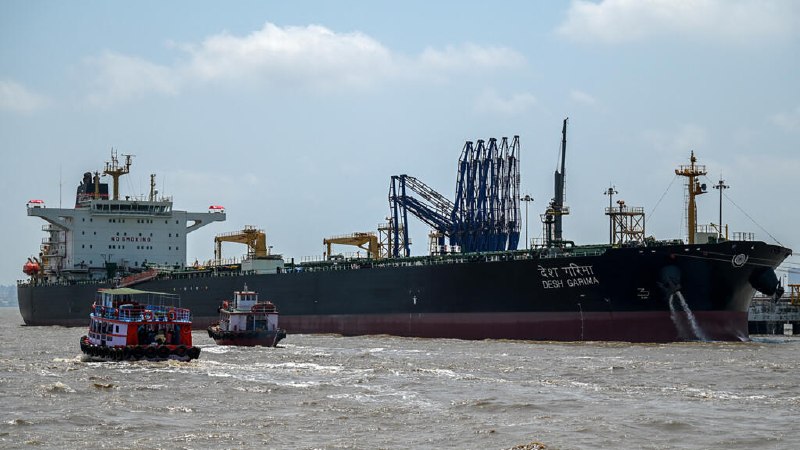
At 23:22 UTC on 6 July 2026, the United Kingdom Maritime Trade Operations centre logged a single line of incident traffic: a tanker had been hit by a projectile eight nautical miles east of Limah, on Oman's coast. By 23:47 UTC, UKMTO had issued a follow-up advisory — the vessel's port side was struck, a fire had broken out. By 00:26 UTC on 7 July, Axios was reporting that Iran had fired at least two missiles at commercial ships transiting the Strait of Hormuz. Three alerts in just over an hour, all pointing at the same stretch of water, and all of it on a corridor that moves something close to a fifth of the world's traded oil every day.
What happened overnight is less important than what it tells us about a chokepoint the global economy has, for decades, treated as a free good. The incident sits at the intersection of an active Iran–United States confrontation and a maritime system that was not designed to absorb even a small, deliberate shock. The world has talked about Hormuz as a vulnerability for forty years; on the night of 6 July, that vulnerability produced a very specific kind of news — an actual fire, on an actual hull, in waters no rerouting can avoid.
What UKMTO actually reported
The sequence began with the maritime alert system, not with any government. UKMTO, run out of the United Kingdom under the Royal Navy's umbrella, is the closest thing the merchant fleet has to a real-time incident channel. Its function is narrow: receive reports from masters, log positions, and push advisories back out so other vessels can adjust course. It does not assign blame.
The 23:22 UTC alert named a projectile strike on a tanker eight nautical miles east of Limah, Oman — a stretch of water just south of the Strait of Hormuz's narrowest point, on the Omani side of the shipping lane. The 23:47 UTC follow-up added the operational detail: port side struck, fire reported, vessel status pending. Both advisories carried the same coordinates; both reached global ship operators within minutes.
By 00:26 UTC on 7 July, the political attribution had arrived. Axios reported that Iran had fired at least two missiles at commercial ships transiting through the Strait of Hormuz. The missiles, per Axios's reporting, were directed at vessels attempting to cross via the Omani route — a phrasing that, whether intentional or not, echoes a separate claim carried earlier on Middle East Spectator, a widely followed Arabic-language channel, that the IRGC Navy had struck a vessel "that attempted to cross the Strait of Hormuz via the Oman route without Iran's permission." The two framings are not identical, but they triangulate.
What the public record still does not contain is the name of the vessel, its flag state, its cargo, the extent of the damage, or any casualty count. UKMTO advisories of this kind typically precede — by hours, sometimes days — formal identification by the operator and the flag state. That lag is normal. It is also the reason maritime insurance markets react to the coordinates first and the identities second.
The IRGC framing, and why it matters
The Middle East Spectator line — that the strike was a punishment for transiting "without Iran's permission" — is the framing Tehran has used for years to describe its asserted authority over the northern reaches of the strait. It is not a framing the rest of the maritime order recognises. Under the United Nations Convention on the Law of the Sea, transit passage through straits used for international navigation is supposed to be continuous and expeditious; coastal-state consent is not a prerequisite. Iran's interpretation, in short, is incompatible with the treaty regime the global merchant fleet operates under.
But to stop there is to miss the structural point. Iran's maritime posture is not a quirk of one revolutionary government; it is the response of a state whose conventional naval deterrent cannot, in any honest accounting, stand up to the United States Fifth Fleet, and which has therefore invested heavily in asymmetric tools — fast boats, mines, anti-ship missiles, and the political leverage that comes from controlling the coastline at the narrowest point of a chokepoint. A missile fired at a tanker is not, in this logic, an act of war against a ship. It is a statement that the strait is not a public good; it is a bargaining chip.
The alternative read is more straightforward: the strike was a punitive action tied to a specific political dispute, not a generalised assertion of dominion over the waterway. That framing is also present in the early reporting — Axios's line that the target was vessels using "the Oman route" suggests an effort to signal pressure on a particular traffic pattern rather than to close the strait outright. Closing the strait would be the kind of move that produces an immediate, overwhelming military response; signalling that certain transits will be punished is a different, less catastrophic kind of escalation.
Both reads can be true at once. The danger of the moment is that the international system tends to hear only one of them, then respond to the wrong one.
A corridor built on the assumption of peace
The Strait of Hormuz is roughly 21 nautical miles wide at its narrowest, with shipping lanes on each side and a two-mile buffer in the middle. Roughly a fifth of globally traded oil passes through it every day, alongside a significant share of liquefied natural gas from Qatar. The geography is what it is: there is no overland pipeline system large enough to bypass it, and Iran's coastline sits on the northern shore.
The system that protects this traffic is, in effect, a coalition of national navies operating under the umbrella of the Combined Maritime Forces, with the US Fifth Fleet as the senior partner. The presence is real; it is also thin. There are not enough warships to escort every tanker, and the shipping industry has never been organised on the assumption that it needs to be. Insurance, routing algorithms, and a dense web of incident-reporting channels — UKMTO among them — do the daily work of risk pricing. When those mechanisms register a missile strike at the coordinates UKMTO published on 6 July, the pricing adjusts before the politics do.
This is the structural point that tends to disappear in the first 24 hours of coverage. A single projectile strike on a single tanker off Limah is, in one reading, an isolated enforcement action. In another reading, it is a stress test of a maritime order that has spent two decades externalising its security costs onto a small number of flag states, insurance underwriters, and a Royal Navy liaison office in Dubai. The order did not fail on the night of 6 July. But it flinched. And a system that flinches is a system that the next actor will test again.
What the next 72 hours will tell us
Three signals matter more than the strike itself. The first is the identity of the vessel and its flag state. A Liberian-flagged tanker owned by a Greek operator and carrying Saudi crude produces a different political reaction than an Iranian-flagged vessel carrying Iranian condensate — and the early reporting does not yet distinguish between the two possibilities. UKMTO advisories typically stop short of identifying the ship; that information arrives from the operator.
The second signal is the oil-market response. As of the early UTC hours of 7 July, benchmark crude had not yet opened in a way that fully prices a sustained Hormuz disruption. A short, sharp spike on the order of one to three dollars per barrel is consistent with a single incident; a sustained move higher, or a measurable widening of the Brent–Dubai spread that captures regional geopolitical risk, would tell a different story. That data will land in the next Asian trading session.
The third signal is the diplomatic one. Iran's foreign ministry had not, as of the time of UKMTO's late-evening advisories, publicly confirmed or denied responsibility in a way the international wires could cite. Axios's reporting carried the attribution; Tehran's own read is still pending. If the IRGC claims the strike, the diplomatic frame is set — escalation management becomes a face-to-face negotiation between Washington and Tehran. If Tehran denies it, the framing shifts toward a rogue-element scenario, and the analytical task becomes untangling command-and-control.
The longer arc is harder. The Strait of Hormuz has been the subject of threat-and-retreat cycles since the Iran–Iraq war in the 1980s. Each cycle ends the same way: the threat is withdrawn, traffic resumes, and the structural vulnerability remains. The risk of the present cycle is that the architecture underwriting that pattern — the assumption that a single incident is a signal rather than a precedent — is being asked to absorb more shocks, in shorter intervals, with thinner diplomatic padding between them.
What remains genuinely uncertain
Three things are unsettled at the time of writing. First, the identity of the vessel and its flag state — without which casualty, environmental, and legal questions cannot be properly answered. Second, whether the strike was a one-off enforcement action or part of a broader pattern of pressure on specific traffic routes through the strait; UKMTO's late-June traffic logs would need to be cross-checked against the past 30 days to see whether other near-incidents were reported and downplayed. Third, the operational picture inside Iran — whether the strike was ordered at a political level, conducted by an IRGC unit acting within standing rules of engagement, or the product of a localised commander interpreting a permissive environment too broadly. The sources available on the night of 6 July do not resolve any of these three. They establish the coordinates and the fact of the strike; everything beyond that is reconstruction.
What the record does establish is harder to argue with. A projectile struck a tanker in the Strait of Hormuz on the evening of 6 July 2026. UKMTO logged it within minutes. Axios, within an hour, named Iran as the actor. The corridor moved oil the same way it has every day for decades, and the same way it may not be able to move it indefinitely, if the assumption of peace keeps being tested by actors for whom that assumption was never the point.
This piece relies on UKMTO advisory traffic and Telegram-distributed early reporting because the official attribution chain — flag state, operator, insurer — had not yet closed at the time of writing. Where Iranian state-aligned channels supplied the political framing, they are cited as such and not as stand-alone factual claims.
Wire provenance
This editorial synthesis draws on the following public wire/social posts:
- https://t.me/wfwitness
- https://t.me/wfwitness
- https://t.me/rnintel
- https://t.me/Middle_East_Spectator
- https://en.wikipedia.org/wiki/Strait_of_Hormuz
- https://en.wikipedia.org/wiki/United_Kingdom_Maritime_Trade_Operations
- https://en.wikipedia.org/wiki/Combined_Maritime_Forces
- https://en.wikipedia.org/wiki/United_Nations_Convention_on_the_Law_of_the_Sea
- https://t.me/wfwitness
- https://t.me/wfwitness
- https://t.me/rnintel
- https://t.me/Middle_East_Spectator
- https://en.wikipedia.org/wiki/Strait_of_Hormuz
- https://en.wikipedia.org/wiki/United_Kingdom_Maritime_Trade_Operations
- https://en.wikipedia.org/wiki/Combined_Maritime_Forces
- https://en.wikipedia.org/wiki/United_Nations_Convention_on_the_Law_of_the_Sea