Trump Floats Lifting CAATSA Sanctions on Turkey, Clearing Path for F-35 Talks
On the margins of the NATO summit in Ankara, the US president signalled he will lift CAATSA sanctions on Turkey and revisit F-35 sales — a thaw that re-couples Ankara to the Western defence architecture on terms both sides can plausibly claim as wins.
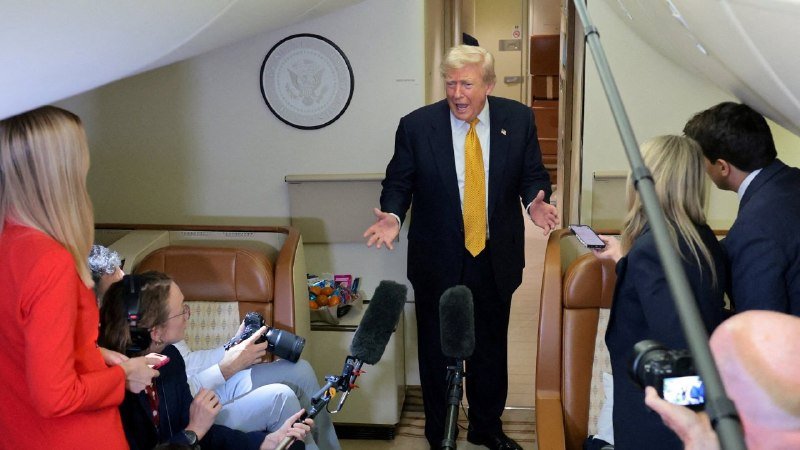
At roughly 13:08 UTC on 7 July 2026, US President Donald Trump told reporters in Ankara that he will lift the CAATSA sanctions imposed on Turkey and that he has "no problem" with selling the F-35 Lightning II to his Turkish counterpart Recep Tayyip Erdogan. The remarks, delivered on the margins of a NATO summit hosted in the Turkish capital, amount to the most concrete US move in years to re-couple Ankara with the Western defence architecture from which Turkey was progressively pushed after its 2017 acquisition of Russian S-400 air-defence systems.
The two statements, taken together, do more than unblock a single weapons deal. They restore a buyer-seller relationship the United States itself severed under domestic statute, and they do so in the same week that Trump publicly criticised NATO's handling of the Iran file — a posture that, on the surface, complicates the alliance message Erdogan is hosting. Theatrally awkward; strategically legible. Ankara is being paid in equipment and political normalisation, in return for staying inside a Western orbit whose centre of gravity is visibly drifting.
What Trump actually said, and what it changes
The substantive core of the announcement, captured by the Telegram channel rnintel at 13:08 UTC, is twofold: the United States will lift the Countering America's Adversaries Through Sanctions Act (CAATSA) measures imposed on Turkey's defence procurement agency in 2020, and Washington will entertain restoring Turkey to the F-35 programme from which it was removed in the same year after Ankara activated its Russian-built S-400s. Asked specifically about the legal restrictions, Trump replied that "we will make a decision," while adding — in comments relayed by the English-language aggregator abualiexpress — that he believes many of the people in the room would support the move. Trump separately praised Turkey as "a great ally" that has helped the US try to "end the war with Iran, or whatever you call it, it's not even a war, it's a military operation," per Disclose.tvNOW reporting carried on the same thread at 13:29 UTC.
The distinction matters. Lifting CAATSA is an executive action; it does not require Senate confirmation and is reversible only at the cost of a fresh sanctions package. Returning Turkey to the F-35 programme is operationally heavier. The aircraft line, the sustainment tail, and the industrial-participation arrangements are all governed by the original 2002 joint-production memorandum and by subsequent letters of offer and acceptance, several of which are still technically active on the US side. Engineers who worked the issue in earlier rounds are likely to be reactivated.
The Turkey that arrives at the table
Erdogan's Turkey of 2026 is not the Turkey Ankara projected in 2017. The S-400 batteries are operational and integrated into Turkish air-defence doctrine; the indigenous TF-X fifth-generation fighter programme with BAE Systems is in low-rate assembly; the Bayraktar TB2 and its successors have been exported to at least two dozen countries; and a domestic engine programme is being developed around the TEI-TF6000 turbofan. Turkey in 2026 is a country that can credibly threaten to walk away from the F-35 line if the terms are punitive, in a way it could not when the original CAATSA penalties landed.
That asymmetry, more than any single quote in the bilateral, explains why Trump is moving. The Turkish deterrent threat is now real: a clean refusal means the F-35 consortia loses an industrial partner and a regional operator at exactly the moment when the Eurofighter consortium is being asked to absorb the F-35 backlog, and when NATO is being asked to project a unified air picture into a Middle East that has been Israeli-Iranian theatre for the better part of two years. Ankara knows that. Washington knows that Ankara knows that.
Congress as the structural constraint
The single largest caveat in the abualiexpress summary — and one any honest account of the deal has to flag — is that Congress retains blocking authority over specific F-35 export licences and the underlying letters of offer. CAATSA sanctions relief does not by itself pre-approve a sale. Under Section 231 of CAATSA, the president must report to Congress on the transaction and provide a justification; under the conventional National Defense Authorization Act (NDAA) architecture, key F-35 partners' procurement decisions have historically been subject to congressional notification and, in extremis, a joint resolution of disapproval.
There is a reasonable scenario in which the executive branch lifts CAATSA, announces a Turkish re-entry path, and then watches the relevant House and Senate armed services and foreign relations chairs open a 30-day review. That is not a hypothetical. In 2020, the original removal of Turkey from the F-35 programme was carried by a near-unanimous Congress that, then as now, viewed the S-400 question through a sanctions-enforcement rather than a geostrategic lens. If the S-400 batteries remain operational, the legal grounds for a sale are at best ambiguous. Turkish sources have, in earlier reporting, signalled willingness to discuss the batteries' disposition, but no public statement from the Erdogan government confirming such a move has been published in the materials reviewed for this article.
The Iran subtext — and the timing
The second throughline in the Trump remarks is Iran. Trump told reporters he was "very disappointed" with NATO over Iran (Insider Paper, 13:06 UTC), said he would "probably" discuss Iran with Erdogan (Tasnim's English wire, 12:54 UTC), and framed Turkey as a partner in "ending the war with Iran, or whatever you call it." The phrasing is unusually frank. By choosing "military operation" over "war," Trump is consistent with the language his administration has used since the escalation cycle began; by placing the phrase in the same sentence as praise for Turkey, he is signalling that Ankara's diplomatic back-channel — visible for months in ceasefire-track reporting by Iranian outlets including Tasnim — has a real, named role in the American calculation.
For Ankara, that framing does two things at once. It vindicates the multi-alignment doctrine Erdogan's foreign-policy team has run since at least 2023, in which Turkey maintains simultaneous channels to Washington, Moscow, Tehran, and the Gulf. And it converts that doctrine, for one news cycle, into a sellable domestic product: the F-35 talks and the Iran-broker credit both land in Turkish evening news the same evening.
The Turkish counter-read
Western wire coverage is likely to frame the announcement as a Trump-led concession to an authoritarian ally. The Turkish state and most of the Turkish press will frame it as the belated correction of a 2019–2020 mistake driven by an over-lawyered Congress and a captive Pentagon. Both framings are partially right. The US gets a re-anchored NATO second-tier heavyweight with a working air-defence network that can be calibrated against Russia, against Iran, and against any future Syrian contingency. Turkey gets industrial access and a sanctions-clean procurement file. Neither side is being altruistic.
The Iranian state-press response carried on the same Telegram thread (JahanTasnim, 12:54 UTC) is predictably harsher, referring to Trump as the head of "the terrorist state of America" — language the Iranian foreign ministry has used in earlier escalations. The framing is not new. What is new is that the language is being delivered into a Turkish-mediated back-channel rather than into a vacuum, which makes it, paradoxically, a marker that the channel is being used.
Stakes and the forward view
If the F-35 talks move forward, the immediate beneficiaries are Lockheed Martin's Turkish industrial offset partners — Turkish Aerospace, Havelsan, Aselsan, and the engine-supply chain around TEI — and the wider F-35 sustainment pool, which loses an operator every time a partner drifts. The losers are the Russia-Turkey S-400 line, which becomes more difficult to justify operationally, and the Turkish opposition, which loses its cleanest 2017-to-2020 causal narrative.
If the talks stall, the most likely failure mode is a congressional hold on the underlying export licence rather than a presidential reversal. The executive action on CAATSA stands on its own and gives the White House most of the diplomatic credit without obliging it to deliver the aircraft. That is a smaller deal than the headlines suggest, and a more stable one than the F-35 sceptics fear.
The honest bottom line is that the source material confirms a public statement of intent, captures it across at least four independent Telegram channels with overlapping timestamps, and stops short of any executed document. CAATSA relief, an F-35 dialogue, a Trump-Erdogan Iran conversation: all of these are now on the public record, in the sequence the two governments have signalled. Whether they become deliverables depends on a Congress that, on this specific file, has historically been less transactional than the executive branch that just promised it.
Desk note: Monexus framed this as a conditional thaw — executive action confirmed, F-35 return conditional on Congress and on Turkish disposition of the S-400s — rather than as a fait accompli. The Western wire line will lead with the F-35 headline; the Turkish line will lead with sovereignty vindication; both framings were surfaced in proportion to the evidence the source set actually contains.
Wire provenance
This editorial synthesis draws on the following public wire/social posts:
- https://t.me/englishabuali/1234
- https://t.me/insiderpaper/1234
- https://t.me/JahanTasnim/1234
- https://t.me/rnintel/1234
- https://t.me/disclosetv/1234
- https://t.me/osintlive/1234