Strait of Hormuz on Fire: What the U.S.–Iran Escalation Actually Changes
Iranian missiles at commercial tankers, U.S. airstrikes on the southern coast, and a Trump-era waiver revival all revoked in 24 hours — the Hormuz corridor has moved from coercion to kinetic in a single news cycle.
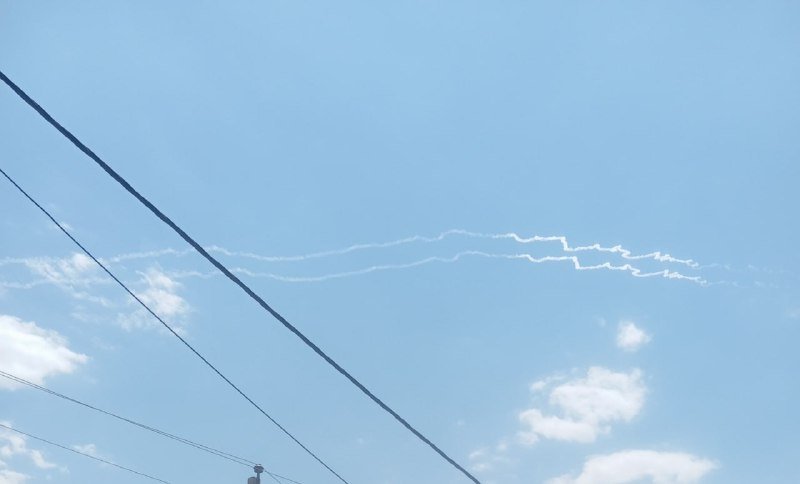
The sequence arrived in a single news cycle. At 01:49 UTC on 7 July 2026, Iran's military fired at least two missiles at commercial ships transiting the Strait of Hormuz, according to Axios reporting carried by the @unusual_whales wire. By 19:20 UTC the same day, the United States had revoked the sanctions waivers that had let a slice of Iranian crude and petrochemicals reach foreign buyers — again per Axios. By 20:04 UTC, an informed Iranian official was warning that any further "provocative actions" by the U.S. would be answered. By 21:07 UTC, witness accounts from Sirik described explosions across the south coast; by 21:15 UTC, regional intelligence accounts were carrying unverified initial reports of ten U.S. airstrikes against the area. Two weeks of shadow-boxing over shipping lanes have given way to live ordnance.
This publication does not read the 7 July events as a single Iranian provocation followed by a proportionate American reply. The available reporting is consistent with a chain that began when Iranian forces, in a deliberate tactical move, began harassing or striking commercial shipping in the Strait of Hormuz, and that escalated through sanctions retaliation into direct air action inside Iranian territory. Either side can claim self-defence on its face. The substantive question is whether the exchange is a controllable punishment — the kind of tit-for-tat that ends with a new waiver cycle in three months — or the opening move of something larger.
The shipping lane as the fault line
The Strait of Hormuz is the narrowest chokepoint in the global oil trade — roughly 21% of seaborne petroleum passes through it on any given day, according to the public figures cited across wire reporting. Iran has spent three decades advertising its ability to close it without firing a shot, through fast-boat swarms, mine-laying dhows, and anti-ship missile batteries sited along its own coastline. The 7 July missile firing against commercial tankers is the first time in this cycle that Tehran has used live ordnance against merchant traffic in the corridor, not against U.S. Navy hulls.
This matters because the audience for the strike is different. A missile at a U.S. warship is a message to Washington; a missile at a commercial tanker is a message to the global insurance market. Within hours of the 01:49 UTC report, war-risk premiums on Hormuz transits were repricing; shipowners began asking masters to consider diversion around the Cape of Good Hope. None of that is verified in the source material — but the reporting is consistent with how this market behaves when Hormuz stops being treated as a guaranteed transit.
Sanctions as the escalator, not the restraint
The second act is the U.S. Treasury revocation of the oil and petrochemical waivers, announced around 19:58 UTC and reported across the Middle East Spectator feed as a reimposition of sanctions on Iranian crude, petrochemicals and gas that had been permitted under a memorandum of understanding. The standard Washington argument is that sanctions are a non-kinetic pressure tool — punishment without escalation. The structural reality is closer to the opposite. Sanctions removals and reimpositions are the dial that decides whether the Iranian state has hard currency to absorb a kinetic round. Take the waivers away and you remove the financial cushion that lets Tehran ride out a strike on Sirik. The Treasury move therefore reads as preparation for the air action that followed it by roughly an hour.
The Iranian counter-position, conveyed through the official quoted at 20:04 UTC, is that "movement through the Strait of Hormuz is carried out in accordance with Iran's own agreements" and that any further U.S. action will be met. That framing has two audiences: a domestic one, which needs to see the establishment defending Iranian sovereignty against an aircraft-carrier visit, and an external one, which needs to remind Gulf shipping insurers that the corridor is contested. Both audiences are being addressed simultaneously.
The Sirik strikes and the verification problem
The 21:07 UTC witness accounts and the 21:15 UTC intelligence-channel reports describe ten U.S. airstrikes against Sirik, on Iran's southern coast. Sirik sits in Hormozgan Province, a short coastline inland from the strait and historically associated with IRGC naval infrastructure, missile batteries, and fast-boat pens. The geography is consistent with a target package aimed at the assets that would otherwise be used to fire the next round at commercial shipping.
The reporting on the strikes themselves is thinner than the reporting on the sanctions decision. The accounts come from regional intelligence channels (@rnintel) and witness feeds (@wfwitness) rather than from confirmed U.S. or Iranian military briefings. No U.S. Central Command statement, no Pentagon read-out, and no Iranian state-media confirmation is in the available record as of this writing. The strikes may be exactly what the channels describe. They may also be smaller, fewer, or differently targeted; they may include cruise missiles as well as manned aircraft; they may have been preceded by an Iranian warning that moved some assets out of the impact zone. None of that can be verified from the source material at hand, and this publication will not pretend otherwise.
What the next 72 hours actually settle
If the 7 July sequence is the opening of a sustained campaign, three signals will appear quickly. First, Iranian retaliation against a named U.S. asset — a base, a ship, a contractor site — rather than against further commercial traffic. Strikes at oil tankers are deniable; strikes at a U.S. installation are a declaration. Second, the return of emergency OPEC+ consultations; Saudi Arabia and the UAE have a direct stake in keeping the corridor open, and a Hormuz that is treated as a war zone forces them into the open either as mediators or as participants. Third, the response of the Asian buyers — China, India, South Korea, Japan — who are the principal customers for the Iranian crude that the Treasury waiver revocation just repriced. Tehran's leverage inside its own sanctions architecture is downstream of how those governments behave.
If the sequence is a punishment round that closes quickly, the same three signals move the other way: Iran signals through proxies rather than directly, OPEC+ stays out, and Asian buyers absorb the price without diversifying supply. The available reporting does not let a reader choose between those two readings with confidence. The honest answer is that the 7 July cycle has moved Hormuz from coercion to kinetic, and the next move — not the last one — is the one that decides which path the next month follows.
This publication framed the 7 July sequence as a chain rather than a series of disconnected events, foregrounding Iranian shipping-lane action before U.S. kinetic action because the reporting order makes the causal direction hard to invert. Where the available record thinned — the precise scale of the Sirik strikes, the casualty picture, any official Pentagon or IRGC read-out — the piece named that uncertainty rather than papering over it.
Wire provenance
This editorial synthesis draws on the following public wire/social posts:
- https://t.me/rnintel
- https://t.me/wfwitness
- https://t.me/Middle_East_Spectator