Venice Biennale Becomes the Stage for a US Ambassador Boycott Call
Cultural workers in Venice are calling for a strike on July 17 to coincide with the US ambassador's expected arrival by yacht — a confrontation that turns the Biennale grounds into a diplomatic flashpoint.
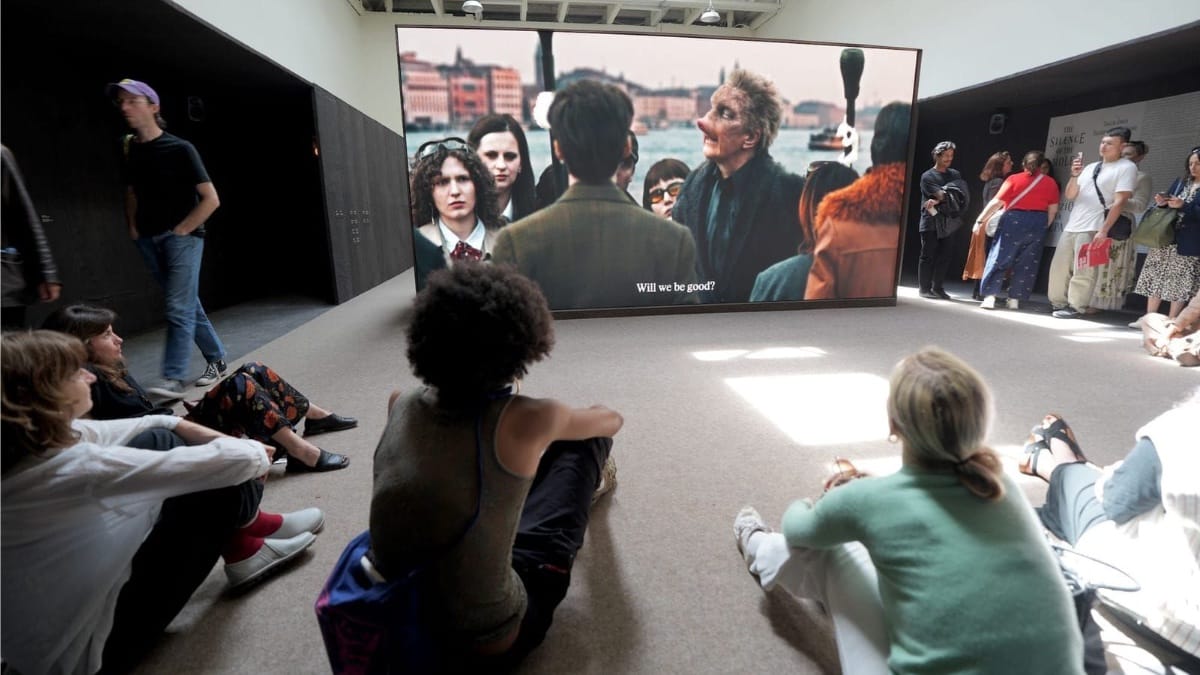
On 7 July 2026, a coalition of pro-Palestinian cultural workers announced a strike and public demonstration timed to the US ambassador's expected arrival in Venice. The call, organised around a 17 July gathering at Campo San Zaccaria, converts the closing days of the Biennale — an event that styles itself as a neutral showcase for the world's art — into a forum over American foreign policy in the Mediterranean. The site the organisers have chosen is not incidental: it is the waterfront piazza where the ambassador's yacht is expected to dock.
The action is small in headcount and large in symbolism. Venice's Biennale infrastructure, lavishly funded by national pavilions and corporate sponsors, runs on the assumption that art and statecraft can co-exist without friction. The strike call is a direct test of that assumption: it asks artists, technicians and visitors to choose between participating in a global cultural event and registering an objection to the diplomatic posture of the country whose flag flies over the ambassador's vessel.
The call, and who is making it
According to ARTNEWS, the strike has been organised by a self-described coalition of pro-Palestinian cultural workers, with protesters invited to gather at Campo San Zaccaria on 17 July. The outlet reports that the demonstration is timed to coincide with the arrival of the US ambassador by yacht — a detail that has drawn attention because it foregrounds the optics of US diplomatic presence in the lagoon city during the Biennale's closing week.
The organisers' choice of venue is tactical. Campo San Zaccaria sits on the Venetian waterfront along the route commonly used by private vessels delivering high-level visitors to the historic centre. A gathering there ensures that the protest is visible from the water and from adjacent vaporetto stops — the practical circulation points through which ambassadors, pavilion delegations and press are likely to pass. The strike component, by contrast, operates inside the Biennale's own infrastructure: technicians, artists and visitors declining to participate in pavilions or events for the day would impose a cost that a one-off rally cannot.
The coalition has framed the call as a question about which governments are welcome at cultural summits, and on what terms. The US ambassador's presence is treated by the organisers not as routine diplomacy but as an implicit endorsement — by attendance — of US policy in the region.
Why Venice, and why now
The Biennale runs on a delicate balance. National pavilions are funded by governments; corporate sponsorship underwrites the central exhibitions; private foundations bankroll collateral events across the city. That architecture gives the event reach but also creates pressure points: any actor willing to disrupt labour, programming or optics can extract a hearing.
The 17 July timing falls inside the final stretch of the 2026 edition, when press attention, collector visits and national-day celebrations peak. A strike call during this window is calibrated to be felt by the institutions that organise the pavilions rather than by the Biennale's central administration. The choice of a waterfront site — and the language about the ambassador's yacht — also turns the protest into a media object in its own right, photographable from multiple angles, reproducible across social platforms, and easily inserted into broader reporting on US policy in the Mediterranean.
The diplomatic backdrop is not neutral. The US has been the most prominent external supporter of Israel throughout the war in Gaza, and successive US administrations have resisted Palestinian statehood recognition and conditioned aid on the conduct of the Palestinian Authority. Against that record, the organisers' framing — that an ambassador's attendance reads as endorsement — has a structural basis even if individual officials would dispute the implication.
The counter-position
The organisers' framing is not the only read of the facts. The US ambassador's presence at the Biennale can be described as routine cultural diplomacy: a senior envoy attending a flagship international event, hosting American artists and meeting Italian counterparts. From that vantage, a strike call reads as the importation of a foreign-policy dispute into a cultural setting, with artists and technicians instrumentalised for a political end they may not share.
The Biennale's organisers have not, on the public record available, taken a position on the strike call. That silence is itself part of the story: the institution depends on goodwill from national governments and corporate backers across the political spectrum, and any explicit endorsement risks alienating one set of stakeholders. The coalition, for its part, is not a Biennale-internal body; it is an extra-institutional grouping acting on the Biennale as a target. Whether that distinction matters — whether pressure from outside the institution is more or less legitimate than pressure from within — is one of the unresolved questions the 17 July action will surface.
What it sits inside, and what is at stake
The action belongs to a wider pattern in which cultural infrastructure has become a venue for disputes that would previously have been confined to legislatures or foreign ministries. Museum workers in Europe and North America have organised walkouts and union statements over institutional ties to donors and states. Film festivals have faced boycott calls over juries and honourees. Concert venues have been pressured over performer affiliations. The Biennale strike call extends that pattern into the visual-art world at its most visible moment.
If the action draws even modest turnout, it will strengthen the position of cultural workers who argue that institutions which accept state funding or diplomatic access are obliged to engage with the policy positions of those states. If it fizzles, the episode will be cited by the Biennale and its backers as evidence that politics can be kept at the door. The structural question — whether international cultural events are spaces of neutral exchange or nodes in a wider diplomatic network — is older than this particular dispute and will outlast it.
Two things remain genuinely uncertain. First, whether the ambassador's yacht will in fact dock at or near Campo San Zaccaria on 17 July, or whether the venue is an expectation rather than a confirmed logistics detail. Second, the size and composition of the coalition behind the call: ARTNEWS describes "pro-Palestinian cultural workers" without naming institutional affiliations, which limits the ability to gauge how much of the Biennale's labour force will observe the strike. Both are questions that the next ten days will answer.
This publication reports the strike call as it was framed by its organisers and as it was covered by ARTNEWS on 7 July 2026, without endorsing either the action or the diplomatic posture that prompted it. The Venice Biennale has not, on the public record, commented.
Wire provenance
This editorial synthesis draws on the following public wire/social posts:
- https://en.wikipedia.org/wiki/Venice_Biennale
- https://en.wikipedia.org/wiki/Campo_San_Zaccaria
- https://en.wikipedia.org/wiki/United_States_Ambassador_to_Italy