CENTCOM's Arabian Sea Surge: Firepower as Diplomacy Toward Tehran
More than 20 US Navy warships are now patrolling waters across the Middle East as CENTCOM stages a visible maritime show of force near Iran — part rhetoric, part insurance policy, all signal.
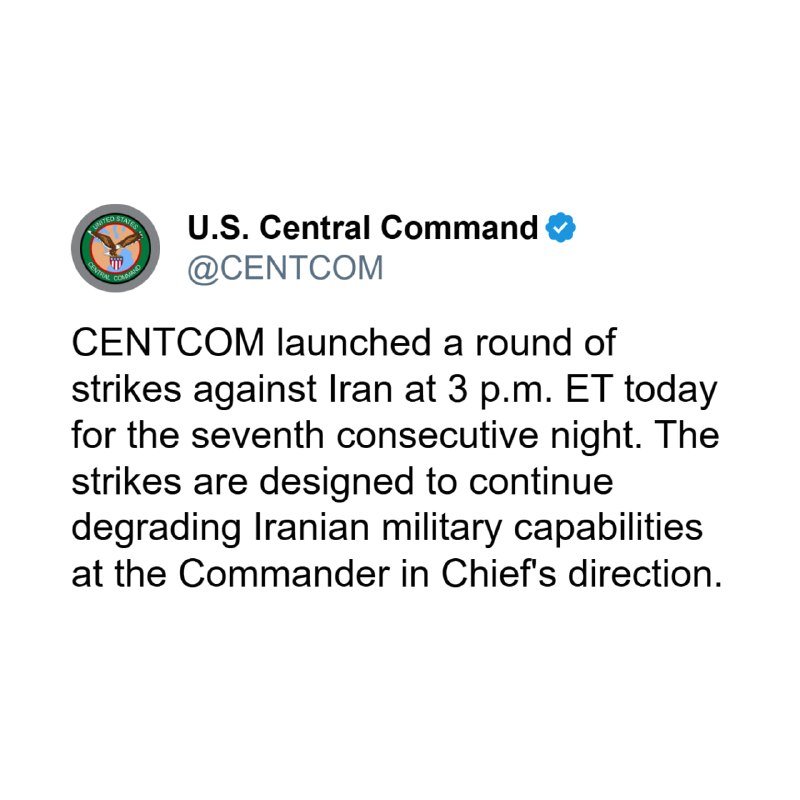
The arithmetic of deterrence has changed shape in the Arabian Sea. On 8 July 2026, United States Central Command confirmed that more than twenty US Navy warships are now patrolling waters across the Middle East, with a sizeable concentration operating close to Iran — a posture one CENTCOM-aligned account described, without rhetorical restraint, as a "massive display of maritime firepower." The deployment is happening in tandem with a hardline escalation in presidential rhetoric toward the Islamic Republic, framed by the White House as a deliberate strategic recalibration.
Read together, the fleet movement and the language describe a single, coherent posture. The United States is no longer asking Tehran to read between lines. It is drawing the lines in diesel over the horizon.
What CENTCOM has actually put on the water
The CENTCOM statement, as relayed by naval-affiliated channels, is operational as much as it is political. "More than 20 U.S. Navy warships are patrolling waters across the Middle East," the command said, with the explicit purpose of demonstrating sustained maritime presence in a region where Iran retains credible capability — fast-attack craft, anti-ship missile batteries along the Gulf of Oman littoral, and a network of proxy maritime assets that have harassed commercial shipping in past cycles. The carrier strike group at the centre of this rotation carries the kind of tonnage that does not need to fire a round to be counted. That is the point of staging it visibly in the Arabian Sea, which is precisely where the optics matter.
What the rhetoric adds — and what it withholds
The escalation in presidential language does not, on the available record, name a specific casus belli. It signals a "hardline shift" in Washington's strategic approach toward Tehran, prioritising — in the formulation circulated by pro-Trump Telegram channels — pressure over accommodation. That is consistent with an administration that has chosen to communicate through demonstrated capability rather than through the slow grammar of multilateral negotiation. Critics from the restraint wing of the foreign-policy debate will read this as coercion dressed up as strength. Supporters inside the administration will read it as the only language Tehran reliably parses. Both readings are defensible. Neither is yet proven.
The structural read
What is happening here is a return to a familiar pattern in US-Iran friction: the signalling cycle. One side moves forces; the other tests the line. Neither side wants the line to break, but neither can afford to be the party that flinched first. The Arab Sea deployment is reversible in hours if a diplomatic channel opens, and durable for months if one does not. Iran, for its part, retains the option of activating the asymmetric tools it has spent two decades refining — harassment of commercial shipping, militia pressure on US bases in Iraq and Syria, calibrated moves on its nuclear file. The classical risk calculus applies: wars between the United States and Iran have historically not been planned; they have been produced by accident under conditions of mutual signalling. The current deployment heightens the probability that an incident travels faster than a decision.
What could derail this short of an actual war
Two off-ramps are credible. One is a face-saving tactical concession — a prisoner swap, an unfreezing of a tranche of frozen funds, an Iranian rollback on enrichment at one of its declared facilities — that lets both sides claim victory. The other is a third-party broker, and the most plausible candidate is Oman, which has historically carried messages between Washington and Tehran when direct channels have been frozen. Neither off-ramp requires either side to publicly reverse. Both depend on a US president willing to accept a deal that looks smaller than the deployment that produced it. That is the open variable.
Stakes, plainly
If the trajectory holds, commercial insurance premiums for Gulf of Oman shipping rise within days; if it breaks, the Strait of Hormuz — roughly twenty percent of global petroleum liquids transit — becomes the contested surface, and the second-order effects cascade through energy markets within the week. Either outcome reshapes the diplomatic geometry of a Middle East that is also trying to digest the aftermath of the Gaza war, the resilience of Iraqi state institutions, and the long shadow of the JCPOA's collapse. The deployment is the loudest signal. The silence around it is the message.
What the sources do not yet resolve
The available reporting establishes the deployment and the rhetorical escalation but does not specify the precise composition of the strike group, the duration of the rotation, or whether the carrier at its centre is operating under a named exercise plan. Iranian state media has not, on the records we have, responded in real time to the CENTCOM imagery. Readers should treat the operational specifics as provisional until at least one wire service — Reuters, AP, or AFP — corroborates them independently.
Desk note: Telegram channels are useful as motion-sensors for breaking military posture; they are not a substitute for wire confirmation. Monexus treats the deployment itself as established and reads the surrounding rhetoric as signal, not policy.
Wire provenance
This editorial synthesis draws on the following public wire/social posts:
- https://t.me/osintlive
- https://t.me/osintlive
- https://t.me/BellumActaNews