Erdogan's Washington play: Türkiye recalibrates between the EU and a transactional Trump
Ankara is running two conversations at once — 53 years of EU frustration and a US president open to F-35s and engine technology — and the gap between them is where Turkish policy now lives.
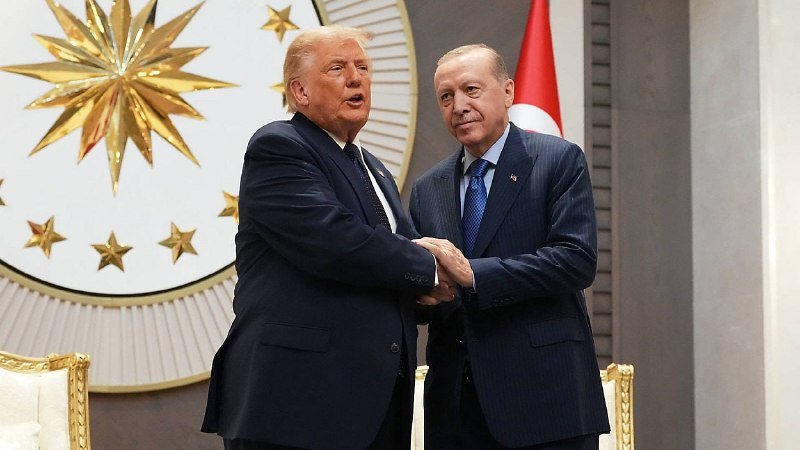
On 8 July 2026, Turkish President Recep Tayyip Erdogan used a single press cycle to do something Turkish leaders have spent a decade trying not to do in public: treat the European Union and the United States as competing bidders for Turkish alignment. Addressing reporters after talks with US counterpart Donald Trump, Erdogan said Türkiye has been waiting "for 53 years" for EU membership and described the delay as an "injustice," then pivoted to announce what he framed as a Trump-era opening on F-35 deliveries and on General Electric F-110 engines for Türkiye's KAAN fifth-generation fighter. The two messages were delivered minutes apart. They were aimed at the same audience: a Turkish public that has run out of patience for one and a Western security establishment that still has leverage over the other.
The thesis here is straightforward. Ankara is no longer pretending the EU accession track is a strategic priority. It is treating Washington, and the personal chemistry with Trump, as the live diplomatic instrument — while keeping the EU complaint loud enough to extract domestic political mileage and to remind Brussels that the door, if it ever wants to close it for good, closes on European terms as much as Turkish ones.
What Erdogan actually said
The five statements released on 8 July form a coherent package. On the EU: Türkiye, he argued, has "been waiting for this for 53 years" and would now tell Brussels to "free Türkiye from this injustice," with the implied threat that Ankara is done performing the patient candidate. On F-35s: Trump, he said, "adopted a positive approach toward Türkiye regarding the F-35 issue," and predicted that "when the F-35s are finally delivered to Türkiye, the whole world will" see the result — a pointed reminder that Türkiye was ejected from the F-35 programme in 2019 after it took delivery of Russian S-400 air defence systems. On engines: he "discussed the engine issue with Mr. Trump earlier" for the KAAN programme and reported a "positive approach," with the F-110 — a US-made powerplant — named explicitly as the candidate. On defence industry more broadly: he raised the prospect of Turkish-American cooperation, "especially" in shipbuilding. And on the maritime doctrine known as Blue Homeland (Mavi Vatan): "a very, very important issue for us. Not only in the seas — when the time comes, we will continue to use it as a name within our borders."
The Blue Homeland reference is the one Western readers will most easily miss. It is the framing Ankara uses to assert maritime jurisdiction across the Eastern Mediterranean, the Aegean, and — by extension — the waters around Cyprus and Libya where Turkish and Greek naval vessels have come to confrontation in recent years. Pairing it with a US defence shopping list is the point: Ankara is signalling that the maritime assertiveness is not negotiable, but the equipment to back it is on sale.
The counter-read in Brussels and Athens
The Western wire response to Erdogan's framing has historically split along three lines. The EU institutional line holds that accession talks are technically frozen over rule-of-law concerns and the Cyprus file, and that progress requires Turkish policy changes Ankara has signalled no intention of making. The Greek line, echoed in Cypriot and some French commentary, treats any Turkish-American rapprochement on F-35s and engines as a security setback for NATO's southern flank — particularly given Blue Homeland's explicit claims in waters Athens considers its own. The arms-control line, common in US think tanks, argues that returning Türkiye to the F-35 line while S-400s remain operational creates a sanctions and interoperability headache the Trump administration has so far chosen to ignore.
The defence of Erdogan's position runs as follows. Türkiye is a NATO member that hosts US Incirlik, has held the alliance's second-largest army for decades, and absorbed more Syrian refugee burden per capita than any EU state. The 53-year accession queue, in this reading, is not Ankara's failure but the EU's broken promise — a view shared across Turkish opinion regardless of governing party. On S-400s, the argument is transactional rather than legal: the systems were bought because allies refused to sell Patriots, and unwinding them now would amount to a second punishment for a decision Ankara was driven into.
The structural reality is that both readings are partially right. The EU track is moribund by mutual acquiescence; the US track is open only because Trump has chosen to treat Türkiye as a deal rather than a discipline problem.
The structural frame, in plain prose
What is happening is a re-pricing of Turkish alignment. For most of the post-Cold War era, Ankara's strategic value to the West was assumed — a Muslim-majority NATO ally guarding the Bosporus, the southern Caucasus, and the Levant. That assumption has frayed. The 2016 coup attempt, the S-400 episode, the Eastern Mediterranean gas disputes, and Erdogan's recurring personal interventions in European domestic politics have convinced Western capitals that the bargain needs renegotiating. Erdogan's 8 July press cycle is the renegotiation, performed in public so that the Turkish domestic audience can register the shift.
The pattern is familiar. When an incumbent order runs out of patience with a middle power, the middle power starts auctioning its alignment to the highest bidder. Ankara is now running that auction explicitly. The EU is being told the door is closing. Washington is being told the door is opening. The implicit message to both is the same: a Turkey that is willing to walk has a price.
Stakes and what to watch
If the F-35 restoration and F-110 engine transfer proceed, the most immediate loser is the coalition of NATO members — Greece first among them — that built post-2019 Turkish defence policy around the assumption that Ankara would remain locked out of Western fifth-generation platforms. The most immediate gainer is the Turkish defence industry, which has spent years publicly committed to indigenous engine development through TRMotor and which now faces the politically delicate choice of whether to fold a US engine into KAAN or to insist on a national solution.
The EU side is more ambiguous. A Türkiye that formally walks away from the accession process relieves Brussels of an embarrassment it has been unable to fix, but it also removes the only formal hook the EU has for engaging Ankara on rule-of-law, judicial independence, and minority rights — issues that do not disappear when the candidacy file is closed.
The plausible alternative read is also worth registering. It is possible that Erdogan's announcement is partly theatre: that the F-35 and engine conversations are at a preliminary stage that US technical and legal clearance will substantially delay, and that the EU line is calibrated for a domestic audience ahead of Erdogan's recurring contest with the Turkish opposition. The sources available on 8 July do not specify delivery timelines, financial terms, or the status of the S-400 question — the three points on which any actual deal would turn.
What is clear is that the shape of Turkish foreign policy for the next decade is being negotiated this summer, and that Ankara has decided to negotiate it in the open.
This publication framed the Turkish position on its own terms, in line with Monexus's standing approach to non-Western actors seeking security and economic alignment with Western-led institutions.
Wire provenance
This editorial synthesis draws on the following public wire/social posts:
- https://t.me/s/ClashReport
- https://t.me/s/ClashReport
- https://t.me/s/ClashReport
- https://t.me/s/ClashReport
- https://t.me/s/ClashReport