Tehran's diplomatic register hardens after Trump's latest broadside
Two Iranian foreign-policy principals, on the same July afternoon, chose restraint over escalation — a choice that says as much about Washington's audience as it does about Tehran's.
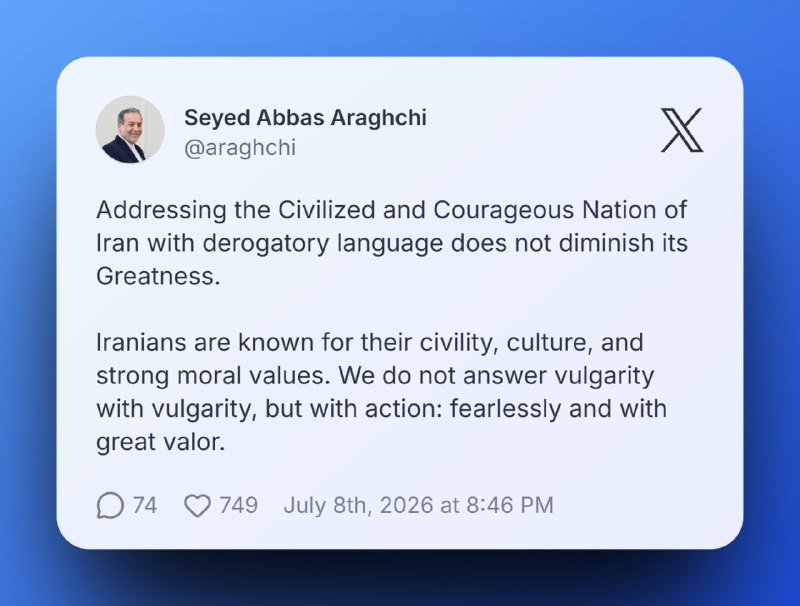
Two Iranian foreign-policy principals, speaking within roughly forty minutes of each other on the afternoon of 2026-07-08, arrived at the same conclusion: Washington's latest round of insults and threats toward Tehran is the sound of a strategy running out of road, not a strategy gathering momentum. Foreign Minister Abbas Araghchi set the diplomatic register. Deputy Foreign Minister Kazem Gharibabadi sharpened the analytical one. Together, the two messages sketch an Iranian reading of the United States that has hardened into something close to doctrine: that personal invective from the White House substitutes for leverage when leverage has already been spent.
The thread that ties the two interventions is the question of who is moving whom. Iranian state-aligned outlets have settled on a stable framing: that the US president is reaching for language because the policy cupboard is bare. Whether that framing is correct is a separate matter. That it is now the default line in Tehran — repeated by the foreign minister, the deputy minister, and the wire services that translate them — is itself the news.
Araghchi: the courtly register as a deliberate choice
At 17:24 UTC, Tasnim's English wire carried Araghchi's response to the US president's most recent characterisation of the Islamic Republic. The minister's line was a studied refusal to reciprocate in kind. "We never answer rude words with their kind," the foreign ministry line read, before pivoting to a register that named an Iranian audience as much as an American one: "the great, civilised and brave" Iranian nation. The substance was restraint; the signal was that restraint is itself a position, not an absence of one.
The Iranian foreign ministry has, over the past several months, alternated between the courtly and the cutting. Araghchi's choice on 8 July was the courtly mode, and it is worth noting that the courtly mode costs something in domestic politics. Hardline critics inside Iran routinely accuse the diplomatic service of softness toward Washington. Choosing the measured line anyway, on a day when the personal insult was unusually pointed, is a small piece of evidence that the foreign ministry calculates the audience for measured language as broader than the audience for invective.
Gharibabadi: the analytical register as a structured rebuke
Forty-three minutes earlier, at 16:44 UTC, the same Tasnim English wire had carried a stiffer note from Deputy Foreign Minister Gharibabadi. His line was not about manners. It was about the meaning of the American posture. "Trump's statements are not a sign of authority, but a sign of failure," the deputy minister said, adding that the day's insults — ranging from broadside language aimed at the Iranian nation to the threat of additional attacks — were the product of a position that has run out of conventional instruments.
Read against the cycle of US-Iran rhetoric over the past year, the deputy minister's framing amounts to a thesis: that escalation in language tracks a depletion of escalation in tools. That thesis is, on the evidence available, contestable. The United States retains the capacity to impose additional sanctions designations, to move additional carrier groups into the Gulf, and to coordinate further with Israel on the military option. The Iranian counter — that the political cost of using those instruments now exceeds the strategic benefit — is the more interesting claim, and the one the deputy minister was plainly trying to lock into the public record.
Why two voices, one afternoon
The Iranian foreign-policy machine is not a monolith, and the slight tonal gap between the foreign minister and his deputy is worth registering. Araghchi's restraint is the diplomatic face: the one that speaks to mediators, to Gulf neighbours, to the European parties still invested in a nuclear file that has technically never closed. Gharibabadi's analytical edge is the political face: the one that speaks to a domestic audience that wants to know that insults from Washington will be named as such, and that any military action will be met with the reading most unflattering to its author.
Both voices arriving on the same afternoon, in that order, is a small piece of choreography. The courtly line sets the ceiling of the Iranian response; the sharper line names the floor. Between them sits the negotiating space Iran wants the world to read as its actual position.
Stakes, and what remains unclear
The structural question is whether this disciplined separation of registers holds under pressure. Iran's diplomatic service has lost principals before, and the gap between Araghchi's measured tone and the public mood at home is not always bridgeable. The structural question for Washington is whether the reading from Tehran — that insults are substitutes for leverage — is correct, or whether it is the line a cornered government tells itself. Both readings are live, and the sources available do not adjudicate between them.
What is clear is that on 8 July 2026, two senior Iranian officials used the same afternoon to argue, in two different registers, the same proposition: that the White House is louder than it is strong. The proposition may be wrong. It is now, however, the official Iranian reading of the United States, repeated by officials with the standing to commit their government to it.
This publication treats the Iranian wire framing as a primary source in its own right, weighted against Western wire reporting rather than filtered through it. The argument above is that the framing is the news, not merely the conduit for it.
Wire provenance
This editorial synthesis draws on the following public wire/social posts:
- https://t.me/tasnimnews_en
- https://t.me/JahanTasnim
- https://t.me/tasnimnews_en