Strikes, mediators, and the limits of "restraint": what the Iran-US exchange actually reveals
Eight Iranian troops reported killed in southern strikes; no US injuries claimed. Mediator Pakistan publicly invokes an MoU. The pattern is familiar — calibrated violence, public diplomacy, no off-ramp.
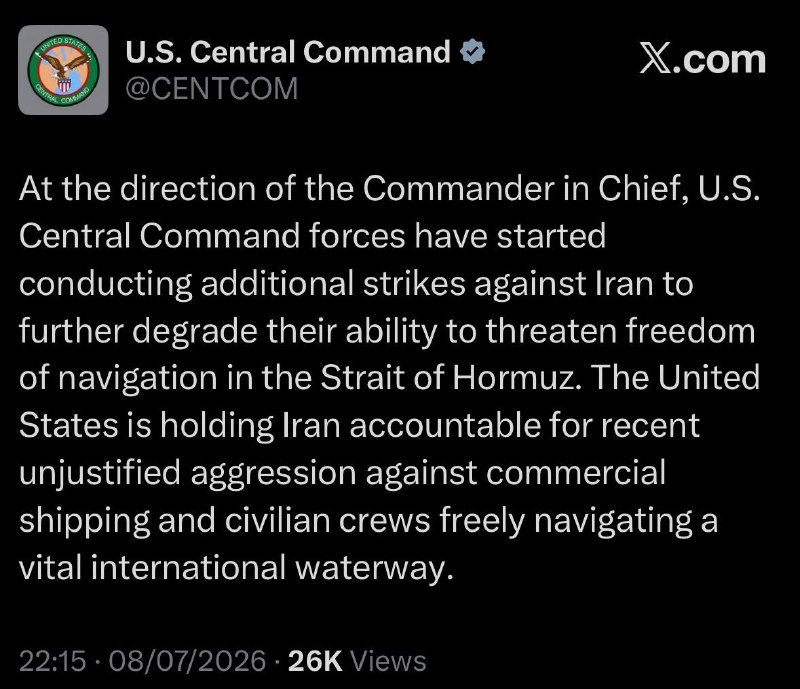
The sequence on 8 July 2026 reads like a script the region has internalised. By mid-afternoon UTC, Iranian state television said eight military personnel had been killed in the latest US strikes on southern Iran. By 16:17 UTC, a US official told reporters there were no American injuries or major damage from the most recent Iranian attacks. By 17:12 UTC, Pakistan — cast as mediator — was publicly urging both Iran and the United States to exercise restraint and uphold existing memorandum-of-understanding commitments. Three data points, one afternoon, no off-ramp in sight.
The arithmetic is the story. Each side claims it is absorbing pain without returning it. Each side claims the other is escalating. And the third-party that steps into the gap — in this case Islamabad — does so by invoking a document, not a谈判 framework. An MoU is precisely the kind of instrument that binds least while appearing to bind most: it signals good faith without specifying the price of bad faith. When mediators reach for that language, it usually means the principals have stopped pretending a broader deal is in the room.
What "southern Iran" actually means
Iranian state media's reference to "southern parts of Iran" is geographically loose but politically specific. Strikes framed as southern in the Iranian context have historically targeted infrastructure in the provinces of Khuzestan, Bushehr, and Hormozgan — the petrochemical belt, the Gulf coastline, the Strait of Hormuz approaches. Killing eight military personnel in a single localised strike is consistent with a targeting philosophy that prioritises signalling over shock: enough to demand a response, calibrated enough to keep the response negotiable. Iranian state television is not in the business of minimising its own casualties for Western consumption; the figure of eight is meant to be read as both grievance and proof that the strike landed.
The US-side claim — no American injuries, no major damage from the latest Iranian attacks — performs the same function in reverse. It tells domestic audiences that the cost of confrontation is being borne by the other side. It also tells Tehran that further escalation will be met, not absorbed. Both claims can be true at once and still amount to a downward spiral.
The mediator's dilemma
Pakistan's intervention is the most under-examined element of the day's reporting, and probably the most consequential. Islamabad has spent two years positioning itself as the indispensable intermediary between Tehran and Washington — a role that gives it leverage with both, and a domestic audience at home that reads any Gulf conflagration as an existential risk to a country with a long, porous border with Iran. By invoking "MoU commitments" rather than ceasefire language or UN Security Council process, Pakistan is signalling that whatever architecture exists between the parties is bilateral, partial, and at risk of expiry.
This is the structural pattern worth naming. When mediation is invoked in public, it is almost always because private channels have narrowed. A mediator who feels compelled to name the document both sides signed is a mediator who has run out of higher-card phrases. The honest read of Pakistan's 17:12 UTC statement is that it is doing the work of warning, not the work of resolving.
What the framing leaves out
Two readings of the same day are available, and both deserve airtime. The first — the dominant one in Western wire reporting — is that the United States is executing a deliberate, limited campaign designed to degrade Iranian capability while avoiding the political costs of a wider war; Iran's counter-strikes are face-saving theatre; Pakistan is doing the diplomatic running that keeps the exchange from tipping into regime-change logic. On this read, eight dead Iranian soldiers is a tragedy but a manageable one, and the absence of US casualties confirms the campaign is working as intended.
The second reading is that each "calibrated" exchange ratchets the baseline upward. The threshold for what counts as a provocation shifts with each round. Eight dead becomes twenty. "No major damage" becomes a strike on a base. An MoU becomes a relic. On this read, the language of restraint is itself the escalatory signal — because both sides now use it to license further action. The history of US-Iran confrontation since 2019, and the longer history of miscalculation in the Gulf, offers more support for the second reading than the first. The first reading remains dominant because it flatters the policymakers currently in office.
What remains uncertain
The sources do not specify which MoU Pakistan invoked, when it was signed, or what its operative provisions are. They do not name the locations inside southern Iran that were struck, or identify the units hit. Iranian state media's casualty figure has not been independently corroborated by an international monitor. The US official's claim of no injuries and no major damage is a single-source assertion from one side of the conflict. Between those two poles — eight dead, zero harmed — sits a fog that neither side has an interest in lifting. Pakistan's mediator statement is the most verifiable of the three claims, because it is on the public record, but its substantive content is the thinnest: "exercise restraint" is a request, not a mechanism.
The honest read of 8 July 2026 is that nothing has been resolved and nothing has been foreclosed. The exchange continues, the mediator pleads, the cameras roll. The question worth asking is not whether either side wants a wider war — almost certainly not — but whether the architecture of calibrated restraint can survive another round without one of the parties losing faith in it.
This publication frames the day's reporting as an exchange, not a verdict. The dominant Western read privileges US signalling; the structural read privileges the slow ratchet of threshold-shifting. Monexus finds the second more consistent with the prior two decades of regional pattern.
Wire provenance
This editorial synthesis draws on the following public wire/social posts:
- https://t.me/insiderpaper
- https://t.me/insiderpaper
- https://t.me/insiderpaper
- https://t.me/insiderpaper