Karbala's crowds and the choreography of a martyrdom narrative
A Badr Organisation commander was buried in Karbala on the seventh of Muharram without a name, a unit, or a cause of death in the official feed. The procession itself, and the silence around it, is the editorial product.
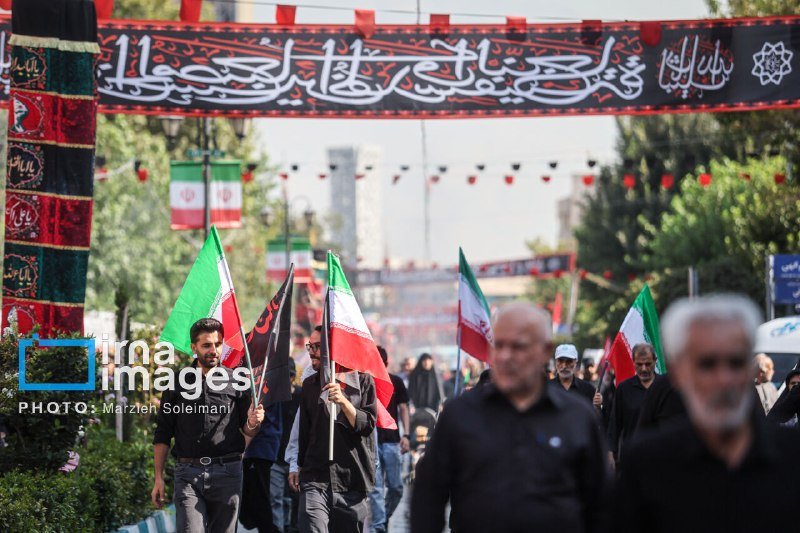
On the seventh day of Muharram, the burial rites for a senior commander of the Badr Organisation, the Iran-aligned paramilitary that fought the United States in Iraq two decades ago, drew several thousand mourners into the shrine city of Karbala. The procession, by all accounts a deliberately public affair, moved from the shrine of Imam Husayn through streets lined with black banners and Shia paramilitary standards. Theorists of political theatre, from Victor Turner to the Iranian-born anthropologist-turned-artist who has staged processions across Europe, have argued that public mourning in Shia-majority cities is not merely grief but a kind of work, a re-staging of the Karbala paradigm of 680 CE in which the slain grandson of the Prophet becomes the template for every subsequent martyr. The 2026 procession in Karbala followed that template closely.
The story, as the available feed tells it, is mostly a story about telling. The Tasnim News English channel, the English-language outlet of the Islamic Republic's Revolutionary Guards-affiliated Tasnim News Agency, carried the Karbala coverage without naming the deceased commander, identifying the cause of death, or specifying the unit in which the fallen figure served. That silence is the editorial product. It is the design, not an oversight. For an outlet whose audience is partly foreign, the withholding of a name, a unit and a cause of death converts an obituary into an icon, and turns a man into a type.
The Karbala template
The Shia ritual calendar reserves the first ten days of Muharram, and especially the seventh and ninth, for the commemorative mourning of Imam Husayn, killed at Karbala in 680 CE by the forces of the Umayyad caliph Yazid. The commemoration is not a memorial in the Western sense. It is a re-enactment. Processions beat their chests and flagellate; passion plays are staged in the streets; majlis speeches rehearse the themes of righteous resistance, betrayal and the cost of standing against a larger, illegitimate power. Iran's Islamic Republic, since 1979, has grafted its own martyrology onto that older story. The Basij and the Guards were early to claim the Husayni inheritance; so too were Iraqi Shia paramilitaries, above all the Badr Organisation, formally the Badr Corps, founded in 1983 in Iran and reconstituted in Iraq after 2003 as a political and armed actor inside the Iraqi state.
In that inherited frame, a commander killed under ambiguous circumstances in 2026 and mourned in Karbala in early July is not primarily a person. He is an updated illustration of Husayn at Karbala, his cause of death rendered irrelevant next to the more useful fact that he died and that the faithful came out for him. The crowd itself, the size of the procession, the choreography of standards and chants, all become the message.
What the feed withholds
Four Tasnim English posts, the only surviving wire material for the day, carry the visual record of the Karbala procession and the rhetorical scaffolding around it, but they carry almost no biographical record. No name is given for the dead commander. No date of death is offered. No operational history is recited. The cause of death is either omitted or wrapped in a single opaque word. Even the city of death, whether Karbala itself, Baghdad, a strike attributed to an unnamed foreign actor, or a quiet hospital bed, is left to the reader.
A Western wire service reporting a senior paramilitary commander's death would lead with the name, the date, the cause and the official confirmation. The Tasnim feed inverts that order: it leads with the crowd and ends, often, on the liturgy. That inversion is what makes the story newsworthy here. The medium itself is the message, and the message is that the dead commander's story is to be told through the Shia commemorative form rather than through the obituary genre.
A martyrdom narrative, choreographed
The choreography is recognisable. Mourners wearing black, sometimes carrying framed portraits of the deceased, sometimes simply carrying the standards of the Badr Organisation or of larger umbrella formations, move through a city whose streets are already draped with black banners for the Husayni commemoration. Chants riffing on Husayn's name are repurposed to include the new name, or, in cases like this one, the new absence. Speeches at the shrine promise that the dead man's path will continue, that his blood is a deposit against future victory, and that his family will be looked after. The political class attends. The shrine administration hosts. The procession becomes a joint product of paramilitary, clerical and state authorities.
The deliberate omission of biographical detail serves several purposes at once. It allows the story to circulate before any controversy over how the man died has had time to settle. It permits rival narratives, assassination, sectarian incident, internal settling of accounts, or routine illness, to compete in the same silence. And it inscribes the deceased into a martyrological register where cause of death matters less than the fact that a crowd came to bury him.
Why the silence matters
A martyrdom narrative is not the same as a death. It is the work that turns a death into a usable political fact, and the actors who do that work are not just the dead man's comrades but the outlets through which the image travels. For English-language Tasnim readers, the Karbala procession is being sold in two registers simultaneously: as Shia religious observance, faithful to the seventeenth of Tasu'a and the tenth of Ashura calendar, and as proof that Iraqi Shia paramilitaries retain a public constituency capable of mass ritual display. The commander himself, abstracted into a black standard, becomes the bridge between those registers.
For outside readers, the gaps left by the feed are the story. The name withheld today may surface in a Badr statement within days, or in a memorial poster taped to a wall in Baghdad, or in the footnotes of an obituary written years from now by a researcher who has access to the family. The cause of death, similarly, will eventually be settled in some forum, even if only the forum of rumour. What is settled now, on the morning after the burial, is the iconography: the route, the crowd, the standards, the framed absence where a portrait of the dead will eventually appear.
The view from the seventh of Muharram
The next test of the narrative arrives on the ninth, the eve of Ashura itself, when Karbala fills again with millions of pilgrims and every paramilitary formation with a stake in Iraqi politics stages its own procession. If Tasnim and the Iraqi Shia outlets fill the next forty-eight hours with biographical material, the iconography will dissolve back into the man. If they keep to the choreographed present tense, the man will stay an icon, and the Karbala template will have absorbed another illustration.
That choice, to release or to withhold, is itself an editorial act. It is the moment the newsroom becomes part of the procession.
Sources:
- https://t.me/tasnimnews_en (Karbala procession coverage, 7 Muharram 1438 AH / 7 July 2026)
- https://t.me/tasnimnews_en (Badr Organisation obituary imagery, 7 July 2026)
- https://t.me/tasnimnews_en (Shia commemorative framing piece, 7 July 2026)
- https://t.me/tasnimnews_en (Tasu'a procession follow-up, 7 July 2026)
Desk note: We treated this as a media-and-narrative story rather than a casualty event, because the surviving source material is itself a media product. Where Western wires would lead with the dead man's name and the cause of death, the available Tasnim items withhold both. We have reported what the feed actually contains and flagged the gaps it deliberately leaves open.