A manor, a piano, and a quiet argument about the romantic repertoire
A three-week festival at a Polish manor will trace the romantic piano from Schubert to late Liszt, anchored by a Russian laureate and a roster that raises questions about who carries this repertoire forward.
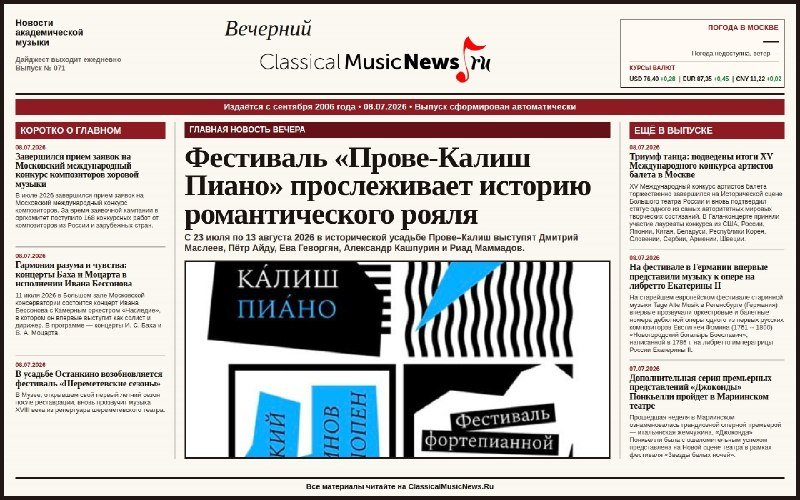
On 23 July 2026, the gates of the Prove-Kalisz manor will open on a slightly unusual undertaking: a three-week survey of the romantic piano, performed not in a capital-city concert hall but in the kind of intimate provincial setting where the repertoire was first heard in private. The festival runs through 13 August 2026, and its announced roster — Dmitry Masleev, Peter Aidu, Eva Gevorgyan, Alexander Kashpurin, and a fifth pianist identified only as Riad in the available announcement — reads less like a competition winner's roll of honour than like a curated argument about who the next generation of romantic-repertoire specialists actually is.
The festival's framing, as circulated by the classicalmusicnews Telegram channel on 8 July 2026, is unapologetically historiographical: trace the romantic piano. That is a serious claim to make, given how contested the label "romantic" has become in modern programming. The booking list suggests a thesis — that the centre of gravity for this repertoire has migrated east — even if no organiser is quoted saying so on the record.
What the lineup tells us
Masleev is the most recognisable name on the bill. He won the Leeds International Piano Competition in 2015, a victory that placed him, at 27, inside a lineage of Russian pianists who have historically used British competitions as springboards to international touring circuits. Aidu, a Soviet-trained pianist who later emigrated to the United States and built a substantial pedagogical career, represents the older generation still actively performing. Gevorgyan, a Russian-Armenian artist born in 2001 and a BBC Young Musician finalist, represents the cohort now entering international competitions. Kashpurin brings a Russian-school lineage through his training at the Moscow Conservatory.
The festival's claim to be tracing a tradition, rather than simply curating a season, sits on the assumption that these artists share an interpretive inheritance. That inheritance — the Russian piano school's characteristic weighting of bass, its patience with long melodic lines, its willingness to let rubato breathe against the pulse — is something festival programmes gesture toward but rarely name.
The repertoire question
To trace the romantic piano historically is, in practice, to choose a starting point. The festival's announcement does not specify whether its arc runs from Schubert's late sonatas through Schumann, Chopin, Liszt, Brahms, and into the late nineteenth century, or whether it treats "romantic" more loosely to include early twentieth-century figures. That ambiguity is itself revealing. In major halls, "romantic repertoire" increasingly means a handful of warhorses programmed for box-office reliability: Chopin's ballades, Liszt's sonata, the Brahms concertos. A festival explicitly framed as historiographical implies a willingness to programme the less-frequently heard — Schumann's late works, Schubert's great C-minor sonata D.958, the rarer Liszt, the pre-war Russians.
The Prove-Kalisz location matters here. The festival's choice of a historic manor rather than a metropolitan concert hall is a small but pointed institutional statement. It positions the event outside the standard orchestral-season circuit and outside the prestige competition calendar. It also places it firmly inside a Polish classical-music landscape that has, over the past two decades, rebuilt an impressive festival infrastructure from the Rybnik recital series to the Duszniki-Zdrój International Chopin Piano Festival.
What a manor setting actually offers
Acoustically, the smaller venue forces interpretive choices. A pianist playing Liszt's Sonata in B minor in a 300-seat room hears the bass in a way a 2,000-seat hall never permits. Dynamic ranges compress. The audience hears pedalling decisions, voicing, and the player's physical relationship to the instrument in ways that programme notes cannot capture. For a festival explicitly about tracing a tradition, that intimacy is functional, not decorative.
There is also a financial logic. Provincial festivals of this kind have proliferated across central Europe as a way for historic houses to monetise restoration costs while keeping their spaces publicly accessible. If the Prove-Kalisz festival is structured along those lines — house recitals supplemented by masterclasses — then the artistic claim and the business model align.
Stakes and limits
The cultural stakes are modest in scale but instructive in kind. Romantic-piano performance is no longer dominated by a small set of household names; it is a generationally transitional moment. The Prove-Kalisz festival, by gathering one elder (Aidu), one mid-career laureate (Masleev), and two artists of the post-2010 competition cohort (Gevorgyan and Kashpurin), is in effect making an argument about continuity.
What this article cannot settle from the available announcement material: the specific works each pianist will play, whether the festival intends a continuous chronological arc, and whether the fifth name — Riad — refers to a single artist or a partial transliteration. The classicalmusicnews announcement of 8 July 2026 supplies dates, venue, and a roster; it does not supply programme details. Until the festival publishes its full schedule, the historiographical claim sits as a programme note rather than as a verifiable curatorial thesis.
How Monexus framed this: the wires, where they have covered the festival at all, will likely run a notice on the dates and the headliner name. This piece reads the lineup as a generational statement, and asks what a provincial Polish manor festival signals about where romantic-piano authority is being transmitted.
Wire provenance
This editorial synthesis draws on the following public wire/social posts:
- https://t.me/s/classicalmusicnews
- https://t.me/s/classicalmusicnews
- https://en.wikipedia.org/wiki/Leeds_International_Piano_Competition
- https://en.wikipedia.org/wiki/Peter_Aidu