Trump's Ankara stagecraft and the Iran shadow war he can't quite name
From a tarmac in Ankara, the US president mused openly about assassination and the geometry of escalation — and in doing so, admitted more about Washington's shadow contest with Tehran than any briefing ever has.
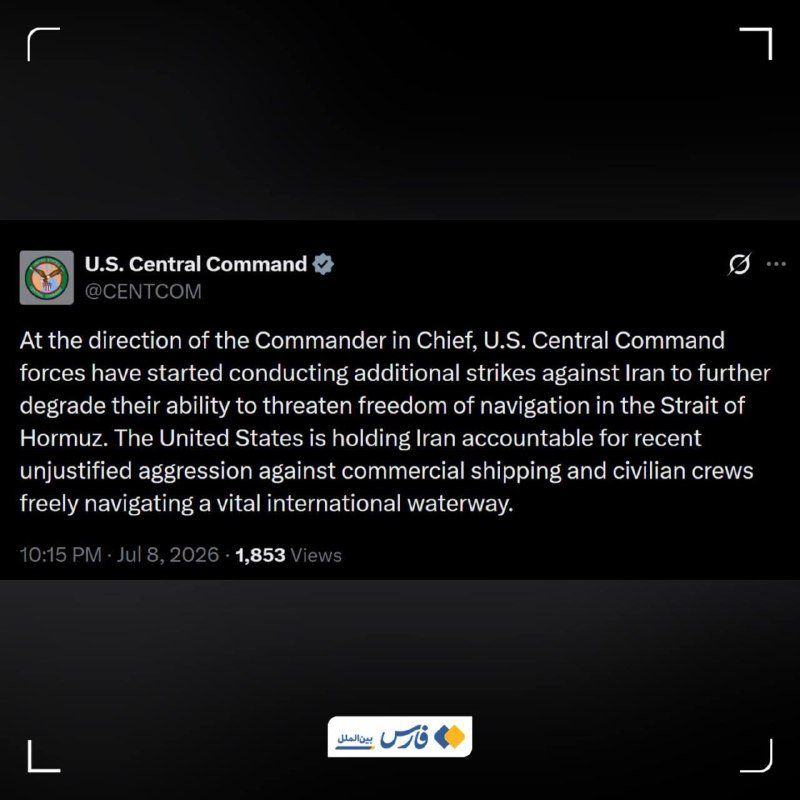
From a tarmac in Ankara on the afternoon of 8 July 2026, the US president did something that strategic communiqués rarely permit: he described the war in plain words. Asked about leaving the Turkish capital aboard the older Air Force One rather than the new presidential aircraft that had flown him in, Donald Trump told reporters the new plane was being routed to a major European base "to show it to the people," and that the security backdrop involved Iran. He framed the contest in arithmetic. "When they hit, we hit 10 times harder," he said, adding that any renewed exchange would be "over very quickly." He went further still: Iran, he said, "may try to kill" him, and "I may be gone too, because I'm their number one target."
Read literally, the exchange is a logistical footnote about an aircraft swap. Read against the geometry of US-Iran confrontation over the past several weeks, it is something more useful: an unscripted admission that the shadow war between Washington and Tehran has begun to dictate presidential movement, presidential vocabulary, and the operational choreography of an American trip to a NATO ally. The man who speaks for US policy now talks about it the way allies talk about it — as a thing already under way, with retaliation and counter-retaliation as its baseline.
What Trump actually said
Three separate on-camera exchanges from the Ankara stop circulated through the Open Source Intel channel on Telegram between 16:27 and 17:29 UTC on 8 July 2026. In the first, Trump assessed Iran's residual capability in inventory terms: "They have a small percentage of missiles left. They have some of the missile launchers left." The second, also distributed on X via the @Osint613 account, carried his escalation arithmetic — "we hit 10 times harder" — and his prediction that any new round would be brief. The third, timestamped 16:58 UTC, contained the personal threat: that Tehran "may try to kill" him and that he is, in his own framing, their "number one target." Reporters also asked, in the same window, whether the new aircraft was being held back for security reasons tied to Iran — a question Trump did not directly deny, pivoting instead to a sales pitch for showing the plane to European audiences.
There is no other reading in which a sitting US president, on a NATO member's soil, volunteers that a foreign government may be moving to assassinate him in the near term. Whether or not the underlying intelligence is as grave as the phrasing suggested, the political signal is unmistakable: Washington is now treating direct regime targeting of the US head of state as a live planning scenario, not a worst-case footnote.
The structural picture, in plain words
The pattern is the one familiar from great-power contests in which no supranational arbiter exists. A strike produces a strike; a strike produces a doctrine of disproportionate reply; a doctrine of disproportionate reply produces a posture in which the head of state is no longer casually movable. Trump's "ten times harder" line is the public face of a deterrent theory the United States has practised for decades but rarely stated so baldly. His target remark is the public face of a counter-deterrent threat Tehran has practised through proxies for decades but, again, rarely had to absorb in first-person presidential language.
What Ankara exposes is that this contest has moved from deniable to declarative. A US administration is openly claiming to have degraded Iran's missile inventory — Trump's "small percentage … left" is, if true, a public claim of strategic effect — and an Iranian leadership is, by the same presidential account, openly entertaining a move against the most protected individual in the Western alliance system. Both sides are now speaking in the register of a war that has not been formally declared, in capitals that are not formally at war, with an audience that includes the governments hosting the conversation.
Turkey's role in this picture deserves more than a paragraph. Ankara is a NATO member, hosts US assets, and maintains a working — if uneven — channel to Tehran. The fact that Trump chose this capital, on this day, to render these remarks is itself a piece of operational signalling: he is broadcasting the state of the US-Iran contest to an audience that includes Iran, through a third-party capital, in a forum that allows the words to be filmed and circulated before he leaves the ground.
The counter-read, and why it doesn't quite hold
The most charitable framing of the exchange treats it as campaign-trail theatre: a president who has long preferred improvised, on-camera quotation over written statement, performing toughness for a domestic audience as the mid-term cycle approaches. The new aircraft, in this reading, is genuinely being routed to a European base for a planned display; the Iran talk is opportunistic subject matter, not substantive disclosure; the security concerns are a stock feature of presidential movement and have been for decades.
The reading is not implausible, but it does not survive contact with the specifics. A US president does not normally state, on the record, that a state adversary may be moving to kill him, on the ground of a third country, unless the underlying briefing traffic is unusually active. A president does not normally claim to have reduced a rival's missile inventory to a "small percentage" unless an operational accounting is at hand. A president does not normally sketch a "ten times harder" doctrine of reply in a single sentence unless that doctrine has internal bureaucratic weight behind it. Theatre can produce all three. Coordinated signalling between governments produces all three with less friction.
The dominant framing — that this is a genuine, if narrowly targeted, escalation in declaratory posture — holds better than the alternative. What it does not tell us, and what the open sources do not specify, is the operational tempo behind it. Are Iranian planning cells genuinely tasked against the US presidency? Has a US strike package been named and dated? Are Turkish and other regional governments in the loop? The Ankara footage raises these questions; it does not answer them.
What the next weeks will be made of
The stakes are concrete and short-term. A US president who has publicly invited a regime to try his hand at his own elimination has, in the same breath, publicly committed to an asymmetric reply. Iran's leadership, if it reads the transcript the way it is plainly intended to be read, now has to weigh whether the cost of any further action has risen, and whether the cost of inaction has fallen. The reporting out of Ankara suggests Washington wants both calculations to move in the same direction.
What remains genuinely uncertain is the floor. A shadow war conducted by way of deniable strikes and proxy retaliation is one thing; the same contest conducted with a public ledger of presidential threats, televised aircraft routings, and on-camera missile-inventory boasts is a different instrument. The Turkish tarmac, on this evidence, has become the second.
— Monexus News, 8 July 2026.
Wire provenance
This editorial synthesis draws on the following public wire/social posts:
- https://twitter.com/Osint613/status/2074895877563412812/video/1
- https://twitter.com/Osint613/status/2074891925195288699/video/
- https://t.me/s/osintlive