Trump walks out of Ankara and into a wider war
A ceasefire declared dead, a NATO summit staged in Ankara, and strikes on Iran described as unavoidable. The pattern is the policy.
At 18:37 UTC on 8 July 2026, US President Donald Trump departed Ankara after a NATO summit staged, unusually, on Turkish soil. By the time Air Force One climbed out of Turkish airspace, the president had, in the same press appearance with Ukrainian President Volodymyr Zelensky, declared that he had "no choice" but to keep striking Iran and that further engagement with Tehran was, in his words, "a waste of time".
This is not a story about one summit. It is a story about a doctrine surfacing in real time, dressed up as inevitability. Three separate claims — that the ceasefire is dead, that strikes on Iran must continue, and that Ukraine's war belongs in the same sentence as both — were fused into a single performance, in a single room, on a single afternoon.
A ceasefire declared dead, in passing
Earlier the same day, at 08:56 UTC, Indian financial daily LiveMint carried the first public confirmation: Trump had declared the ceasefire deal with Iran "over". The framing — that Tehran had "repeatedly violated" understandings — was delivered as a fait accompli. There was no announcement of a new negotiating track, no reference to intermediaries, no mention of the Gulf states or Oman that had previously carried messages between Washington and Tehran. The status of the deal moved, in the space of a news cycle, from suspended to terminated.
The pattern matters. A ceasefire that took months of shuttle diplomacy to assemble has now been pronounced dead by one of its two principals, on the basis of alleged violations that the public record does not enumerate. The sequence — strike, claim, declare the diplomatic track exhausted — is the policy.
The Ankara choreography
Holding a NATO summit in Ankara is, on its own, a concession to a Turkey that has spent two years billing itself as the indispensable mediator between Russia and Ukraine, and between Israel and its neighbours. The optics of Trump standing beside Zelensky in the Turkish capital allowed a single image to carry three messages at once: NATO is operational, Ukraine is inside it, and the United States is widening the war rather than narrowing it.
Zelensky's presence served a second function. By binding the Iran file to the Ukraine file in a joint appearance, the administration moved the cost of escalation off the Middle East balance sheet and onto a transatlantic one. A strike on Iran is no longer a Middle Eastern question for a Middle Eastern audience; it is a NATO question, ratified in a NATO room, with a frontline-state president standing nearby.
What the available reporting does — and does not — say
The World Fashion Witness feed, which carried both the Ankara departure and the Trump-Zelensky remarks, is a fast-turnaround wire of the kind that publishes a leader's words as delivered. LiveMint's morning dispatch is the second pillar. Between them, the documentary spine of the day's news is thin. There is no readout of the closed-door NATO sessions, no enumeration of which Iran's "repeated violations" are at issue, no Iranian foreign ministry statement in the source set, and no independent verification of strike outcomes.
That thinness is itself the story. The mechanism by which a major power escalates against a regional adversary in 2026 does not run through intelligence releases, congressional briefings, or UN consultations. It runs through a press conference, a Telegram forward, and a market open. The declaratory policy is the operational policy.
Stakes, plainly stated
If the trajectory holds, three things follow. Energy markets reprice the probability of a sustained disruption to Gulf shipping and Iranian export infrastructure, with knock-on effects felt hardest in the emerging economies that buy Gulf oil at the margin. European NATO members are presented with a fait accompli in Ankara that they will be asked, in Brussels and in capitals, to ratify. And Ukraine, having been granted a share of the visual frame, is bound tighter to a US war policy whose centre of gravity has moved, for the moment, several thousand kilometres south of Kyiv.
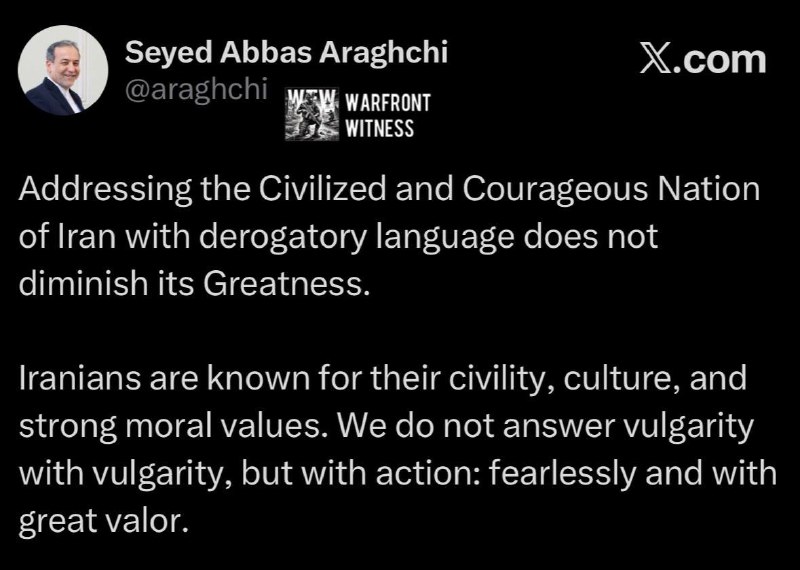
The Iranian foreign ministry, per the source set, has not yet responded on the record. That silence will not last. The next move belongs to Tehran, and the question worth watching is whether it comes in the form of a statement or a shipment.
How Monexus framed this: where wire coverage treated the Ankara summit as a sequence of disconnected headlines — Iran one day, Ukraine the next — this piece reads the joint appearance and the morning ceasefire repudiation as a single policy event. The article does not assert strike outcomes that the source set does not document.
Wire provenance
This editorial synthesis draws on the following public wire/social posts:
- https://t.me/wfwitness
- https://t.me/wfwitness
- https://t.me/LiveMint