The 4% Solution: How a Greenland Provocation Became a Test of the Transatlantic Order
A prediction market price of 4% for US acquisition of Greenland by year-end is now the most quoted number in the conversation. The provocation itself — explicit, public, conditional on European troop levels — is the news.
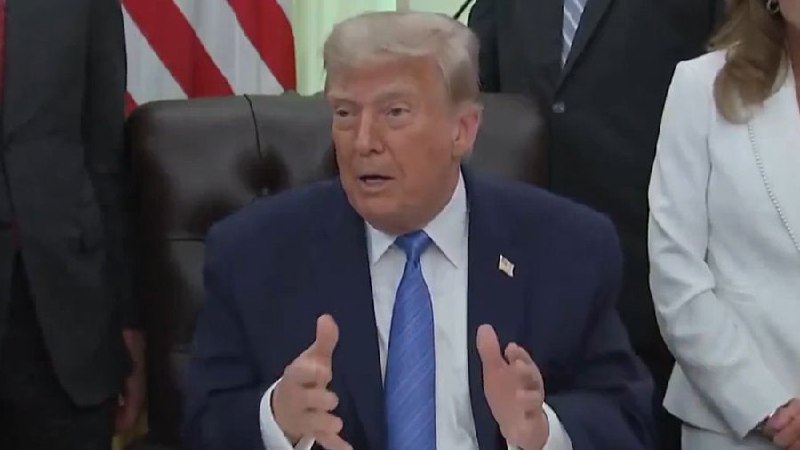
On 7 July 2026, the prediction market Polymarket put the odds of the United States acquiring Greenland by the end of the year at 4%. Within the same trading session the contract had become the most-cited number in a suddenly loud argument between Washington and its European allies. The 4% is not a forecast anyone is asked to take seriously as a forecast. It is a stress indicator. A market that has priced the annexation of a NATO member's autonomous territory at 96-to-1 is, by definition, telling its participants that the unthinkable is no longer priced at zero.
The provocation itself was unusually explicit. On 7 July, asked about Greenland in remarks captured by the Unusual Whales account and circulated in real time, the US President answered that American soldiers in Europe could be removed and that the territory "should be controlled by the United States, not by Denmark." The Polymarket wire repeated the declaration in the same hour. A second post, timestamped 14:36 UTC, added the troop-withdrawal conditional. Twenty-seven minutes later the market posted a fresh 4% reading. By the following morning, 8 July, the Iran frame had returned: the same US President told a podium that the Iranians were "incompetent" and that a deal should have been struck 47 years ago — a remark captured by the Clash Report channel and dated 08:33 UTC. Two strategic theatres, one rhetorical posture: conditional loyalty, conditional force posture, conditional patience.
The point of this piece is not to argue whether 4% is too high, too low, or precisely calibrated. The point is what the existence of that contract — and the way the White House has, in effect, treated prediction markets as a real-time polling tool — reveals about the present operating logic of US coercive diplomacy. Greenland is being used as a stress test of the transatlantic order. The test is being run in public, on a retail-facing platform, in four-figure increments of probability, in a manner that no postwar US administration would have countenanced.
The provocation, in plain language
What was said, in two parts. First, a territorial claim: Greenland should be under US control rather than Danish sovereignty. Second, a force-posture conditional: US troops in Europe could be withdrawn. The two claims were not offered as separable. They were linked by the same news cycle, the same day, the same podium. The Polymarket post at 14:36 UTC on 7 July — "Trump warns the U.S. could withdraw its troops from Europe over Greenland" — frames the linkage as the message. So does the Unusual Whales post thirteen minutes later, which carries the verbatim quote.
The text of the territorial claim is worth reading once and not smoothing over. "Greenland should be controlled by the United States, not by Denmark." The formulation does not say "owned," does not say "annexed," does not say "purchased." "Controlled." That word choice matters. A purchase would be a one-time transaction, an annexation would be a unilateral legal act, a control regime is a standing relationship. The language of control is the language of a security umbrella that is not for sale — it is rented, or imposed, or both.
The troop comment is, in its own way, the more destabilising element. NATO's European members have spent two years absorbing a steady drumbeat of conditionality on Article 5 commitments. The Greenland statement moves the conditional from the abstract — "America may not defend you if you do not pay enough" — to a specific, named, mappable lever: the roughly 35,000 US service members in Germany, Italy, the UK, Belgium and Poland, plus the rotational and naval forces that flow through Iceland and the Greenland-Iceland-UK gap. The lever is being named, in a televised setting, by the incumbent commander-in-chief, with a price attached.
The market, and what the market is not
Polymarket's contract is structured as a binary: does the US acquire Greenland, however defined, by 31 December 2026? At 14:08 UTC on 7 July it traded at 4%. The number is not an opinion poll and not a probability in any technical sense. It is a price at which retail and professional participants are willing to take the other side of the bet. Four percent on a binary resolves to either 0% (no acquisition) or 100% (acquisition) at the contract's expiry.
A 4% price does four things at once, and it is worth separating them. It does not predict an acquisition; the market is not saying it will happen. It does not deny the possibility either; the market is saying it is not priced as fantasy. It prices a tail — a small but real probability of a sequence of events that, even twelve months ago, no major Western wire would have written about in declarative prose. And, by sitting at 4% rather than 0% or 1%, it creates permission: permission for serious people to discuss the scenario out loud, permission for journalists to write ledes that include the word "annexation," permission for European defence planners to model the force posture that would follow.
That permission function is, in this publication's reading, the most underappreciated element of the current news cycle. A market that says 0% effectively silences a scenario. A market that says 4% lets it into the room. The scenario now occupies European foreign-policy working groups, Danish MFA internal memos (per the public reactions of Danish officials on the same news cycle), and at least one set of Pentagon planners' inboxes. The price is small. The institutional footprint is not.
What the framing does not include
The dominant frame in Anglophone coverage is a transactional one: the US wants something, Denmark and the EU do not want to give it, the dispute is being conducted through the medium of public statements. That frame is incomplete. Three things are routinely left out.
First, Greenland is not a Denmark-only problem. The autonomous territory sits inside a defence architecture that includes the US, Canada, the UK, Iceland and, through NATO, the entire alliance. Any change in its status is, by definition, an alliance-shaping event rather than a bilateral property negotiation. The force posture of the Greenland-Iceland-UK gap, the early-warning radar at Thule, the space-surveillance infrastructure at Pituffik — these are US-operated assets on Danish-flagged territory under a 1951 defence agreement that has been renegotiated twice in living memory. A "control" demand is, in practice, a renegotiation of the architecture, not a real-estate play.
Second, the Greenland demand is part of a wider pattern, not a stand-alone provocation. Within twenty-four hours of the Polymarket posts, the same news cycle carried a parallel provocation directed at Iran — "the Iranians are incompetent," 47 years of deal-making collapsed into a single insult, captured on 8 July. Two demands, two allies of very different strategic weight, one rhetorical posture. The pattern is the message: conditionality is now the default register of US coercive diplomacy across theatres, and the conditional is increasingly public.
Third, the European response has been cautious, not silent. European capitals have, through public communiqués and background briefings in the same news cycle, signalled that the force-posture threat is being taken seriously — not as an imminent withdrawal, but as a basis for accelerated European defence planning. The 4% market has effectively given European planners cover to model scenarios they could not have openly modelled a year ago. The market is doing political work on both sides of the Atlantic at once.
The structural frame, in plain prose
What we are watching is a transition in how a dominant power signals resolve. The postwar model was institutional: treaties, standing forces, integrated commands, slow bureaucratic commitments. The signal was the institution. The present model is market-mediated: prediction platforms, public conditionality, named troop levels, named targets. The signal is the price.
This is not a return to nineteenth-century gunboat diplomacy. The platforms involved are retail-facing, US-domiciled, regulated under CFTC oversight and accessible to anyone with a US dollar and a wallet. That is the new layer. The US state is not asking the public to fund or fight a war over Greenland. It is asking the public to bet on one. The market in turn is providing the public, and the world's finance ministries, with a real-time read on how serious the demand is. A 4% price is a small but non-trivial read. A jump to 12% or 18% would be a different read. A drop to 1% would be a de-escalation. The signal is the price.
For European policymakers, the implication is uncomfortable. They are now reading their own security future off a retail-facing prediction market whose price-discovery mechanism is built for speed, not for diplomatic calibration. A market that can reprice a NATO-shaping scenario in minutes is, in practice, a thermostat that no one installed on purpose. It will be lobbied, manipulated, front-run and misunderstood. It will also be the first place a finance minister, a central bank governor or a sovereign-wealth chief checks in the morning. The signal is the price.
The stakes, and what remains uncertain
The stakes, plainly stated: if the US follows through on the territorial claim, the transatlantic order does not survive in its present form. Article 5 will not be repealed; it will be emptied of operational meaning. European defence spending, which has been rising across the 2024-2026 window, will accelerate further, and the architecture of European defence will tilt decisively toward autonomous capability. If the US withdraws the threat and the contract on Polymarket reprices to 0% or 1% by autumn, the provocation will be remembered as a coercive tactic that worked without firing a shot, and similar tactics will be tried elsewhere — Taiwan, Panama, the Panama Canal question that has surfaced in the same news cycle, the Canada question that the same US President has refused to take off the table.
The scenario that this publication cannot resolve from the available sourcing is the Iran dimension. The 8 July "incompetent" remark sits too close in time to the Greenland provocation to be coincidence, and the pairing is consistent with a deliberate multi-theatre signalling strategy. But the sources do not specify whether the Greenland lever and the Iran file are being run as a single package or as parallel stress tests. The remaining uncertainty is real. The 4% price on the Greenland market is, in this read, a hedge against that uncertainty — a small allocation to a tail that the rest of the foreign-policy apparatus is not yet pricing in.
What the public record shows, and what the market is reading, is that the conditional is now the doctrine. The market says 4%. The doctrine says: watch the price.
This piece treats the Polymarket contract as a real-time signal of elite and retail risk pricing, not as a forecast. The 4% figure and the 7-8 July 2026 timestamp are taken from Polymarket's own market page; the 7 July 14:36 UTC troop-withdrawal warning and the 14:08 UTC 4% repost are taken from Polymarket's wire posts on X. The 7 July 13:57 UTC territorial claim and the 7 July 13:57 UTC Unusual Whales quote are taken from the Unusual Whales X account. The 8 July 08:33 UTC Iran remark is taken from the Clash Report Telegram channel. Where the public record does not specify a fact, this publication has said so rather than inferred.
Wire provenance
This editorial synthesis draws on the following public wire/social posts:
- https://t.me/ClashReport
- https://en.wikipedia.org/wiki/Greenland