Trump's Greenland gambit and the NATO question: threat, leverage, or the start of something larger
On 7 July 2026 Donald Trump publicly floated pulling US troops out of Europe unless Washington controls Greenland. NATO's Mark Rutte pushed back. The episode exposes how Arctic real estate and continental deterrence have fused into a single bargaining chip.
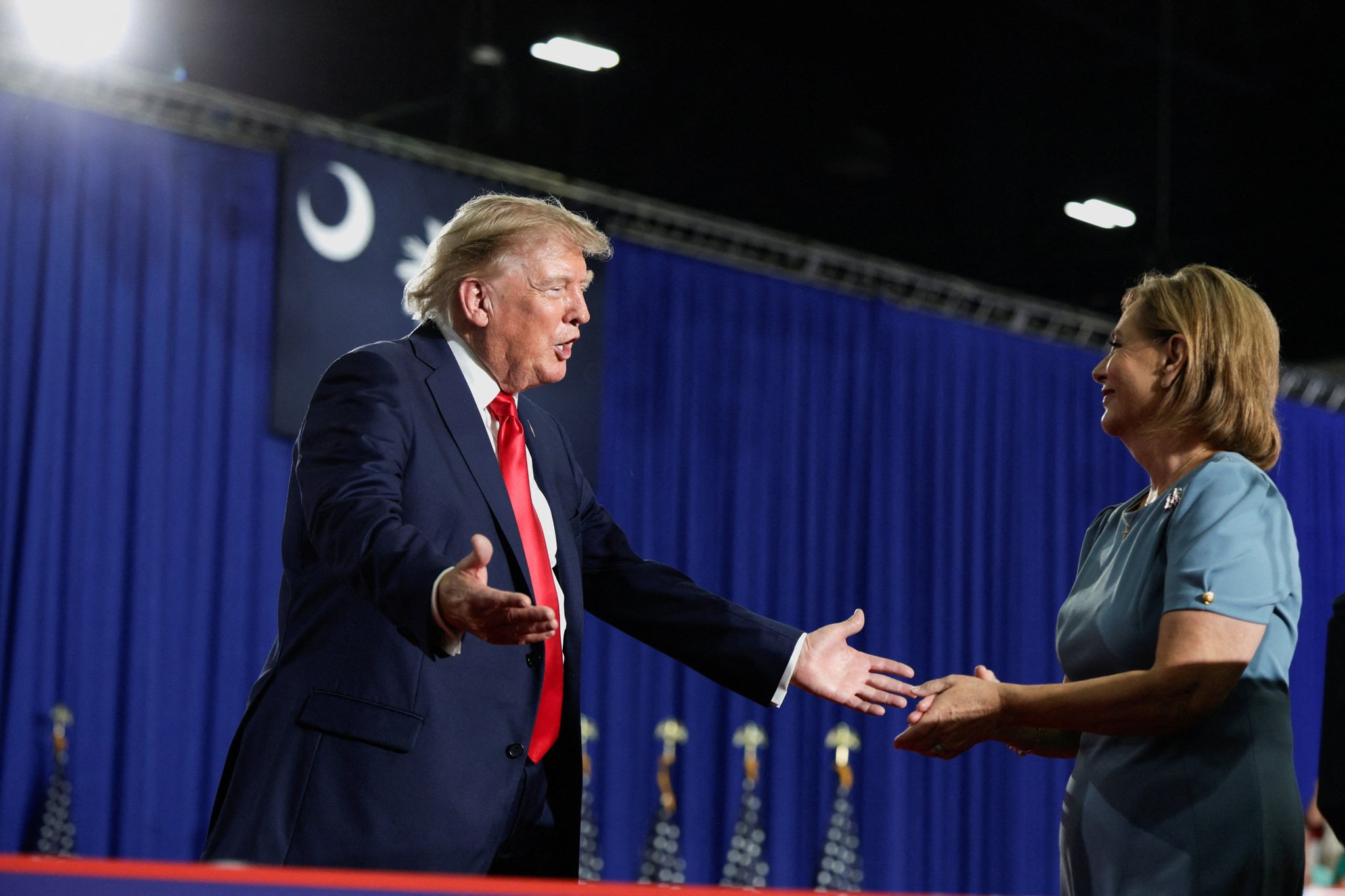
On 7 July 2026, at 13:57 UTC, Donald Trump told reporters that the United States "could remove all of our soldiers out of Europe" and that Greenland "should be controlled by the US." The phrase landed in the middle of an otherwise routine news cycle and detonated outward. Within hours, the prediction market Polymarket had flagged the warning as a breaking item, and by 05:14 UTC on 8 July, NATO Secretary General Mark Rutte was fielding a question about it from a journalist at a press conference: does the alliance take Trump's threats seriously, or is he a committed member of the team? Rutte's reply, partial in the wire transcript but unambiguous in tone, was that the US president is "completely committed" to NATO. He then added, in a separate exchange captured at 05:19 UTC, that recent American military action against Iran was "absolutely necessary" because Tehran "is violating the ceasefire."
That double appearance — first denying a fracture was opening at the heart of the Atlantic alliance, then endorsing American escalation against Iran in the Middle East — frames the Greenland episode correctly: it is not, on its face, a story about secession or Arctic sovereignty. It is a story about leverage, about how an American president who is openly sceptical of the postwar European settlement has learned to convert territorial appetite into negotiating capital. The danger is not that Greenland is annexed; the danger is that the threat keeps working.
The Greenland arithmetic
Greenland is the world's largest island, an autonomous territory of the Kingdom of Denmark with a population of roughly 56,000. Its strategic value is straightforward and has been understood in Washington for decades: it sits across the sea lines of communication between North America and Europe, hosts the Pituffik Space Base (formerly Thule Air Base), a key node in the US missile-warning architecture, and is increasingly central to any calculation about Russian and Chinese activity in the Arctic as the ice retreats. The United States already operates there under a 1951 defence agreement with Denmark.
What is new is the framing. For most of the postwar period, American access to Greenland was treated as a quiet arrangement inside the NATO family — a logistical fact rather than a political claim. The 2019 attempt by the first Trump administration to purchase Greenland produced an awkward week of diplomatic theatre and was withdrawn. The 2026 version is qualitatively different in two ways: it is being run alongside explicit threats to redeploy US forces from the European mainland, and it is being run while the United States is simultaneously striking Iranian targets. The transactional logic is plausible. Greenland, in this telling, is a price the United States should stop renting and start owning because the alliance it defends no longer pays its rent in the currency Washington cares about.
Brussels and Copenhagen read the message differently. The Danish government, which controls Greenland's foreign and defence policy short of outright independence, has reiterated that the territory is not for sale. Greenland's own government — led since 2025 by a coalition that includes pro-independence parties — has been considerably more direct: in successive statements through 2026, Greenlandic Prime Minister Kim Kielsen's successors have argued that Nuuk should set its own terms with Washington rather than have Copenhagen mediate. That posture complicates any clean European "no" to the American offer and provides Trump's negotiators with a domestic interlocutor in Nuuk who is willing, in principle, to talk.
What the alliance just heard
Rutte's intervention matters less for its content than for its existence. The NATO Secretary General does not normally need to publicly certify that the president of the United States remains a faithful member of the alliance; the premise is taken for granted at every summit communiqué since 1949. When that premise has to be stated aloud, it is because someone in the room has been working to undermine it. The press conference exchange at 05:14 UTC and 05:19 UTC on 8 July reads, parsed cold, as the alliance's chief civilian trying to close a door that the alliance's most powerful member keeps nudging open.
There are two ways to read Trump's posture. The first, the one Brussels prefers, is that it is bluster — a negotiating position designed to extract concessions on burden-sharing, Arctic basing rights, and critical-minerals supply from Greenland's rare-earth deposits rather than the territory itself. On this reading, the troop-withdrawal threat is a price tag, not a plan, and the endgame is a revised basing agreement that gives Washington more unilateral latitude on Pituffik Space Base and any future installations tied to missile defence and space surveillance. The second reading, taken seriously in capitals from Warsaw to Tallinn, is that Trump means at least part of it. European defence planners have spent the last eighteen months quietly gaming scenarios in which the United States reduces its forward presence on the continent by one or two heavy brigades and the alliance's nuclear umbrella becomes ambiguous. The Greenland comments feed directly into that scenario set.
The Polling-and-positioning overlay is worth noting. Polymarket's 7 July flagging of the troop-withdrawal warning, by treating a presidential remark as a tradeable event, captures something real about how these signals are now priced. The conversation about American commitments in Europe is no longer only a conversation between diplomats; it is also a conversation between market participants who can bet on whether the president is bluffing.
A wider negotiating posture
The Greenland gambit does not arrive alone. In the same press cycle, Trump publicly endorsed US military action against Iran, characterising it as a response to ceasefire violations by Tehran. Rutte's "absolutely necessary" endorsement of those strikes, delivered to a journalist's question rather than initiated by NATO's press team, ties the European alliance more visibly to a Middle Eastern escalation that not all of its members would have chosen. The political effect is to remind European governments that the same American president who wants to absorb Greenland is also the one making the calls on Iran.
This is the part of the episode that gets less attention than the headline grab. The transatlantic relationship is being re-priced not only on territory but on conflict. European governments that might prefer to stay out of an Iran escalation find themselves, through NATO's public framing of necessity, drawn into a rhetorical alignment. Even where the legal exposure is limited, the reputational and basing exposure is real: US airframes flying from Ramstein and Aviano and RAF Fairford have, at various points over the past year, been part of operations against Iranian proxies and Iranian state targets. When Washington characterises those operations as necessary, it expects its allies to be on the same page in public.
What could go right, what could go wrong
The optimistic case is that this resolves as the 2019 bid did: a flourish, a Danish "no," an American pivot, and a quiet status quo restored with a few cosmetic adjustments. The structural facts — Pituffik Space Base, the existing defence agreement, Greenland's autonomy — make outright annexation close to impossible without Danish and Greenlandic consent, and neither appears imminent. A negotiated outcome that strengthens Washington's basing rights, accelerates critical-minerals extraction from Greenlandic deposits, and provides a face-saving political narrative in Washington is the kind of deal that solves most of these problems for most of the principals. European NATO members, relieved that the worst did not happen, would likely tolerate it.
The less optimistic case is that the threat becomes routine. A US president who learns that floating troop withdrawal produces a buying rush from anxious allies has an incentive to keep floating it — across NATO summits, across budgetary cycles, across Arctic Council negotiations. Each round produces marginal concessions; each round also normalises the idea that the American commitment is conditional. The cumulative effect, over a decade, would be a NATO that still exists on paper but operates on shorter fuses and thinner assumptions. The alliance would survive; it would not be the same alliance.
The most uncertain element is Nuuk. Greenlandic politics has moved firmly into a self-determination register since at least 2009, and the current government coalition includes figures who have been openly willing to discuss annexation-style outcomes with Washington. If Copenhagen tries to hold the line and Nuuk opens a parallel channel, the Danes will be negotiating against their own autonomous territory — a situation that gives Washington more leverage, not less. The island's resource profile, its geography, and the trajectory of Arctic ice are all pulling in the direction of greater American interest. Greenland's room to manoeuvre is real but narrowing.
What the wire does not yet tell us
The sources for this episode are unusually thin for a story of this magnitude: a handful of public remarks by Trump, two short Rutte exchanges captured on the press conference record, and a prediction-market confirmation that the troop-withdrawal line was received as serious enough to price. Missing from the public record, as of 08:00 UTC on 8 July, is any formal Danish or Greenlandic government response; any NATO communique; any readout from the State Department or the Pentagon on whether the troop comments represent an articulated policy, an off-the-cuff remark, or a tactical opening; and any reaction from the other Arctic Council members — Canada, Norway, Iceland, Finland, Sweden, Russia — whose interests in Greenland's status are not negligible.
The transcript also stops short of the substantive question. If the United States were to withdraw forces from Europe as leverage, how would it sequence such a withdrawal? Where would those forces go — back to the continental United States, to Greenland itself, to other Atlantic and Pacific theatres? The sources do not say. What is clear is that the mere mention of the move has already bought political time in Washington and produced a NATO Secretary General publicly confirming the alliance is intact. Whether that is the intended transaction, and whether it can be repeated, are the questions that will define the Atlantic relationship for the rest of this decade.
Desk note: Monexus framed this as a leverage story anchored in two short, on-the-record press exchanges, rather than as an annexation story or an alliance-collapse story. The contested material here is thin enough that any narrative flourish would outrun the evidence; the work was in pulling the immediate quotes into a single structural read and naming what the public record does not yet contain.
Wire provenance
This editorial synthesis draws on the following public wire/social posts:
- https://t.me/ClashReport
- https://t.me/ClashReport