Trump casts himself as Iran's "number one" target as US strike toll reportedly hits 8
Hours after reports of an 8-person strike toll in southern Iran, the US president told reporters he is "number one" on Tehran's kill list — then pivoted to claiming success on oil and the alliance.
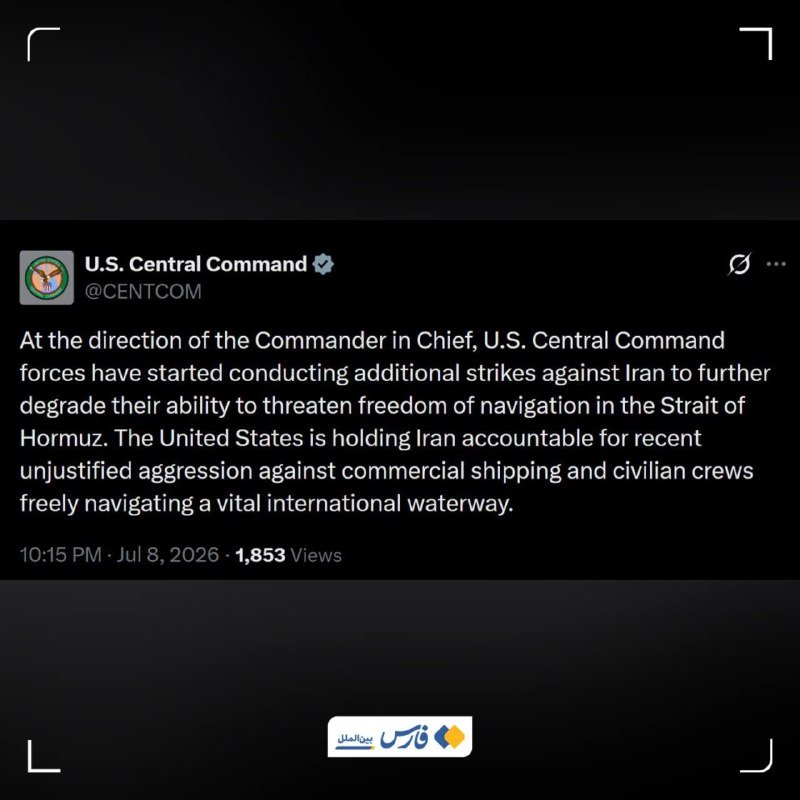
At 17:02 UTC on 8 July 2026, Telegram accounts monitoring the US–Iran corridor began carrying a single, blunt item: eight Iranian military personnel had been killed in US strikes on southern Iran the previous day. Within minutes, the same wire of channels carried a second item — this one from Donald Trump, speaking to reporters: "I'm #1 on the kill-list for Iran," and "I may be gone too, because I'm their number one target." The juxtaposition is unusual even by the standards of this White House. A strike with a reported eight-person military toll, a presidential self-description as the adversary's primary assassination target, and a verdict that "the Iran War has been a tremendous military success" — all delivered inside a single news cycle.
What the day's comments actually consolidate, beyond theatre, is a particular framing of US engagement with Iran: short, lethal, dominated by airpower, defended in domestic-political terms by oil prices and casualty framing rather than by a declared strategic objective. The reading below tracks the day's claims, contrasts them with what remains unreported, and locates them inside the longer pattern of how Washington has talked about Iran since the strikes began.
A strike with a named toll, and a president who cites himself
The first operational claim of the day came from channels aggregating field reports from the Iranian side of the Gulf: eight Iranian military personnel killed in US strikes on targets in southern Iran on 7 July 2026. The figure has not, at time of writing, been independently confirmed by Pentagon briefing transcripts or by a wire service with on-the-ground access to strike sites, and the channels carrying it (bricsnews, Clash Report, Disclose TV) sit at the aggregation end of the news spectrum rather than at the institutional reporting end. The number should be read as a starting figure for further reporting, not as a verified final count.
The political claim came from Trump himself, in the same window. In remarks reported across insiderpaper, Disclose TV and Clash Report between 16:32 and 16:45 UTC, the president said he believed he was "number one" on an Iranian kill list, that he "may be gone too," and that he "don't really care" because he was "doing my job." Trump separately framed the war as already won: "The Iran War has been a tremendous military success" and "the oil prices are lower than they were when I started."
The combination does political work whether or not it is operationally accurate. Strikes-with-toll-and-no-strategy is the kind of posture that can be defended domestically by reference to a body count and to a pump-price line. By placing himself at the centre of the threat — and by citing low oil as the deliverable — the president converts a kinetic event into an American-consumer story. The threat to himself becomes the headline; the body count in southern Iran becomes context.
The NATO echo, and what "respect" is doing in this story
Alongside the Iran material, the same channels carried Trump's comments on the NATO summit he attended earlier in the week. Per insiderpaper at 16:32 UTC, Trump told reporters that NATO leaders told him "we love you," described the room as having "the respect and the love," and speculated: "Maybe they're trying to get to me."
Read alongside the Iran remarks, the NATO material reads less like a separate story than like a second register of the same performance. Alliance politics is being transacted through personal flattery; adversarial politics is being transacted through personal threat. In both cases, Trump positions himself as the principal — the person with whom other states have relationships, and against whom other states design operations. The structural effect is to keep NATO backing for any Iran posture framed as a question of his standing rather than as a question of alliance strategy.
That matters because the strike posture, however many casualties it inflicts, requires airspace access, basing, intelligence sharing and overflight permissions that ultimately run through NATO members. If the alliance story of the week is "they said they love me," then the Iran strike story of the week inherits that affective framing. It is harder for domestic critics to argue the strike is a strategic error when the alliance supporting it is being narrated as a personal tribute.
The 52,000 figure, and what we don't know about Iranian domestic casualties
In the same remarks, Trump cited a figure for Iranian internal repression: "Iran killed 52,000 protesters over the last three months." The same remark, per Clash Report at 16:33 UTC, had earlier in the day been put at 54,000 — the kind of intra-day revision that suggests the figure is being asserted rather than drawn from a single underlying dataset. Both numbers sit inside a contested reporting environment.
International human-rights organisations have for months been tracking a brutal crackdown inside Iran following large-scale protests. The exact casualty total is not knowable from open sources at this hour, and the variance between the two figures the president cited (52,000 vs. 54,000) is itself a useful signal: this is a number being used to make a political point, not a number being carefully sourced for briefing papers. What the figure does, regardless of its exact value, is cast the Iranian state as already at war with its own population — a framing that makes a US kinetic posture look, by contrast, like a constrained external action against an already-violent regime. Whether that framing survives contact with the next round of field reporting is a separate question.
Stakes: oil, escalation, and the bracket the wire forgot
The clearest stake in the day's remarks is the oil claim. If oil prices are genuinely lower than when this presidency began its Iran posture — a comparative claim that should be benchmarked against Brent or WTI on inauguration day and on 7 July 2026 — then the president has a single sentence that closes the case for the strikes in domestic terms. If they are not, the line will not survive the next pump-price cycle, and the framing will have to shift toward body counts and strategic achievement. The day's references to NATO "respect" and to a personal kill-list ranking suggest the administration is already hedging that risk by widening the case beyond price.
The second stake is escalation. A US president publicly identifying himself as the Iranian regime's primary target, in the same news cycle as a strike with reported Iranian military casualties, narrows the diplomatic off-ramp. It also obliges Tehran, whatever its internal posture, to treat the next round of rhetoric as part of the operational environment. The Iranian counter-narrative — that the strikes are an unprovoked aggression and that the Iranian military dead are victims, not combatants in the framing Washington prefers — is the version regional outlets will carry over the coming days. The bracketed element the wire coverage largely omits is what the strikes were hitting in southern Iran. The Iranian military's southern commands sit along the Gulf coast; targets there include air-defence sites, missile batteries, and command nodes. The reporting does not, at this hour, name which categories produced the eight-person toll.
What remains uncertain
Three points warrant explicit caveat. First, the eight-person strike toll originates with Telegram aggregators and has not yet been corroborated by Pentagon transcripts, Reuters or AP field reporting, or Iranian state media's own count. Second, the 52,000/54,000 Iranian protester-death figure carries an intra-day variance large enough to suggest it is a talking point rather than a stable datum; rights groups tracking the crackdown have so far published lower cumulative figures, though those figures describe an earlier window than the one Trump cited. Third, the claim that oil prices are lower than when the president "started" depends on a baseline the White House has not yet published; without that baseline, the claim is unfalsifiable as stated.
What is settled is the posture. Strikes with named casualties. A president who describes himself as the target. An alliance story told in personal rather than strategic terms. A domestic-repression figure asserted at scale. None of this resolves the underlying question of what the Iran war is for. It does, however, give the next round of reporting a clear set of claims to test against primary documents, wire reporting, and the field evidence from southern Iran.
Desk note: Monexus is leading this story from Telegram aggregator wire and from the president's own on-camera remarks; we are not yet sourcing the strike toll to a wire with on-the-ground access, and we have flagged that asymmetry rather than smoothing it.
Wire provenance
This editorial synthesis draws on the following public wire/social posts:
- https://t.me/bricsnews
- https://t.me/insiderpaper
- https://t.me/disclosetv
- https://t.me/ClashReport
- https://t.me/ClashReport
- https://t.me/ClashReport
- https://t.me/disclosetv
- https://t.me/insiderpaper