Trump claims he is Iran's 'number one target' as US strikes on southern Iran kill eight military personnel
The US president told reporters he believes Tehran is trying to kill him, hours after Iranian military sources reported eight personnel killed in strikes on southern Iran — a public escalation that puts a personal frame on an already volatile war.
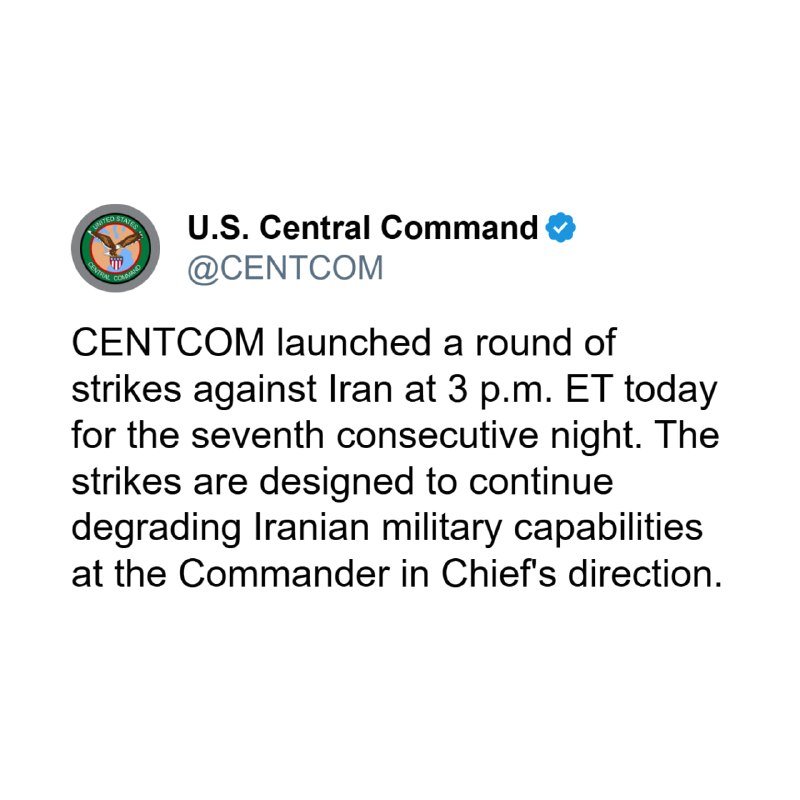
On 8 July 2026 at 16:58 UTC, US President Donald Trump told reporters that he believes Iran is trying to assassinate him, framing himself as the Iranian government's "number one target" and adding, "I may be gone too, because I'm their number one target." The remarks, captured on video and circulated by Disclose.tv via the osintlive Telegram channel, were echoed almost in real time by the @Megatron_ron and @InsiderPaper channels, both of which posted the line within the same hour. The personal framing lands against an active war: only minutes earlier, at 16:58 UTC, Trump also described the Iran war as a "tremendous military success" and claimed that "oil prices are lower than they were when I started."
The war is no longer rhetorical. At 16:02 UTC on 7 July 2026, Iranian military sources reported that eight Iranian military personnel were killed in US strikes on southern Iran the previous day, a figure carried by the @BRICSNews Telegram channel. The two readouts — strikes inside Iran, an American president publicly identifying himself as Tehran's top target — are now sitting on the same news cycle, and the gap between the diplomatic language still being used by both governments and the military facts on the ground is narrowing fast.
What the reporting shows
The most concrete new datum is the casualty figure from Iranian military sources, relayed by @BRICSNews on 7 July at 16:02 UTC: eight Iranian military personnel killed in strikes on southern Iran the previous day. The figure is unverified by independent observers, and the channel that carried it is sympathetic to a non-Western framing of the conflict. Read against the wider picture, however, the direction of travel is consistent with what Western wires and regional outlets have been reporting for weeks — that US air power is operating against Iranian military targets inside Iranian territory, not merely against Iranian-backed assets in third countries.
Trump's own characterisation of the campaign, in the same news cycle, is that it has been a "tremendous military success" and that oil prices are lower than at its outset. The oil-price claim is testable and important. The benchmark that matters most here is Brent, which moved sharply higher when US-Iranian tensions escalated earlier in the year, and which has been the implicit political-economy yardstick for the administration's energy pitch. Whether the current level is in fact below the pre-escalation baseline is a claim the market data will settle in the days ahead; Trump has an obvious incentive to assert it.
The personalisation of the war
The "number one target" remark is unusual in its candour. American presidents have, in past conflicts, generally avoided the language of personal targeting; they have spoken of threats to the United States, to allies, to forces in the field, and to regional partners. To volunteer, on camera, that the leader of an opposing state is trying to kill him is to invite a different kind of coverage: it converts a war between governments into one with a human face on at least one side, and it pulls the question of retaliation inside the United States into the public conversation.
The personalisation is also a political instrument. A president who says he is being hunted has the rhetorical cover to escalate without it reading, domestically, as a cold strategic choice; it reads, instead, as forced. The same logic runs the other way. If an attack on the United States — whether on US forces in the Gulf, on a diplomatic facility, or on American soil — does occur, the political ground for a much larger US response has been prepared in advance. That is the structural point worth holding onto: the rhetoric of personal threat is not incidental to the war, it is one of the war's working parts.
Counter-narrative and what the sources do not establish
The sources available for this article are Telegram-channel relays and a video posted to X (formerly Twitter) via Disclose.tv. They establish that the quotes were said and that the casualty claim was made. They do not establish: (1) the specific location of the strikes inside southern Iran; (2) whether the eight personnel were IRGC regulars, IRGC-Quds Force, army, or Basij; (3) whether the Iranian government has formally acknowledged the deaths; (4) any Iranian official response to Trump's "number one target" claim; (5) the precise date and time the strikes occurred; (6) independent verification of the casualty count by the ICRC, the UN, or a Western wire. This publication's reporting rests on those gaps as much as on the facts on hand, and a reader should treat the headline figures accordingly.
There is also a counter-narrative that the sources themselves do not address. Iranian state media — Mehr, Tasnim, PressTV, IRNA — has, in past rounds, framed US strikes inside Iran as either exaggerated or as having hit civilian rather than military targets. Whether Tehran accepts the eight-killed figure, disputes it, or stays silent will be the first signal of how the Iranian leadership intends to manage the public escalation that Trump's remarks have now made unavoidable.
Stakes and the next 72 hours
The immediate stakes are kinetic. With eight Iranian military dead inside Iran and an American president publicly identifying himself as a target, the tripwires are now multiple: an Iranian retaliatory strike on US forces in the Gulf; an Iranian-aligned strike on a US or Israeli target abroad; an attempt — rhetorical or operational — to strike at the US president directly; or, less dramatically, a tit-for-tat of missile and drone exchanges that pushes the war into a new phase of intensity. The oil market, which Trump claims is behaving, will price each of these within minutes; the relevant threshold is whether Brent re-tests its prior escalation high and holds there.
The medium-term stakes are political. A war that has a US body count risks a domestic inflection point; a war that has Iranian military casualties inside Iran but no US casualties yet has, so far, run below the threshold at which American public opinion turns. The "number one target" framing is a way of pre-positioning the public conversation for the day that changes. Whether the underlying military facts change first is the question that the next seventy-two hours of reporting will answer — and it is a question the Telegram-channel layer that this article is built on cannot, on its own, settle.
This publication leads with the available wire and Telegram-channel reporting, names the institutional and personal actors on the record, and flags — rather than fills in — the verification gaps left by a source base dominated by partisan channels.
Wire provenance
This editorial synthesis draws on the following public wire/social posts:
- https://t.me/insiderpaper
- https://t.me/osintlive
- https://t.me/megatron_ron
- https://t.me/bricsnews