Trump's three-front week: Kyiv visit, Patriot license, and another Iran night
In a single news cycle the White House signalled a Patriot production licence for Kyiv, floated a post-war presidential visit, and warned of renewed strikes on Iran — a posture that looks less like grand strategy than three concurrent bets.
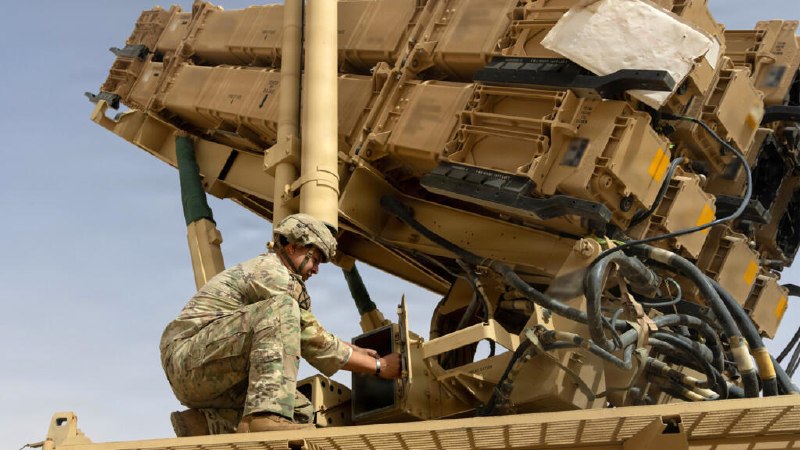
By 17:55 UTC on 8 July 2026, the White House had put three distinct foreign-policy bets on the table in the span of an afternoon: a licence for Ukraine to produce Patriot air-defence systems, a conditional willingness to visit Kyiv once the war is "over or significantly reduced," and a warning that the United States would "very probably" strike Iran "hard again tonight." Taken together the items sketch a posture that is hard to summarise as grand strategy and easier to read as three concurrent wagers, each with its own coalition, timeline, and risk profile.
The through-line is not ideological. It is transactional. Each move is calibrated to a domestic audience — defence-industrial voters in the case of the Patriot licence, a peace-deal narrative in the case of the Kyiv visit, a deterrence constituency in the case of Iran — and each is hedged in language that leaves the president room to reverse course within forty-eight hours.
The Patriot licence: industrial policy dressed as security aid
The announcement, made during a bilateral meeting with President Zelenskyy, is unusual in form. A Patriot production licence is not a donation of interceptors or a transfer of batteries; it is permission to manufacture under licence on Ukrainian soil. The substantive questions — which subsystems are covered, what the royalty structure looks like, whether Raytheon's supply chain can absorb a second production line, and whether allied components are included — are not addressed in the dispatch. The framing matters: in Washington, "made in Ukraine" reads as burden-sharing; in Kyiv, it reads as sovereignty over a critical-defence capability; in Moscow, it reads as escalation.
The dominant Western wire line will be that this is a hardening of the air-defence umbrella at exactly the moment Russian glide-bomb sorties have intensified. The plausible counter-read is more sober: a licence without a funded industrial base, without a domestic interceptor line, and without allied missile-supply guarantees is a press release with industrial-policy garnish. Ukraine has the engineering talent to integrate Patriot-class systems; it does not, on the available evidence, have a domestic foundry capable of producing the radar arrays and seeker heads at scale. The licence is real. Its operational consequence is not yet.
The Kyiv visit: a hostage to a peace that has not arrived
The companion item — Trump expressing a desire to visit Kyiv "before it experiences further destruction," preferring to wait until the war is over or significantly reduced — is the kind of sentence that does more work as signal than as policy. A presidential visit to a capital under bombardment is, in normal diplomacy, a solidarity gesture. One conditioned on a pre-agreed reduction in hostilities is something closer to a hostage to the negotiation: the visit is offered as the carrot, the reduction as the benchmark, and the implication is that the absence of either is the other side's failure.
The framing favours Moscow. A visit gated on a "significantly reduced" war means the United States is publicly attaching its symbolic presence to a Russian decision to de-escalate. Kyiv's incentive structure here is asymmetric: a Zelenskyy who agrees to a quiet frontline in exchange for a presidential photograph in Bankova is trading blood for optics. The framing that holds up better is the one Ukraine's own diplomats have used for two years — that any reduction imposed by Moscow is a temporary tactical choice, not a peace — and that a visit contingent on that tactical choice is a hostage, not a handshake.
Iran: the third front and the second-strike problem
The Iran thread is the one with the shortest fuse. "Very probably" strike Iran "hard again tonight" is the kind of public warning that, in any previous administration, would have been a back-channel private communication wrapped in deniable language. The decision to put it on the record — and to telegraph the timing window — does three things at once. It pressures Tehran's leadership to relocate assets. It reassures Gulf partners that the United States is not tapering. And it gives domestic political cover for what comes next, including the possibility that what comes next is nothing at all.
The dominant Western framing holds that sustained kinetic pressure is the only credible response to an Iranian nuclear programme that has, by every public estimate, advanced further in the last twelve months. The plausible counter-read is that public warnings before strikes degrade the strike's military value — air defence is at its highest state the moment a politician names the hour — and they widen the political blast radius if the strike under-delivers. There is also the third option, the one the public framing never quite names: that the announcement is itself the action, and the strikes, when they come, are calibrated to match the rhetoric rather than to disrupt the underlying programme.
What remains genuinely uncertain
The sources for this cycle are narrow. The dispatches on Ukraine and Iran are short, declarative, and carry no named attribution beyond the principals. There is no detail on the Patriot licence's scope, no confirmation from Raytheon, no readout from the Ukrainian defence ministry, and no Iranian foreign ministry response to the strike warning. The peace-deal optimism — that "both President Putin and President Zelenskyy want to reach" an agreement — is reported as a Trump statement, not as a confirmed negotiating position of either counterpart. A reader should treat the cycle as a posture, not a settlement.
The pattern worth noting is structural: a White House that runs three foreign-policy tracks in parallel, with three different tempos, three different audiences, and three different thresholds for escalation. The risk is not that any one track fails. The risk is that a reversal on one — a cancelled strike, a deferred visit, a delayed licence — is read by the relevant counterpart as a green light on another. Diplomacy conducted at this speed does not tolerate mistranslation.
Desk note: Monexus framed this as a posture cycle, not a deal cycle. The wire services will likely lead on the Patriot licence as the day's headline; we held it as one of three because the peace-visit conditional and the Iran warning carry equal weight in the calendar of consequences.
Wire provenance
This editorial synthesis draws on the following public wire/social posts:
- https://t.me/s/OSINTdefender
- https://t.me/s/OSINTdefender
- https://t.me/s/OSINTdefender
- https://t.me/s/OSINTdefender