Black Flag Resynced and the quiet collapse of Ubisoft's blockbuster logic
A remaster launches to derision, fifty-one staff lose their jobs, and the DLC costs more than the game. The pattern is older than the console cycle that produced it.
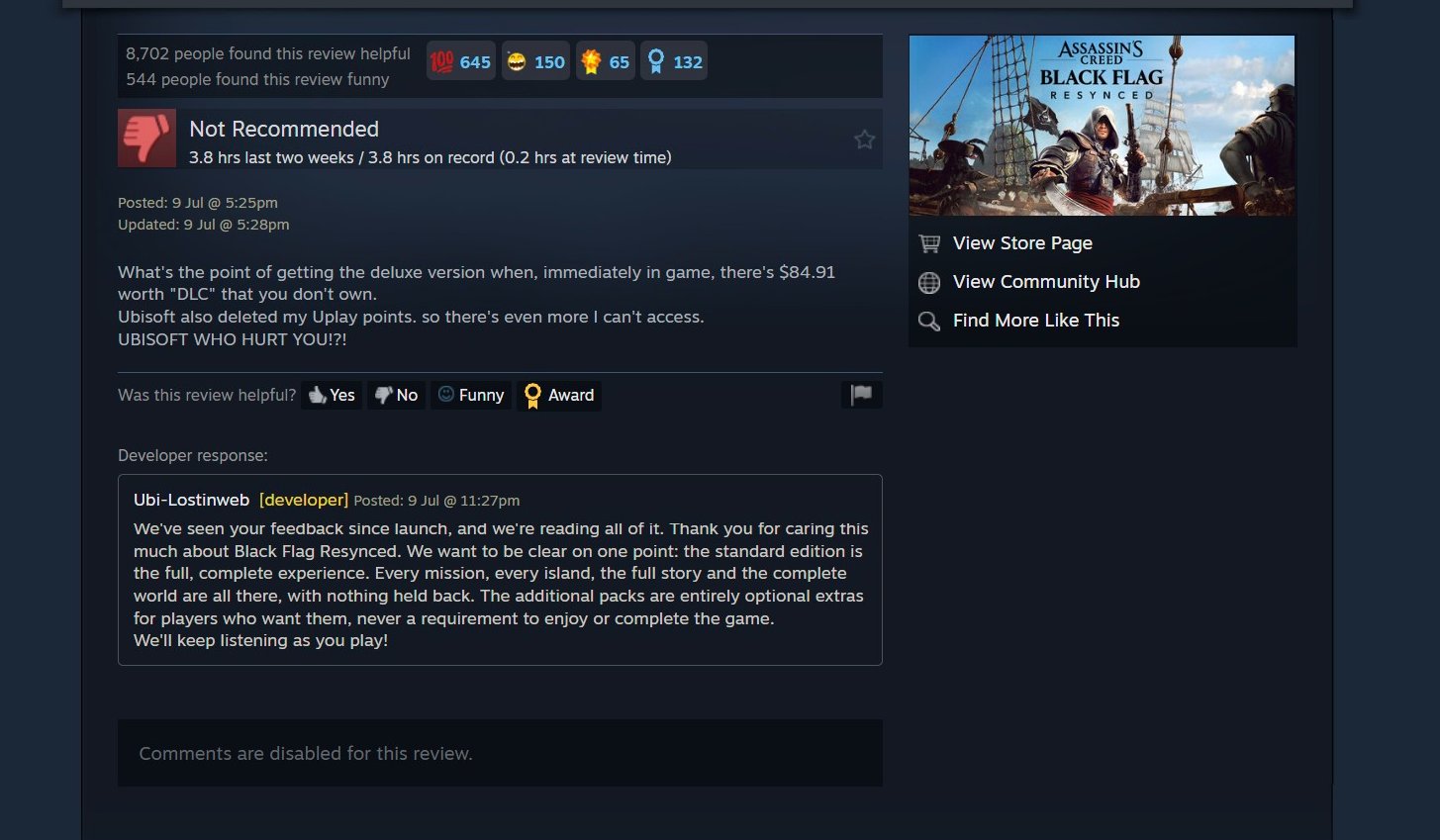
On 9 July 2026, Ubisoft launched Assassin's Creed Black Flag Resynced into a marketplace that greeted it with a Mostly Negative Steam rating and roughly 98,000 concurrent players at peak, per launch-week reporting compiled by the X account @pirat_nation. Within hours, journalist Tom Henderson of Insider Gaming reported that 51 employees at Ubisoft Barcelona had been laid off shortly after the title went live. The company has not, in the materials available to this publication, publicly disputed either figure.
A remaster of a thirteen-year-old game, sold at full price, performing badly enough to cost its own developers their jobs, while asking players to buy back content that was cut from it. That sequence is not a glitch. It is the operating model, and it is no longer hiding.
The product that ships is not the product that was made
The complaints registered on Steam are unusually blunt. Cutscenes, players report, are capped at 30 frames per second in a remaster released in 2026. Microtransactions sit in front of content that was demonstrably part of the original game. The DLC catalogue, per @pirat_nation, costs more than the full price of the title itself. None of these are edge cases; they are the headline reception.
The structural move here is familiar to anyone who has watched the industry over the last decade. Content is removed from a finished product, repackaged as downloadable add-ons, and sold back to the audience that already paid for the base game. The label "Resynced" is doing real work: it is a marketing permission slip to charge a new price for an old artefact while treating the old artefact's actual contents as optional inventory.
The labour ledger
Fifty-one redundancies at a single Barcelona studio, on or around launch day, is the part of the story that should not be skimmed. The headline framing of "tech layoffs" usually obscures who pays for the bet. Here the cost is legible. A development team in Catalonia produces a remaster; the publisher prices and packages the remaster in a way the audience rejects; the developers are the line item that gets cut when the reception does not match the forecast.
This is the standard sequence in modern games publishing: the marketing surface absorbs no penalty, the executives who greenlit the strategy face no public consequence, and the people who wrote the code or drew the frames are the variable cost. Tom Henderson's reporting names Ubisoft Barcelona specifically. The pattern is not new. The visibility is.
What the numbers actually say
Ninety-eight thousand concurrent players is not, in isolation, a failure. It is a respectable launch number for most games. Read against Ubisoft's own positioning of Black Flag as a tentpole franchise refresh, however, it is a quiet disaster. The publisher bet on nostalgia plus artificial scarcity. The audience responded by going elsewhere — to the original 2013 release, to the ezio collection, to other open-world games that did not require a second purchase for content they had already played.
The Mostly Negative rating is the more important data point. It tells you that the people who did show up did not enjoy what they found. A 98k peak with a hostile reception is worse for the long tail of a brand than a 30k peak with a warm one. Word of mouth now runs against the next Ubisoft release before that release is even announced.
The structural frame, in plain terms
A publicly traded publisher has a fiduciary obligation to maximise per-customer revenue. The cleanest way to do that, in software, is to fragment the product: ship a base, hold back content, monetise the gap. The tactic works until the audience learns to read the schedule, at which point trust collapses and the publisher responds by raising the base price to recover the loss. The cycle is well documented across mobile, AAA, and live-service titles. What is unusual about Black Flag Resynced is that the cycle has been compressed into a single launch week: the remaster is the price hike, the DLC is the fragmentation, the layoffs are the cost, and the negative reviews are the market's verdict — all in the same news cycle.
Stakes
If the trajectory holds, three things follow. First, the talent pipeline out of southern European studios tightens; experienced developers do not stay in a market that treats them as the first line item cut. Second, the Ubisoft brand — still one of the most valuable in the medium — depreciates faster than its catalogue can compensate for. Third, the lesson other publishers draw is not "make better remasters" but "manage expectations down and monetise harder," which is the lesson that produced this moment in the first place.
What remains genuinely uncertain is whether the executives responsible for the strategy will pay a visible price. The 51 named employees at Ubisoft Barcelona already have.
This publication framed the Black Flag Resynced launch around the gap between price, content, and labour cost — a frame the gaming press has touched on but rarely tied together in a single launch week.
Wire provenance
This editorial synthesis draws on the following public wire/social posts:
- https://x.com/pirat_nation/status/194362791000000000
- https://x.com/pirat_nation/status/194362500000000000
- https://x.com/pirat_nation/status/194361900000000000