The morning's toll in Gaza: a thread, a pattern, and the question the framing leaves out
Two deaths reported in a strike on a tent in Nuseirat, and a rising daily count from the same wire — the picture is consistent, and so is what it leaves unexamined.
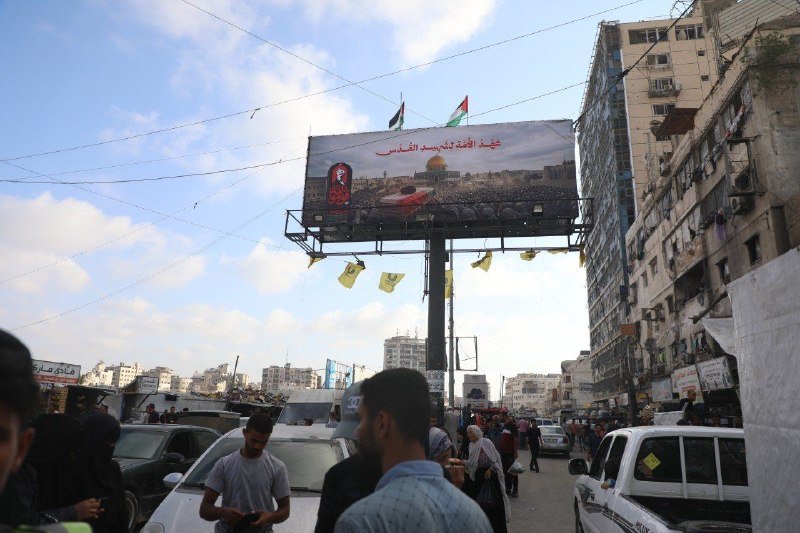
At 16:10 UTC on 9 July 2026, a Telegram channel affiliated with reporting out of Gaza carried word that two people had been killed in an attack on a tent in the Nuseirat refugee camp, in the central Gaza Strip. The same channel had earlier in the day logged five Palestinian fatalities from Israeli fire since dawn; a slightly earlier post had the figure at four. The pattern of those three messages — ascending numbers, same source, same operational window — is itself the story.
Casualty counts in this conflict rarely arrive as single events. They arrive as threads: a strike, an initial count, a revised figure, a fatality attributed hours later to a person who died of wounds sustained the day before. Reading those threads side by side is how the picture of a day actually gets assembled, and how quickly a single sentence — "two deaths reported" — can be turned into a smaller figure than the day's total.
What the wire actually says
The three items are all from the same family of regional reporting that monitors the conflict through Gaza-based stringers and Iranian- and Lebanese-aligned outlets: abualiexpress carried the Nuseirat strike at 16:10 UTC, and al-Alam Arabic posted two running tallies at 15:22 and 15:45 UTC, moving from four to five dead "due to occupation fire" since dawn on 9 July. That phrasing — fire — is consistent with how these channels report Israeli military operations; the Israeli Defence Forces Spokesperson's office is the institution that would normally confirm or contest such figures on its end, and the thread context does not contain that confirmation. The numbers are therefore initial, Gaza-side, and uncorroborated from outside.
There is also a definitional point. "Martyrs" in this reporting tradition is the Arabic word of art for those killed in the conflict; it does not imply combatant status, and the wire does not here distinguish civilians from militants. That ambiguity is not unique to these sources — major Western wires operate with the same gap, because the basic on-the-ground distinction between combatant and bystander in Gaza has been structurally hard to draw since the war began — but a reader should hold the number as a total, not a categorical breakdown.
What the framing — any framing — tends to miss
The first thing the framing misses is the unit of analysis. Two deaths, four deaths, five deaths: these are daily increments of a war that has, across nearly two years, produced a documented civilian toll of a scale that renders any single day's count almost meaningless as a moral unit. The structural reality inside those numbers is displacement, destroyed housing, the absence of functioning hospitals, and the steady routinisation of what would, in any other context, register as a war crime. Reading one bulletin in isolation lets a viewer absorb the day's figure and move on; reading three bulletins from the same morning shows how the figure updates in real time, and how easy it is to be three days behind the wire.
The second thing the framing misses is the asymmetry of who counts. Israeli casualties in the conflict are tallied by a state with a functioning civil registry, regular press briefings, named victims with names attached. Palestinian casualties are tallied by Gaza-based press, by the territory's health authorities, and by regional outlets operating under war conditions, with attribution to "occupation fire" that does not distinguish munition type, strike category, or whether the location named was one already flagged to civilians as a humanitarian zone. The reliability gap between those two streams is not a moral judgment about either — it is a logistics fact. Treating them as equivalent sources of information without flagging the gap is a category error.
What Israeli security reporting also says
It is also true — and the structure of this conflict requires saying so plainly — that the Israeli military's daily operational picture, available through the IDF Spokesperson's briefings and through Israeli outlets like the Times of Israel, Haaretz, Ynet, and Jerusalem Post, regularly identifies specific targets: Hamas and Palestinian Islamic Jihad commanders, weapons depots, tunnel shafts, rocket launch sites embedded in civilian infrastructure. That reporting does not absolve a strike; under international humanitarian law, embedding military assets in civilian infrastructure imposes obligations on the attacker that go beyond the existence of the target. But it does mean that every strike listed in the day's bulletins has an Israeli operational justification attached, even where that justification is contested by independent observers in real time. A reader looking only at the casualty bulletin sees only the harm; a reader looking only at the briefing sees only the rationale. Both views are incomplete.
The structural argument, in plain words
The dominant pattern here is one the wire feeds replicate almost by default: a brief strike notice, a casualty figure, and then a wash of the next item. Casualty aggregators — the UN's Office for the Coordination of Humanitarian Affairs, the International Committee of the Red Cross, the Ministry of Health in Gaza, the IDF Spokesperson — operate at different cadences and with different definitions. None of them tells the structured story. The structured story is that the present operational tempo in Gaza, measured in tent-strikes on internally displaced people, has been continuous for months, and that the international system has had no mechanism to alter it. Reporting on a single strike answers the question "what happened today"; it does not answer the question "why is this still happening". The latter question is the one the bulletin is implicitly pre-empting.
Stakes
The stakes for how this gets reported are not abstract. Western wire readers who see only the casualty bulletin develop a strong, correct revulsion at the death of two civilians in a tent strike — and have no obvious way to understand why, across the same morning, three other bulletins just like this one exist, and why a generation of Palestinian children in places like Nuseirat now understand tent fabric as a structural material of their childhood. The stakes for Gaza readers who see only Israeli operational briefings develop an equally strong, equally correct sense that the language of "surgical" strikes has become detached from the experience of people on the ground. Either of those one-eyed views, scaled across years, has produced the present.
What the sources do not settle
The three items in the thread are Gaza-side and regional. None of them is independently corroborated by a second, ideologically distinct source inside the same time window. The death toll figures match each other within the same feed family, but cross-checking against Reuters, the AFP wire, the United Nations, or the IDF Spokesperson would require leaving this thread behind. The reader should treat the morning's count as Gaza-sourced and consistent with that source family, not as a multi-source verified total — and should expect that count to be revised upward by the end of the day, because that is what the wire has consistently done across the war.
Desk note: this publication leads civilian-casualty reporting with the numbers as published by the relevant wire, names both the source family and the absence of independent corroboration from outside it, and treats Israeli operational framing as a legitimate counterweight without letting either side carry the entire moral load.
Wire provenance
This editorial synthesis draws on the following public wire/social posts:
- https://t.me/abualiexpress
- https://t.me/alalamarabic
- https://t.me/alalamarabic