A funeral procession, a flag, and a regime reading the moment
State-aligned channels in Iran are broadcasting a choreographed farewell to a senior figure — and the messaging is pointedly aimed at Washington.
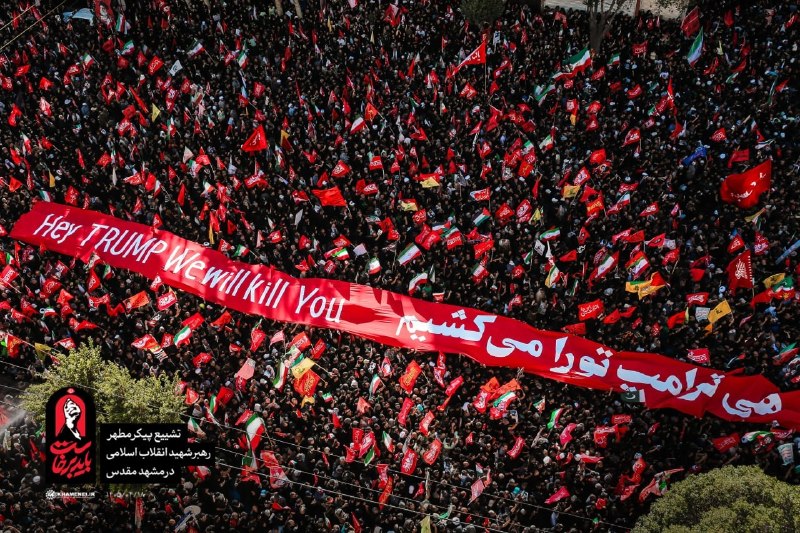
Mashhad filled with mourners on 9 July 2026 as the body of Iran's Supreme Leader, Ayatollah Ali Khamenei, was carried through the streets toward the Razavi shrine. State-aligned channels broadcast the procession in real time, and the framing was unmistakable: this was a state ritual aimed as much at Washington as at the domestic faithful.
The choreography matters because the rhetoric does. Tasnim News, the outlet closest to the Islamic Revolutionary Guard Corps, ran an on-the-ground dispatch at 15:28 UTC describing the cortege moving toward Khomeini's mausoleum — the holiest civic space in the post-revolutionary landscape. A second item at 15:35 UTC showed a long banner reading "mourners for revenge against the killer Trump" stretched along Imam Reza Street. By 15:57 UTC, the same outlet was circulating a line attributed to the founder of the Islamic Republic, Ayatollah Khomeini: that God has willed Iran to reach "the highest levels," and that the system itself is the vehicle. At 16:19 UTC, the technical logistics were being broadcast: the precise address of the portico of Dar al-Zhakr, the burial place of Khamenei's father, now revealed as the site of rest for the martyred leader himself.
The message, decoded
The four dispatches form a single editorial product. A funeral becomes a referendum — on the regime's resilience, on the succession, and on the external enemy. The founder is quoted so the founder sanctions the moment. The street is named — Imam Reza Street, the axis of Mashhad's identity — so the geography itself is mobilised. And the banner is photographed, not described, so the camera does the diplomacy.
A state-broadcaster can do two things with a transition of this scale. It can manage the mechanics: securing the body, choreographing the route, vetting the elegies. Or it can manage the meaning: choosing which founder-quote, which banner, which street name goes on the air. The Tasnim feed is doing both, and the sequencing — founder at 15:57, banner at 15:35, address at 16:19 — is a deliberate counter-programming to any external reading of Iranian politics as adrift.
What the wire is not yet saying
The Western agencies have so far run carefully framed pieces: confirmation of death, succession procedure, the role of the Assembly of Experts. None has yet had to parse the messaging inside the procession itself, which is where the next seventy-two hours of Iranian policy will actually be set. Coverage that defers only to the procedural language of official spokespeople will miss the substance. The banners and the founder-quotes are policy drafts, in the same way that a minister's interview is a policy draft.
The structural pattern is familiar: a state in transition uses funeral ritual to consolidate legitimacy and signal external posture simultaneously. The revolutionary generation ends, the second generation inherits, and the new leadership needs to show that the founder's mission is intact and the cost of testing it has been named. The English-language channel Tasnim operates is built for precisely this audience — foreign observers, regional chancelleries, and a global Shia readership — which is why the founder-quote and the banner are in English, not only Persian.
The counter-read
There is a plausible alternative reading. Iran-watchers in Washington and Europe have argued, after previous such moments, that the public choreography conceals a quieter, more contested succession — that the Assembly of Experts process is slower and more negotiated than the street-level messaging implies. The state-aligned feed, on that view, is over-claiming; the banners and the founder-quotes are compensating for intra-elite uncertainty rather than expressing unified resolve.
Both readings can be partly true, and the public materials so far do not let this publication choose between them. The Tasnim feed is designed to project unity; the absence of internal-elite friction from the feed is not, by itself, evidence of its absence. The honest position is that the regime is broadcasting confidence and that confidence is a posture, not a measurement.
Stakes
The immediate stakes are external. A leadership transition in Tehran, paired with banners naming a US president, is a signal to every Gulf capital and every negotiator in Vienna, Geneva, and Muscat about the cost calculus the new leadership intends to project. It is also a signal to the Iranian street about the price of dissent at the moment the founder-quote is being read aloud.
The longer stakes are structural. Iran's leadership has spent four decades building a state-broadcast apparatus that fuses civic ritual, founder-canon, and external enemy into a single usable product. The Mashhad procession is the latest proof that the apparatus still works. Whether it works at the scale of a US-Iran negotiation is a separate question — and one the next several weeks will answer more clearly than any single banner.
This publication read the Tasnim English feed between 15:28 and 16:19 UTC on 9 July 2026, and treated it as state-aligned primary source material rather than as neutral wire copy.
Wire provenance
This editorial synthesis draws on the following public wire/social posts:
- https://t.me/tasnimnews_en
- https://t.me/tasnimnews_en
- https://t.me/tasnimnews_en
- https://t.me/tasnimnews_en