Iran's rulers stage a funeral procession for a 'martyr leader' at Karbala's twin shrines — and the choreography tells its own story
Fars, Tasnim and Fars News International carried footage of a coffin procession between the shrines of Imam Husayn and Imam Abbas in Karbala in the early hours of 9 July 2026 — a tightly-scripted piece of shrine diplomacy that doubles as a regional message.
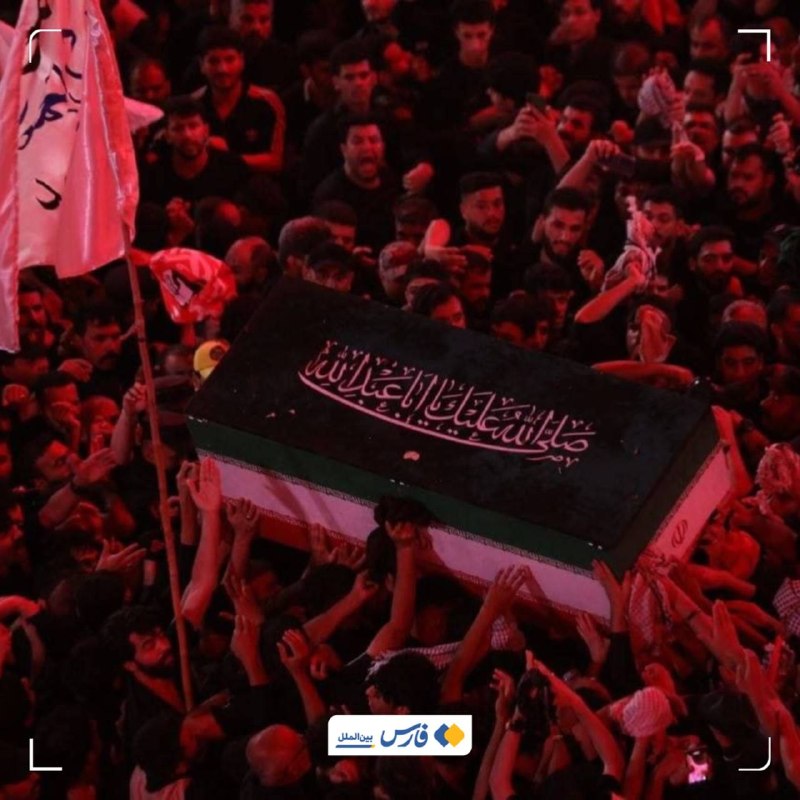
In the small hours of 9 July 2026, Iranian state media broadcast a carefully stage-managed procession through the Iraqi shrine city of Karbala. Fars News Agency's English-language channel carried footage of a coffin — described in its own captions as that of the "martyr leader of the revolution" — being lifted through what Fars identified as the Martyr's Gate of the Holy Shrine of Imam Husayn, then carried along the packed courtyard between the twin shrines of Imam Husayn and Imam Abbas. By 00:17 UTC the procession had moved to the Shrine of Abbas, with Fars noting that crowding between the two holy sites had forced organisers to slow the route. Tasnim News International added its own footage from inside the Husayn shrine, while Fars News International ran video of the recorded greeting to Imam Husayn being played over the shrine's loudspeakers. The sources do not specify the identity of the deceased, the date or cause of death, or the office held, and the official language ("martyr leader of the revolution") sits uneasily between religious register and political title.
What the four dispatches from Fars, Tasnim and Fars News International do establish is that a high-status funeral is being staged at one of Shia Islam's holiest sites, with all the logistical and security apparatus that implies. That, more than the identity of the deceased, is the news: Iran's state-aligned press choosing Karbala as the venue, in coordination with Iraqi shrine authorities, broadcasts a particular kind of authority to audiences in Tehran, Najaf, Basra and Beirut at the same moment.
The setting matters as much as the coffin
Karbala, in central Iraq roughly 100 kilometres southwest of the capital, is the site of the 680 CE killing of Imam Husayn at the hands of the forces of the Umayyad caliph Yazid — an event that anchors the martyrdom-centred strain of Shia identity and the annual Arbaeen pilgrimage that draws millions on foot from across the region. The twin shrines of Imam Husayn and his half-brother Abbas sit a few hundred metres apart across a courtyard that, on ordinary days, accommodates tens of thousands of pilgrims. Fars's footage shows that courtyard functioning as it does during the peak of Arbaeen — a tightly packed human corridor with the coffin held aloft.
That a body described as Iran's "martyr leader of the revolution" should be processed through those two shrines, rather than through a Tehran mosque or a public square in Isfahan, is a deliberate choice of stage. The audience that Fars, Tasnim and Fars News International are addressing is partly domestic — Iranians who follow shrine networks on Telegram and state television — and partly the wider Shia public across Iraq, Lebanon, the Gulf and South Asia, for whom a Karbala funeral carries an authority that no Iranian venue could replicate.
What the official framing tells us, and what it leaves out
The language used by the three outlets is consistent. Fars, in two dispatches timed to the move between shrines at 00:16 and 00:17 UTC, calls the deceased the "martyr leader of the revolution" and frames the procession as a passage through the Husayn and Abbas shrines. Tasnim News International, posting from inside the Husayn shrine at 23:25 UTC on 8 July, describes a "roaring sea of lovers of Imam Martyr" — a phrase that fuses the religious register of Husayn's devotees with the contemporary political vocabulary of "martyrdom" that the Islamic Republic has used since 1979 to honour its dead, from battlefield commanders to nuclear scientists assassinated during the early 2020s. Fars News International at 22:54 UTC carried audio of the recorded greeting to Imam Husayn inside the shrine.
Several facts are notably absent. None of the four items names the individual being carried; none gives a date or cause of death; none specifies which Iranian institution organised the transfer or which Iraqi authority authorised it; and none cites a named Iranian or Iraqi official. The sources do not specify whether the procession represents the office of the Supreme Leader, the Islamic Revolutionary Guard Corps, a specific martyred commander, or a parallel figure from a non-Iranian Shia axis. That silence is itself a clue: the event is being presented as a transnational Shia occasion rather than a state funeral for an identifiable officeholder, and the choreography is doing work that explicit attribution cannot.
The regional read: shrine diplomacy as power projection
Two structural patterns are visible underneath the footage. The first is the routine use of Karbala and Najaf as the symbolic stage on which Iranian-led Shia politics is performed. Iraq's holy cities sit inside Iraqi sovereignty, under Iraqi security and the administration of the Astan (shrine) authorities — and yet Iranian state media regularly produces live, prime-time coverage of Iranian figures moving through them, with Iraqi cooperation taken as a given. The second is the consolidation of a cross-border Shia media ecosystem: Fars, Tasnim and Fars News International, all of which carry the procession in real time on Telegram, reach audiences that overlap heavily with the readership of Iraq's Shia outlets and Lebanon's Hezbollah-aligned channels. A Karbala funeral, framed in the language of "martyr leader of the revolution" and broadcast on this network, lands simultaneously as grief, as theology and as a quiet assertion of who can speak inside the shrine.
A counter-reading is worth airing. Karbala's shrine authorities have their own institutional weight and their own Iraqi political constituencies — clerics around Grand Ayatollah Ali al-Sistani's office in Najaf, for instance, have spent two decades cultivating a strictly non-Iranian, apolitical Shia authority. A high-profile Iranian-organised procession through Karbala could be read not as a seamless display of Iranian reach but as a friction point: a reminder that Iranian and Iraqi Shia hierarchies compete for the same sacred ground. The footage published so far does not let this publication settle the question; it shows coordination, not the politics around it.
What remains uncertain
The most basic facts — who has died, when, and of what — are not in the four dispatches available to this publication. Fars's "martyr leader of the revolution" could plausibly describe a serving or former senior official, a long-dead historical figure whose remains are being reinterred, or a recently killed commander whose death Iranian outlets have not yet named explicitly. The sources do not specify the institutional affiliation of the deceased, the role of the Iraqi Astan in authorising the procession, the security forces managing the corridor between the shrines, or whether senior Iranian or Iraqi officials are present. Until those gaps are filled by a primary obituary or an Iraqi interior ministry statement, the procession's full political weight — mournful tribute, shrine diplomacy, or something more pointed — will remain open to competing readings.
Stakes
For Tehran, a Karbala funeral staged in the language of martyrdom projects two messages at once: that the Islamic Republic retains the standing to command the holiest Shia sites, and that its dead, however defined, belong to a community that stretches across the Iranian border into Iraq. For Baghdad, hosting the procession is a low-cost affirmation of cross-sectarian Shia ties and a quiet counter to pressure from Gulf capitals and Washington to limit Iranian footfall in the shrine cities. For the wider region, the test will be whether the event closes cleanly — whether the body is interred in Karbala, returned to Iran, or processed further south — and whether the official identification, when it comes, narrows or widens the political audience the footage was designed to reach.
Desk note
This piece relies entirely on four Telegram dispatches from Iranian state-aligned outlets (Fars, Tasnim, Fars News International) dated 8–9 July 2026. Monexus has not yet been able to cross-reference the procession with Iraqi state media, Astan press releases, or independent reporting from Karbala; the sources do not specify the deceased's identity, so the article presents the event as a piece of choreographed shrine politics rather than as an obituary. Readers should treat the official "martyr leader" framing as Iranian regime vocabulary, not as an independently verified title.
Wire provenance
This editorial synthesis draws on the following public wire/social posts:
- https://t.me/farsna
- https://t.me/farsna
- https://t.me/tasnimnews_en
- https://t.me/FarsNewsInt
- https://en.wikipedia.org/wiki/Karbala