IRGC claims ballistic-missile strike on US-linked airbase in Jordan; Pentagon casualty picture unclear
Tehran's Revolutionary Guard says it fired ten ballistic missiles at a US-linked airbase in Jordan, the most direct Iranian claim against American military infrastructure since the regional war began.
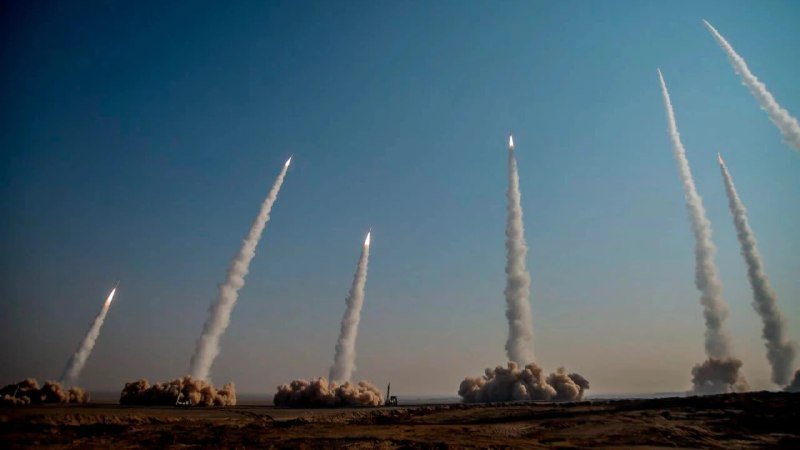
The Islamic Revolutionary Guards Corps said on Thursday, 9 July 2026, that it had fired ten ballistic missiles at the Muwaffaq Salti Air Base in Jordan, a facility long used as a hub for US and allied air operations in the Levant. In a statement carried by Iranian-aligned Telegram channels and summarised by open-source monitors, the IRGC said the barrage targeted US military infrastructure at the base, including a command-and-control node. The claim, issued around 13:16 to 13:21 UTC, marks the most direct Iranian-state attribution of a missile strike on US-linked infrastructure in Jordan since the current regional war began.
What is being asserted, and by whom, is unusually explicit for an IRGC announcement. The Guard named the base, named the type of munition — ballistic missile — and supplied a count. That is a deliberate signal: the language of an organisation that wants the strike read as state policy, not as deniable proxy fire. The framing matters because the choice of Muwaffaq Salti, a base used by US and partner air crews for years, pushes the confrontation onto Jordanian sovereign territory and onto a long-standing bilateral US-Jordanian defence arrangement.
What the claim contains, and what it omits
The IRGC statement, as carried by open-source monitors, specifies three pieces of information: the target (US military infrastructure at Muwaffaq Salti), the munition class (ballistic missiles), and a quantity (ten). It does not specify the missile variant, the time of impact, or the damage assessment. Crucially, it does not claim US or Jordanian casualties — a notable omission that is itself a piece of information. Strikes announced in this register are usually calibrated to claim an operational effect without committing the issuer to a casualty figure that can be checked and contradicted by the targeted party.
Iranian-aligned channels in the Telegram ecosystem moved in lockstep within minutes of the announcement, republishing the IRGC framing verbatim and adding claims about air-defence activity overhead — language consistent with a package designed for speed of distribution rather than independent corroboration. Jordanian and US authorities had not, as of the timestamp of the report, issued a confirmation of impact, casualty figures, or damage assessments.
Why Muwaffaq Salti, and why now
The base sits roughly 70 kilometres east of Amman in the Jordanian desert and has hosted US and allied air assets, including fighters and surveillance platforms, for two decades. Its selection is not incidental. Muwaffaq Salti is the textbook example of a forward-deployed Western air hub on Arab-soil territory: Jordanian sovereignty, US and partner use, broadly understood but rarely named in Iranian communiqués. An IRGC strike there says several things at once. It says the geography of the confrontation has widened beyond the Levant's coastline. It says Iranian ballistic-missile reach is being publicly demonstrated, not implied. And it puts Jordan in the position of having to answer, publicly, for the presence of foreign military infrastructure on its soil at the moment that infrastructure is being struck.
The timing is no less deliberate. The strike is announced in a week in which the regional war's air campaign has produced a running debate in Western capitals about the scope of the response, about escalation management, and about what would constitute an Iranian red line. A claim of ten ballistic missiles on a US-linked base in a third country is the kind of headline that resets that debate on the Iranian side's terms.
The structural frame, in plain prose
Read for what it is, this is an exercise in calibrated escalation. The IRGC has not announced a strike on the US homeland, on a US carrier, or on Israeli territory. It has announced a strike on a forward base in a third country, with the target framed as infrastructure rather than personnel. That is the language of an actor that wants to register a cost — political and operational — without committing to the kind of retaliation that would force a full US reply. It is also the language of an actor that wants its claim to dominate the next news cycle, and that is preparing the diplomatic ground for a moment when the claim can be walked back, narrowed, or quietly absorbed into a wider negotiation.
The corollary is that the Iranian state is treating this phase of the war as a public-claims environment, not only a military one. The missile is one instrument; the statement is another. The selection of channels — official IRGC lines mirrored by Iranian-aligned Telegram accounts — is a third. The point is to set a frame before any independent damage assessment can be produced, on either the Jordanian or the US side.
What remains contested, and what to watch
The open-source picture as of 13:21 UTC on 9 July 2026 is single-sourced on the Iranian side: the strike is described in IRGC language, carried by Iranian-aligned channels, and reported by monitors without independent confirmation of impact or effect. There is no confirmed Jordanian military statement on damage, no confirmed US Central Command damage assessment, and no confirmed casualty figure from any party. The pattern of Iranian-aligned Telegram traffic in the minutes following the announcement is consistent with a pre-packaged release rather than a flow of battlefield reporting.
Two scenarios bracket what could come next. In the first, the strike is real, the damage is limited, and the framing becomes a basis for escalation management — a measured Iranian act met by a measured Western reply, with Jordan caught in the middle as host. In the second, the strike is oversold in the announcement and under-delivered on the ground, and the next 24 to 48 hours of casualty and damage reporting determine whether the claim survives contact with the evidence. Either way, the immediate test is the same: the Pentagon's first formal statement on damage, and the Jordanian armed forces' first formal statement on whether the country's airspace and sovereign base were in fact struck.
For Western capitals, the harder question is not the IRGC's claim but its choice of target. A ten-missile announcement aimed at a base that has been quietly central to allied air operations for years is, in effect, a public argument that the geography of this war no longer respects the lines drawn around it at the start of the campaign. That argument will outlast whatever the actual damage at Muwaffaq Salti turns out to be.
This publication notes that the reporting above rests on Iranian-state and Iranian-aligned sourcing for the strike claim itself. Monexus will update the casualty and damage picture as Jordanian, US and independent-wire reporting becomes available.
Wire provenance
This editorial synthesis draws on the following public wire/social posts:
- https://t.me/osintlive
- https://t.me/FotrosResistancee
- https://t.me/AMK_Mapping