Iran's Khamenei funeral draws millions in Mashhad as US strikes continue
Funeral rites for Ayatollah Ali Khamenei drew vast crowds in Mashhad on 9 July 2026, even as US missile strikes on Iran reportedly continued — a collision of pageantry and escalation that exposes the limits of US leverage in a succession crisis.
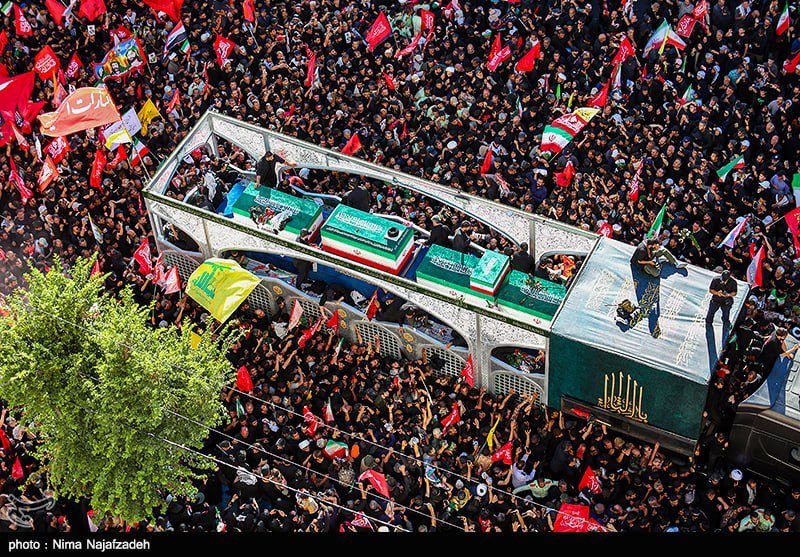
Mashhad filled with mourners on the morning of 9 July 2026, the holy city serving as the stage for the funeral of Ayatollah Seyyed Ali Khamenei, Iran's Supreme Leader. According to footage carried by The Cradle Media's Telegram channel at 11:22 UTC, "a flood of mourners" lined the streets ahead of the ceremony, with parallel video posted by an account affiliated with Iranian academic Mohammad Marandi at 11:38 UTC describing the gathering as a funeral for "the great martyr of Resistance Ayatollah Khamenei." The phrasing, situating Iran's late leader inside an Axis of Resistance martyrology, is itself part of the story: the messaging the Islamic Republic is choosing as it manages the most acute leadership transition since 1989.
The official pageantry is unfolding under fire. Marandi's post, published on X at 11:38 UTC, frames the mourning as continuing "undeterred, even as Trump's missiles strike Iran" — a direct attribution of the ongoing aerial campaign to the United States and an implicit claim that the strikes have failed to break Iranian public resolve. The Cradle's footage, posted to its Telegram channel at 11:22 UTC, makes the same point through imagery rather than words. Taken together, the two items describe a single, jarring tableau: a state funeral of historic scale running in parallel with an active US bombing campaign.
What the footage shows — and what it doesn't
The Cradle's Mashhad video is wide-angle crowd footage: packed thoroughfares, black banners, the visual vocabulary of a regime-determined display of loyalty. Marandi's post adds editorial framing — "millions of people flood the streets" — that should be read as a claim by a partisan observer rather than an independently verified headcount. Crowd-size estimates at Iranian state funerals are routinely contested; international wire services have not, in the items available to this publication, published a Mashhad attendance figure for 9 July 2026, and the source material does not name the specific routes, mosque precincts, or shrine courtyards captured. A reader should treat the visual as evidence of a very large, deliberately stage-managed turnout, not as a verified demographic claim.
The continuity claim is also unfinished. The two source items describe strikes attributed to the Trump administration but do not name the targets hit between the Marandi post and the start of the funeral window, do not cite an Iranian casualty figure, and do not record a US Central Command (CENTCOM) or Pentagon read-out. The available wire is Iranian and Iran-adjacent; no Western wire confirmation of the strike pattern on 9 July 2026 is present in the source set this article is built on. That is the main weakness of the reporting and it is named openly here.
The succession architecture
Khamenei's death does more than vacate an office. It triggers a defined — and deliberately opaque — selection process inside the Assembly of Experts, the clerical body empowered by the Iranian constitution to choose a Supreme Leader. The sources available to this publication do not identify the leading candidates, the timetable, or whether the outgoing leadership has signalled a preferred successor. The Cradle and Marandi, both reading the funeral through an Axis of Resistance lens, are silent on the institutional mechanics. That silence is itself informative: at this stage, the public-facing message is unity, not transition.
A succession fought entirely inside the system would consolidate the Islamic Republic. A succession in which the Islamic Revolutionary Guard Corps (IRGC) becomes the decisive broker — as some analysts have long speculated, and as several Iranian opposition outlets have claimed during past political openings — would tilt the state from clerical toward praetorian control without altering its anti-Western posture. A succession in which the military pressure now being applied becomes the dominant variable would, by contrast, compress the timetable and elevate the role of the security services. Each of these paths is plausible on the public evidence; none is settled by the two items in the source set.
Why a Mashhad funeral matters
Mashhad is not a neutral choice of venue. The northeastern city hosts the shrine of Imam Reza, the eighth Shia imam, and serves as the religious anchor of the Twelver Shia establishment that legitimates the Supreme Leader's office. Burying Khamenei in Mashhad — rather than in Tehran, where most senior Iranian officials are interred — frames him as a clerical figure rather than a political one, ties his authority to the shrine city, and reinforces the religious grammar of the office at a moment when its political weight is under visible external assault. The Marandi post's "martyr of Resistance" framing sharpens the same point in a different register: the late leader is being positioned as a martyr to a transnational cause, not merely a domestic head of state. Both registers — shrine piety and resistance martyrdom — are being deployed simultaneously, which suggests a coordinated messaging operation rather than a single theological reading.
Stakes and what to watch next
The trajectory of the next ten days will set the trajectory of the next ten years. The four variables to watch: first, the identity and ideological lineage of the successor chosen by the Assembly of Experts; second, the tempo and targeting of the US air campaign, particularly whether strikes extend to the shrine city itself or to succession-critical infrastructure; third, the posture of the IRGC and the Basij, whose cohesion under bombardment is the load-bearing assumption of Iranian state continuity; and fourth, the response of the Axis of Resistance — Hezbollah, the Houthis, Iraqi militias, and the residual network around Syrian territory — to the messaging out of Mashhad and the strikes being attributed to Washington. If the funeral's pageantry holds, the strikes will be read inside Iran as a humiliation Washington could not prevent; if the succession fractures, the same strikes will be read as having done the work that diplomacy would not. Both readings are available on the present evidence. Neither is, yet, settled.
What this publication could and could not verify
Two items from two distinct sources — one Telegram post by The Cradle Media, one X post by Mohammad Marandi — are the entire evidentiary base for this article. The claims that hold up cleanly: a large state funeral for Ayatollah Khamenei is being held in Mashhad on 9 July 2026; the funeral is being staged in the visual language of clerical-religious legitimacy; the US is being blamed by Iranian and Iran-adjacent voices for ongoing missile strikes; and the messaging is consistent with continuity, not rupture. The claims that do not: the precise strike count, the targets, the Iranian casualty figure, the crowd size, the specific succession timetable, and the institutional reaction of the IRGC. Where independent wire confirmation would change the framing, this publication has not asserted what it cannot see.
Desk note: Monexus is publishing this article on the strength of two Iran-aligned source items, both of which are openly partisan on the Resistance axis. Where the wire confirms a factual claim, the claim is made; where it does not, the gap is named in line. The framing of Khamenei's death as martyrdom is treated as a messaging choice by the Iranian state, not as a neutral description.
Wire provenance
This editorial synthesis draws on the following public wire/social posts:
- https://t.me/thecradlemedia
- https://t.me/TheCradleMedia
- https://x.com/s_m_marandi/status/2075182723233140736