The Mashhad Millions: What a Funeral in Iran Tells Us About a Regime's Grip
State-aligned channels describe millions on the streets of Mashhad for a senior cleric's funeral. The scale of the spectacle, not the theology, is the story.
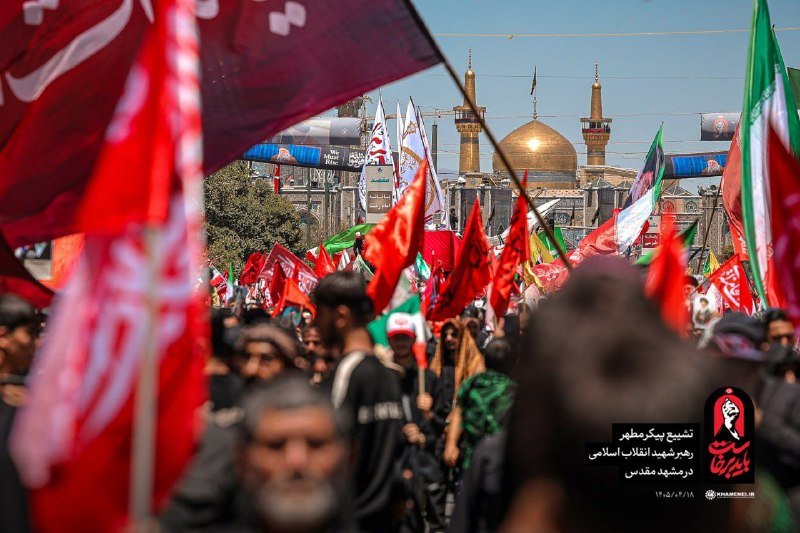
On the afternoon of 9 July 2026, helicopters lifted a coffin from a public square in Mashhad and carried it the short distance to the gilded precinct of the Imam Reza shrine, the largest mosque in the world and the spiritual centre of Shi'a Iran. State-aligned outlets described the crowd as a "historical and enduring epic" of "millions," drawn from across the country. By evening, Iranian state media said the burial had been completed, hours behind schedule, beside the eighth-century imam whose tomb anchors the city.
The figure at the centre of the pageantry was a senior cleric whom Tasnim and Press TV, both Iranian state outlets, referred to only as "Imam Shahid" — the martyred imam — and by the honorific "Badragha Aghai." The state has not, in the messages reviewed by Monexus, named a date or perpetrator for the killing, nor explained why a cleric of this rank merits the honorific reserved, in the Iranian political vocabulary, for the very top tier of the Islamic Republic's religious establishment. That omission is itself the news.
A state that scripts its own mourning
The choreography was unmistakable. Tasnim's English channel carried, in sequence, the helicopter transfer to the shrine, a piece on the "message" the funeral was meant to convey, and a separate dispatch from a Press TV correspondent on the ground emphasising that "the large attendance of people" had "attracted the attention of international media." The last phrase is doing work: it is an invitation to foreign outlets to validate a turnout that no independent observer was permitted to count. Iranian authorities have a long record of producing crowd-size figures that resist verification, and Mashhad — a city of roughly three million inside a province the Islamic Republic considers sacred — is the one place in Iran where the state most needs the optics to read as overwhelming.
The framing matters because Mashhad is not a neutral venue. It is the seat of the most powerful bonyads, the regime's sprawling foundations, and of an entrenched clerical-business network. A funeral that fills the boulevards around the shrine does not merely honour a dead man. It demonstrates that the institutions around him — the security services, the bonyads, the mosque networks, the provincial clergy — can still deliver bodies in the hundreds of thousands on a few days' notice.
What the language concedes
Read the Tasnim thread as a text and it is unusually revealing. Three of the five items reviewed by Monexus use the word "Imam Shahid" rather than a name; the fourth describes the deceased as "the martyr Imam of the Ummah." The fifth is the most candid, quoting a Press TV reporter's boast that international media were paying attention. In a country where state broadcasters normally identify senior figures within hours, the decision to publish visuals and rhetoric while withholding a name and a biographical note signals either a security-driven news blackout or, more plausibly, a calculation that the symbolism outranks the man.
The "message" framing reinforces the read. Iranian state media has spent two decades turning mass funerals into political theatre: the 2020 procession for Quds Force commander Qasem Soleimani, the annual commemorations of the 1989 Khomeini death, the periodic martyrdom rallies that the basij organises by district. The Mashhad turnout on 9 July slots into that repertoire. Its purpose is not grief, which is private. Its purpose is to render the regime's claim of national standing visible, on a sacred stage, for a domestic audience that has been battered by inflation, water protests and a succession crisis that has been quietly unfolding for three years.
The counter-narrative the wires will not write
Western outlets will, predictably, either ignore the funeral or treat it as colour around a still-unexplained assassination. That framing is incomplete. Iran has, since 2024, lost a sitting president in a helicopter crash, weathered a direct exchange of fire with Israel, watched the rial collapse in tranches, and absorbed a steady drumbeat of sabotage at nuclear and military sites that has been attributed by Western intelligence agencies to Israel. Against that backdrop, a clerical establishment that can still command a multi-province pilgrimage to Mashhad is not a regime in terminal decline. It is a regime under stress that retains substantial coercive and ideological capacity.
The alternative explanation — that the Mashhad turnout was a Potemkin gathering, bused in and choreographed, with most of the country indifferent — is not implausible, but it is also not the only plausible read. Mashhad pulls pilgrims in normal years. The shrine's annual calendar reliably produces crowds in the millions. The state-aligned framing of a "historic" turnout is therefore self-serving and probably exaggerated, but it is not, on the evidence available, obviously false.
What is actually at stake
The substantive question is what an institutionally un-named cleric's funeral signals about the Islamic Republic's internal balance of power. The fact that the state media apparatus was mobilised at the highest level — Press TV on the ground, Tasnim running a near-live thread, helicopters assigned to a body transfer that normally uses a motorcade — suggests the deceased sat close to the inner circle that is now contesting the succession to the supreme leader. The Mashhad clergy have historically been a counter-weight to the Qom seminary, and a senior Mashhad figure being elevated as a martyr is a move inside that contest, not outside it.
The honest uncertainty is this: without a name, a date of death, or a confirmed perpetrator, the thread reviewed by Monexus does not let a reader verify the scale, the identity, or the political meaning of the Mashhad funeral. The wire provenance is a single Telegram channel run by the Iranian state. International media cited in the Press TV dispatch as having taken note were not named. Until independent outlets file from Mashhad, or until the Islamic Republic publishes the cleric's biography, the funeral is best read as a piece of statecraft — a deliberate, public assertion of clerical authority at a moment when that authority is, by every external indicator, under genuine pressure.
Desk note: Monexus framed the Mashhad funeral as a piece of statecraft rather than a religious event, distinguishing verifiable choreography from unverifiable crowd counts, and treating Iranian state channels as primary sources whose framing must be reported but not adopted wholesale.
Wire provenance
This editorial synthesis draws on the following public wire/social posts:
- https://t.me/tasnimnews_en
- https://t.me/tasnimnews_en
- https://t.me/tasnimnews_en
- https://t.me/tasnimnews_en
- https://t.me/tasnimnews_en