A funeral in Mashhad, and the question Tehran has not answered
State-aligned channels are broadcasting a choreographed farewell in Mashhad. The political question — who actually runs Iran now — remains unanswered in public.
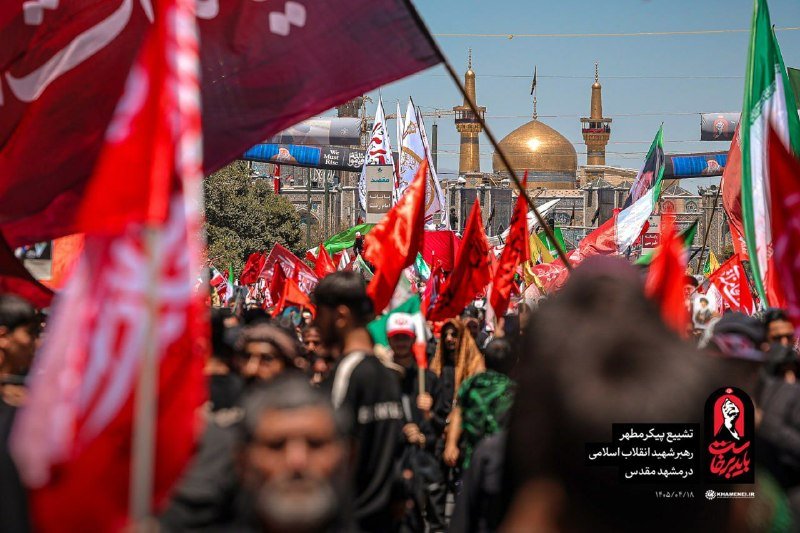
Mashhad was a managed city on 9 July 2026. Hours before the vehicle carrying the late Supreme Leader's body reached the shrine of Imam Reza, khamenei.ir's English-language Telegram channel was already publishing aerial footage of the cortege and amplifying the chants of a crowd that had been told to gather. By 14:48 UTC, the channel was running drone shots of the procession inching toward the shrine. By 15:10 UTC, the same channel was broadcasting a line that framed the event not as an ending but as a transfer of grace: "Our martyred Leader and his successor are great blessings to us." The choreography is the message. The substance is not.
The Islamic Republic has now lost the man who held the system together for almost four decades, and the public-facing text being pushed through state-aligned channels is calibrated to do something very specific — to project continuity rather than contest. The vocabulary ("martyred Leader," "pure body," "successor") is deliberately theological. The image-management is deliberately austere. And the silence around the actual mechanics of succession is deliberate too.
A succession that exists only in slogan
What Tehran is willing to say out loud is that there is a "successor" and that this person is a "great blessing." The khamenei.ir channel has now used that formulation twice in the space of two hours. What it has not done is name the person, define the role, or explain the constitutional pathway. The Islamic Republic's 1989 amended constitution sets out a multi-stage process — the Assembly of Experts nominates, the Supreme Council reviews, the new leader is announced — but the public-facing communications apparatus of the state is treating those steps as if they were either self-executing or beside the point. The slogan does the work that the institutions are not.
That is itself a tell. When a system is confident in its procedure, it lets the procedure speak. When it is anxious about the procedure — about factions, about the street, about what an open contest would reveal — it speaks in liturgy instead.
The frame the regime wants you to read
Three pieces of framing are being pushed simultaneously. The first is martyrdom: the leader did not die, he was "martyred." The term sanctifies him and, by extension, sanctifies the structure he led. The second is family continuity: the procession carries "the pure bodies of the martyred Leader and his martyred family members." Several relatives died in the same incident, and the state is folding them into a single sacred narrative rather than a single accident or attack. The third is geographic resonance: the route through Mashhad, Iran's second-largest city and home to the shrine of the eighth Shia Imam, is a deliberate borrowing of legitimacy from a place the system does not fully control and a figure it did not appoint.
None of this is evidence of weakness on its own. Iran has handled political theatre well for decades, and Mashhad's clerical establishment is closely tied to the centre of power. But the volume of the messaging — drone footage, crowd chanting, repeated slogans — is the volume a state produces when it needs the audience to feel a thing rather than know it.
What the counter-read looks like
A more sceptical read does not require any leap of faith. The "successor" formulation is being used in the conditional register of a slogan, not in the indicative register of an announcement. The Assembly of Experts has not been shown on Iranian state television deliberating. No senior jurist has been named in the briefings this publication has reviewed. And the family-of-the-leader framing — embedding the late leader's relatives in the procession and the language — raises an obvious question the official channels are not asking publicly: is the hereditary instinct that the Islamic Republic formally rejected in 1979 quietly back inside the building, dressed in martyrdom vocabulary?
The honest answer is that the sources available to a reader outside Iran do not yet settle this. State-aligned channels are not in the business of resolving open questions; they are in the business of foreclosing them.
The structural read, in plain language
What we are watching is a hegemonic succession under stress. The Islamic Republic's authority rested, in practice, on a single person arbitrating among the clergy, the Revolutionary Guards, the bazaar, and the street. The arbitration is now vacant. The slogans are not filling it; they are performing the absence. In systems built on a single arbiter, the interregnum is the danger — and the state's instinct during an interregnum is to compress time, to make the transition look inevitable before the actors inside the system have finished fighting it. The Mashhad procession is exactly that: time being compressed in public so that more time can be bought in private.
The stakes, in concrete terms
If Tehran can produce a named successor inside days, accepted by the Guards, the clerical establishment and a quiescent street, the system absorbs the shock. If it cannot, the bargaining moves from the shrine in Mashhad to the offices of the Assembly of Experts in Qom, and from there to the bazaar and the street. Iran's regional posture — the axis of resistance, the nuclear file, the relationship with the Gulf monarchies — all of it is downstream of which of those two outcomes obtains. The Mashhad footage is beautiful. The question it is designed to make you forget is the only one that matters.
What remains genuinely uncertain
The sources available to this publication — the khamenei.ir English Telegram channel and its three posts on 9 July 2026 — tell us only what the Iranian state wants an outside audience to see and hear. They do not name the successor. They do not name the members of the late leader's family whose bodies are in the procession. They do not specify the cause of death. They do not name the members of the Assembly of Experts currently meeting, if any are. Each of those is a question a serious reader is entitled to ask. None of them, on the evidence currently on the wire, has a public answer.
Desk note: Monexus is reporting the Mashhad procession from the only materials the Iranian state itself has chosen to publish in English on 9 July 2026, and is flagging in-line the limits of what those materials establish. The point of the piece is not to second-guess Iranian sovereignty but to insist that a state which tells its audience the answer should also publish the question.
Wire provenance
This editorial synthesis draws on the following public wire/social posts:
- https://t.me/Khamenei_en
- https://t.me/Khamenei_en/1
- https://t.me/Khamenei_en/2
- https://t.me/Khamenei_en/3