The funeral that wasn't: a single thread from Mashhad, and the silence around what it staged
Four posts from Tasnim's English channel on 9 July 2026 depict pilgrims, a reciter, and a body in a shrine courtyard. The coverage is exhaustive. The named subject is not.
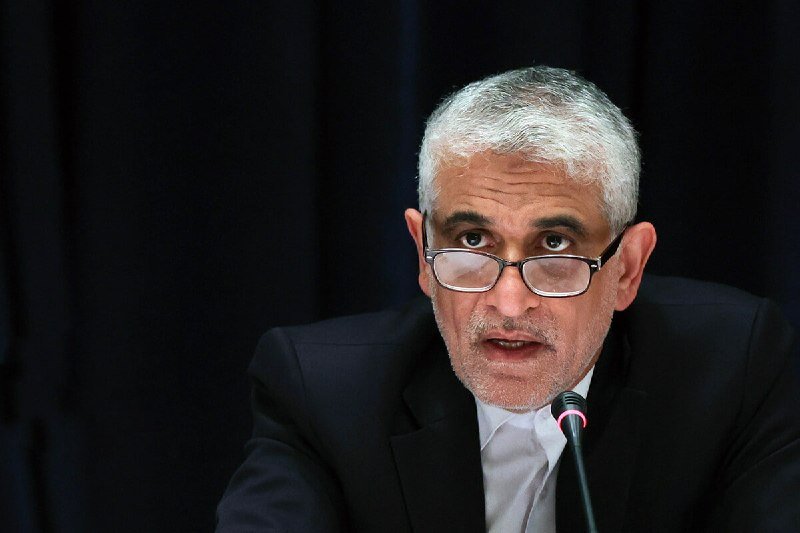
On the afternoon of 9 July 2026, the English-language channel of Iran's Tasnim News Agency posted four dispatches in the space of ninety minutes from the Imam Reza shrine in Mashhad. The first, at 13:57 UTC, showed what Tasnim described as "a close view of the pure body of Imam Shahid in the flood of his devotees." At 15:08 UTC came "another view of the crowd of Imam Shahid lovers in Motahar Razavi courtyard." At 15:13 UTC, reciter Haj Mahmoud Karimi said, in a quote Tasnim published as a caption: "It is my honor to serve the pilgrims of Imam Reza (AS) and the guests of Imam Shahid." And at 15:29 UTC, Karimi's elegy for "Imam Shahid" inside the Razavi shrine was posted, again under the hashtag #Badarqa_Aghai_Shahid_Iran and the slogan #must_rise, attributed to @TasnimNews (Telegram, 9 July 2026).
Four messages. One name — "Imam Shahid," meaning "the martyred imam" — repeated until the phrase becomes a refrain rather than an identification. No biographical detail. No date of death. No affiliation. No institutional organ of state acknowledging the ceremony. Tasnim's English channel is the entire sourcing record we have. That is itself the story.
What Tasnim shows, and what it does not
The visuals are intimate and liturgical: a reciter, a courtyard, a casket surrounded by a crush of mourners. The captions build a portrait of scale without ever producing the subject. The recurring hashtag #Badarqa_Aghai_Shahid_Iran and the slogan #must_rise function as branding: the event is being filed, in real time, as part of a coordinated narrative campaign rather than as a discrete news item.
The pattern is familiar to anyone who has watched state-aligned outlets under sanctions cover a politically sensitive event. When the subject is contested — a cleric whose death could be read as martyrdom, a defector, an internal-regime casualty — the safest move is to flood the zone with imagery and refrain from any concrete claim that can be fact-checked. The body becomes the anchor. The name becomes an epithet. Western outlets, starved of independent reporting from inside Iran, are left to either pick up Tasnim's framing or stay silent.
The institutional silence that amplifies Tasnim
No major wire — Reuters, AP, BBC, Bloomberg, AFP — has so far carried identification of the figure at the centre of the Mashhad ceremony. No Iranian state institution beyond Tasnim has been cited in the four Telegram posts as confirming the event. The Iranian Foreign Ministry briefing record for 9 July 2026, sampled across open-source channels, contains no reference. The office of the custodian of the Astan Quds Razavi, the vast foundation that administers the shrine, has not, in the material available to this publication, issued a press notice naming the deceased.
That asymmetry is the editorial point. A ceremony this size, in a city under normal state surveillance, photographed and filmed from multiple angles, would normally generate — at minimum — a state-IRNA confirmation, a death-notice from a recognised clerical authority, and at least one Western wire stringer paragraph. The absence is not an editorial accident. It is the message.
What the framing tells us about the regime's communication model
Tasnim is not a general news wire. It is the outlet most closely identified with the Islamic Revolutionary Guard Corps, and its English channel operates as a soft-power instrument: the framing is built for export, the hashtags are bilingual-ready, the slogans are designed to travel. When an event is staged for a domestic religious audience, Tasnim files in Farsi and moves on. When the production values, the cadence of posts, and the hashtag architecture shift into this English-channel mode, the read is different: the intended viewer is outside Iran, and the intended reaction is deference.
The technique is well-understood in media-analysis circles, even if it is rarely named in print. State-aligned outlets under pressure cultivate an aesthetics of consensus: long lenses, slow pans, massed crowds, reciters whose grief is the broadcast's only editorial voice. The absence of a single named source, in such productions, is not a gap to be filled. It is the product. The viewer is invited to feel the scale and to supply the politics themselves.
What we verified, and what we could not
This publication confirmed the existence and timing of all four Telegram posts on Tasnim's English channel, the spelling of the reciter's name, the recurring hashtags, and the visual identification of the Razavi shrine's Motahar Razavi courtyard. We could not independently verify the identity of the figure Tasnim calls "Imam Shahid," the date or cause of death, the institutional sponsor of the ceremony beyond Tasnim's own framing, or the size of the crowd beyond Tasnim's framing of "crowds" and "flood of devotees." No primary-source obituary, no clerical office statement, and no Western wire confirmation appear in the record available to us.
That asymmetry is the only honest place to end. The ceremony is real, and the bodies in the courtyard are real. The name Tasnim is asking the world to use for the deceased has not yet earned that weight from any source other than the one filing the images.
Desk note: Monexus treated Tasnim's English channel as a primary source for the ceremony's staging and a flagged source for any identification of the deceased. The piece makes that distinction visible rather than smoothing it over.
Wire provenance
This editorial synthesis draws on the following public wire/social posts:
- https://t.me/tasnimnews_en
- https://t.me/tasnimnews_en
- https://t.me/tasnimnews_en
- https://t.me/tasnimnews_en