Rhetoric, Markets, and the Geometry of an Undeclared Air War: Reading the Trump–Iran Flare-Up of July 2026
Within a single 24-hour window on 8–9 July 2026, the US president publicly declared a wartime ceasefire over, threatened Iran's bridges and power plants, and posted an AI image of a strike on Chabahar. The verbal escalation was faster than any kinetic event.
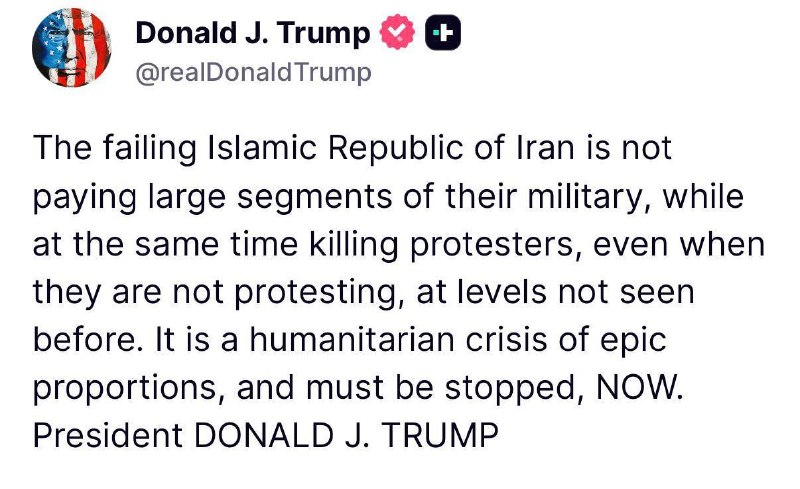
At 13:15 UTC on 9 July 2026, an image circulated from a Telegram channel that has become a fast-moving wire for Middle East signals: a screenshot of a Truth Social post by Donald Trump showing an AI-generated rendering of a US strike on Iran's port of Chabahar, captioned in part, "This is in retribution for yesterday's bombing of ships by Iran. If it happens again, it will get much worse." Within the same 24-hour window, the same channel had relayed the president's earlier statement that "to me, I think it's over" regarding the Iran ceasefire, his line that "Iran has been defeated," his threat to "knock down every single bridge" of the country, his warning that he "would hate to strike desalination plants" but might have to, his assertion that Iran may try to kill him, and — from a separate market-data feed — the single-line summary: "Trump says the Iran ceasefire is over and markets may now have another reason to de-risk."
The shape of what happened on 8–9 July is unusual even by the standards of a US–Iran relationship that has normalised brinkmanship. No major kinetic event has been publicly confirmed. There is no reporting, in the source material, of an actual strike on Chabahar, no Iranian retaliatory attack on Gulf shipping that the US administration has documented in primary form, and no breakdown of negotiations from named Iranian officials. What there is, instead, is a saturation burst of presidential rhetoric, paired with an AI illustration of a strike that has not occurred. The verbal escalation has run ahead of the kinetic one. Markets, on the evidence of the trading-desk feeds, are treating the rhetoric as the event.
A ceasefire declared dead before its corpse is cold
The sequence matters. At 16:37 UTC on 8 July, Trump told reporters, "Iran has been defeated," a victory claim that, on its face, presupposes an end to hostilities rather than a renewal of them. Forty minutes later, at 17:17 UTC, he moved to the menu of destruction: bridges, electric plants, "if we have to." At 17:37 UTC, he declared the ceasefire finished: "To me, I think it's over. I don't want to deal with them anymore. They're scum." At 18:17 UTC came the personalisation — "I may be gone too, because I'm their number one target." At 21:31 UTC, an apparent walk-back: "I don't think the Iran war will start again." Then, on the morning of 9 July, the Chabahar post and the trading-desk reposts summarising the position as markets-relevant.
Two readings are compatible with that record. The first is the literal one: a US administration calibrating pressure in real time, using presidential social media as the lever, with the AI image functioning as a delivery mechanism for the threat rather than a description of a strike. The second is the bargaining reading: an administration attempting to flatten Iranian negotiating posture by collapsing the distinction between rhetoric and action, hoping Tehran cannot tell which is which and prices the worst case into any future posture. Both readings place enormous weight on presidential speech as a strategic instrument. Both also depend on an audience — financial markets, Gulf shipping insurers, European chancelleries, Israeli planners — that has to take the threat at face value long enough for it to do work.
The "ceasefire is over" framing deserves separate scrutiny. A formal ceasefire is a documented arrangement between identifiable parties. The source material contains Trump's characterisation of the ceasefire as finished, and a market-feed summary repeating that characterisation. It does not contain an Iranian foreign ministry statement rejecting the arrangement, a UN observer confirmation that hostilities have resumed, or a maritime incident report from a recognised tracking service. The word "ceasefire" here may be doing more rhetorical than legal work — labelling an irritant as a regime so that a subsequent strike can be framed as a response to a breach rather than an initiation.
The Chabahar image as signal, not as evidence
Chabahar is a specific object. It is a deep-water port on Iran's southeastern coast, on the Gulf of Oman, developed as Iran's answer to Pakistan's Gwadar and as a node in Iran's east-bound trade corridors toward India, Central Asia, and Afghanistan. A US strike on Chabahar would not be a generic escalation; it would be a strike on a piece of infrastructure that has economic and symbolic value distinct from, say, an oil refinery at Abadan or a missile site in Isfahan. It would also be visible to international shipping in a way that an inland strike would not.
The image circulating in the 13:15 UTC Telegram post is presented as an AI rendering. There is no corroborating satellite imagery, no wire-service confirmation, no Iranian state-media response to an actual strike. The image therefore functions as a forecast, not a report. Its purpose, in the logic of the post itself, is to attach a specific target — Chabahar — to a specific threat — "this is in retribution" — in advance of the act. Whether the act follows is, in the moment of the post, the open question that the post is designed to foreclose.
Two competing readings of the AI image are plausible, and the source material does not adjudicate between them. The first is that it is signalling — an attempt to set the price of any Iranian action by making clear that the target list has been drawn and published. The second is that it is performance — a president building a visual record of his own decisiveness for a domestic audience, with the target chosen for symbolic rather than operational reasons. Both are consistent with the pattern of the preceding 24 hours, in which the president moved across a wide spectrum of threat registers — desalination plants, bridges, electric plants, assassination — without producing a single verifiable kinetic event in the source feed.
What the markets heard
The trading-desk framing is austere and deserves its own close reading. The line circulated at 08:59 UTC on 9 July from a venture-focused feed was: "Trump says the Iran ceasefire is over and markets may now have another reason to de-risk." The same line was repeated, in identical words, from a second channel two minutes later. That replication pattern is itself a signal: the line has been cut-and-pasted across feeds that monitor the same upstream source, which is a strong indication that the underlying post originated upstream and was redistributed for downstream consumption rather than independently reported.
"De-risk" is a specific verb in trading vocabulary. It does not mean panic. It means a measured reduction in exposure to assets whose variance is about to rise: oil futures, Gulf shipping-linked equities, Iranian-neighbour currencies, defence-sector shorts. If the operative scenario for trading desks on the morning of 9 July was a renewed US–Iran kinetic exchange, the price action one would expect is a bid into crude, a bid into defence equities, a soft bid into gold, and a softer bid into anything denominated in or correlated with the Iranian rial or the Iraqi dinar. The source material does not contain the corresponding price prints; it contains the upstream text that would justify such moves if they occurred.
This matters for the framing of the story. The event, in the trading-desk rendering, is not a strike. The event is the verbal collapse of a ceasefire. The distinction is more than semantic. A strike produces wreckage, casualty figures, a UN emergency session, a confirmed oil-supply disruption. A verbal collapse produces a margin call. The two have different downstream consequences for different actors. Iran, the UAE, and the small Gulf petro-states are exposed to the first kind of event. Holders of US equities in retail brokerage accounts are exposed to the second.
Structural frame: rhetoric as a substitute for strategy
What is unfolding is a familiar pattern in modern coercive diplomacy, dressed in new clothes. A great power with a capable but overstretched military instrument threatens a regional adversary with a target list, in public, repeatedly, and via channels that include AI-generated imagery. The adversary is invited to read the threat at face value, then is invited to read subsequent restraint as mercy rather than choice. The audience beyond the two principals — markets, allies, domestic constituencies — is invited to treat each new threat as if it were the last warning before action. The economics of the pattern is that the threat costs less than the strike, but does most of the strike's work, if credibility holds.
The credibility problem is structural. The same president who has declared Iran defeated, declared the ceasefire over, threatened bridges and power plants, threatened desalination, said he might be assassinated, walked the war risk back within hours, and then posted an AI image of a strike — has, on the source material, conducted no publicly verified kinetic operation against Iran across the window. An audience that tracks the full sequence can read the threats as discounted. An audience that catches only the latest item cannot. The asymmetry favours the loudest single message rather than the most credible overall pattern, and presidential social media is engineered for the loudest single message.
The structural stakes extend beyond the US–Iran bilateral file. Gulf shipping insurance rates, Indian port-of-call decisions on Chabahar-bound cargo, Chinese refining margins on Iranian crude, European Union sanctions enforcement posture, and Israeli operational planning all price the credibility of the threat. So does the credibility of the ceasefire as a diplomatic instrument: if a ceasefire can be declared dead by a single social-media post, then ceasefires as a category are weaker than they were a week ago. The market data feed that summarised the position as a reason to "de-risk" is, in that sense, also de-risking the diplomatic category.
Stakes, contested ground, and what remains unverified
The principal winners of the present trajectory are those who already hold hedges — Gulf-state sovereign wealth funds with diversified exposure, defence-sector equities long the volatility, oil producers with spare capacity, and political actors on all sides who benefit from a posture of perpetual near-war. The principal losers are Iranian civilians, who would absorb the kinetic consequences of any actual escalation; Gulf shipping workers, who would absorb the maritime consequences; and the credibility of multilateral diplomacy, which loses a category every time a public post substitutes for a documented agreement.
What remains genuinely contested in the source material is whether the verbal escalation has produced any operational reality. The source feed contains no Iranian strike on Gulf shipping that the US administration has corroborated in primary form — the Chabahar post refers to "yesterday's bombing of ships by Iran" as the alleged trigger, but the source material does not name the vessels, the route, the owner, or the flag state. It contains no Iranian official denial and no Iranian official confirmation. It contains no maritime-tracking confirmation. The trigger for the threat is therefore as rhetorically constructed as the threat itself, and a reader interested in the underlying events would need to wait for primary confirmation from the affected shipping lines, the relevant naval coordination centres, or the Iranian foreign ministry before treating the alleged ship bombings as established fact.
The same caveat applies to the ceasefire itself. The source material contains Trump's characterisation that the ceasefire is "over," a market-feed summary repeating that characterisation, and a separate market-feed summary repeating it again. It does not contain a counter-statement from Iranian authorities. A reader interested in whether the ceasefire, as a documented instrument, has been formally terminated would need to wait for an Iranian foreign ministry briefing, a UN observer statement, or a confirmed breakdown in a named channel of bilateral communication. Until then, the strongest reading supported by the source material is narrower than the headline: the US president has declared a wartime ceasefire finished, has threatened a specific list of targets including a specific Iranian port, has published an AI rendering of a strike that has not occurred, and trading desks are treating the verbal posture as a market-moving event.
The geometry of the moment, on the evidence available, is rhetorical rather than kinetic — and the markets, the Gulf shipping insurers, and the diplomatic record will each price that distinction on its own clock.
This article was framed as a structural read of presidential rhetoric as a substitute for, or precursor to, kinetic action. Where wire services have led with the threat, this publication has led with the gap between the threat and the verifiable event.
Wire provenance
This editorial synthesis draws on the following public wire/social posts:
- https://t.me/myLordBebo
- https://t.me/producthunt
- https://t.me/AngelList
- https://x.com/unusual_whales/status/1
- https://x.com/unusual_whales/status/2
- https://x.com/unusual_whales/status/3
- https://x.com/unusual_whales/status/4
- https://x.com/unusual_whales/status/5
- https://x.com/unusual_whales/status/6