US strikes on Iranian vessels near Bandar Abbas raise questions about escalation and civilian exposure
Two separate Telegram channels reported a heavy explosion and US strikes on Iranian boats near Bandar Abbas on 9 July 2026. The framing and timing of the incident is now in dispute.
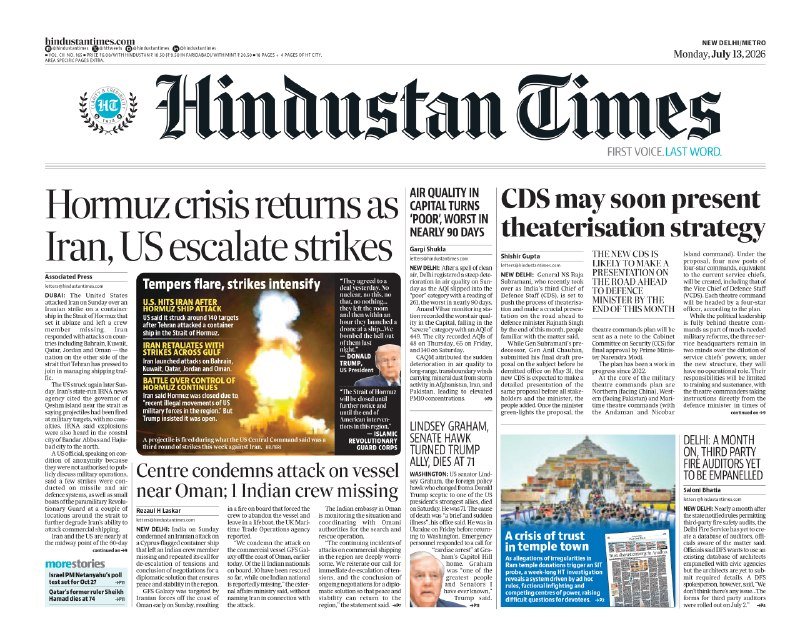
A heavy explosion was reported audible across the Iranian port city of Bandar Abbas at roughly 06:06 UTC on 9 July 2026, according to the Telegram channel Intelslava, with the news framed as a US operation against an Iranian target. Within hours, the Cradle Media account on Telegram — a Beirut-based outlet that has consistently published in opposition to Western intervention in the region — was circulating photographs purporting to show a prior strike on the same city, and accusing the United States of "bombing Iranian fishing boats while telling the world it is targeting IRGC fast-attack boats". The competing accounts, posted within minutes of each other across two ideologically opposed channels, capture the information problem that has come to define the US–Iran confrontation at sea: kinetic action is well-documented; the classification of the boats involved, and therefore the public legitimacy of the strikes, is not.
What is unambiguous, as of 15:00 UTC on 9 July 2026, is that the United States has conducted at least one kinetic action near Bandar Abbas within the past 24 hours, and that Iran is characterising that action as an attack on its civilian maritime community. What remains contested — and what matters for the trajectory of escalation — is what was actually struck, by whom, and under what rules. Until those questions are answered by Western wire reporting or an official briefing from either capital, the event exists in the gap between a US strike doctrine aimed at fast-attack craft and an Iranian narrative that places ordinary fishermen in the line of fire.
The strike, as far as it can be reconstructed
The earliest item to surface in the thread context is a single sentence posted by Intelslava — a Telegram account that aggregates military and conflict reporting, often relying on open-source imagery and audio — flagging a "heavy explosion sound" in Bandar Abbas, the main Iranian naval and commercial port on the Strait of Hormuz, at 12:06 local Tehran time (06:06 UTC). The post did not specify a target. Telegram channels of this kind function as signals rather than confirmation; their value is in compressing a moment of activity into a timestamp that more established outlets can then pursue.
Later in the morning, at 11:31 UTC on the same day, the Cradle Media channel — explicitly sympathetic to the Iranian-led "axis of resistance" framing of regional politics — published an accusation that the United States was targeting Iranian fishing boats rather than Islamic Revolutionary Guard Corps (IRGC) fast-attack craft, while referencing photographs of the aftermath of "the previous attack on Bandar Abbas". The phrasing implies that this is at least the second US action against Iranian vessels in or near the port in recent days, though the channel does not date or specify the prior incident. The post is presented as commentary and curated imagery, not as primary reporting.
The 2026 attacks on Iran described by these two channels are not unique events. US Central Command has, on repeated occasions since 2024, described destroying Iranian-origin fast-attack craft in the Gulf of Oman and the southern Persian Gulf as part of a doctrine aimed at denying Iran the ability to disrupt commercial shipping. The Cradle's specific allegation — that civilian fishing vessels are being hit instead — is a more pointed claim than "collateral damage": it asserts misidentification or mis-targeting at the operational level. The sources available to this publication do not include a US Department of Defense, US Central Command, Pentagon, or Iranian armed forces briefing against which that claim can be independently tested.
Why the framing matters
The Strait of Hormuz is the world's most consequential maritime chokepoint for crude oil transit. Roughly a fifth of global seaborne petroleum passes through the strait each year, along with a substantial share of liquefied natural gas from Qatar. Even a partial disruption forces tanker operators to re-route or delay, and the world oil market prices in that risk on a near-instantaneous basis. Any kinetic action by the United States against Iranian vessels close to the Iranian coast therefore carries an economic signal well beyond its military effect: it tells the market that the US is willing to escalate at the point where an Iranian attempt to close the strait would begin.
The Cradle Media framing — which foregrounds civilian fishermen and frames the US as targeting a livelihood rather than a weapons system — sits inside a wider argument that has been advanced by Iran, by Hezbollah-aligned commentators, and by a number of editorial pages in the Global South for several years. That argument holds that the Western security architecture in the Gulf routinely treats Iranian boats as suspect by default, and that the legal threshold for lethal action against them has fallen to a level that bystanders cannot verify. It is, in essence, a critique of the rules of engagement as much as of any specific strike. The counter-argument, articulated in Washington briefings and in commentary from outlets including the Wall Street Journal and Reuters, is that the IRGC Navy's fast-attack fleet and the IRGC's fast-boat raid doctrine deliberately intermingle civilian and military craft, making distinction hard to enforce under combat conditions. Both arguments can be true simultaneously; the open question is which one applies on 9 July 2026.
Where the public record thins
No major Western wire — Reuters, the Associated Press, the BBC, Bloomberg, the New York Times — appears in the thread context for this incident, and no government readout (a Pentagon statement, a US Navy Central Command release, an Iranian armed forces statement carried by FARS or Press TV) is in the public ledger available here. That absence is not unusual in the first hours of a Gulf incident; Western outlets typically require confirmation from a named US official or from a combatant-command press desk before publishing attribution. Until that confirmation arrives, the visible record consists of (a) a single anonymous signal from a Telegram aggregator and (b) a partisan accusation from a regional outlet that has both the motive and the editorial position to characterise events in a particular way.
The two channels do not, in this writer's reading, contradict each other on what physically happened: an explosion was heard in Bandar Abbas, and US forces have been operating against Iranian-type boats in the Gulf under the same doctrinal umbrella for at least the past eighteen months. They contradict each other on the meaning of the event. For US Central Command, a destroyed fast-attack craft is a defensive success; for an Iranian-aligned outlet, a hit fishing boat is evidence of a war crime. The truth between those poles — and the identity of every vessel destroyed or damaged — is the work of the next 24 to 72 hours of reporting.
What is at stake over the coming week
Three trajectories are plausible. The first is contained: the strikes are confirmed as legitimate hits on military craft, Iranian rhetorical response is calibrated, and the oil price impact fades within the trading session. The second is escalation: Iran retaliates asymmetrically — through proxy attacks in Iraq or Syria, a harassment of commercial shipping, or a direct IRGC Navy strike on a US vessel — and the US responds in kind. The third is investigative: the civilian-casualty claim is corroborated by independent reporting, generates a domestic political backlash inside the United States, and forces the administration to publish operational rules that it had previously kept classified.
Each trajectory implies a different role for press coverage. The first will be dominated by official confirmation; the second by wire reporting under deadline pressure from multiple theatres; the third by the kind of slow, document-driven investigation that rarely publishes inside 72 hours. As of 15:00 UTC on 9 July 2026, none of these has begun in earnest through any source available to this publication. Readers should treat the Telegram-sourced claims in the thread above as signals of an event, not as a settled account of one.
How Monexus framed this: where the available record is restricted to Telegram channels of opposed editorial positions, we report what is and is not verifiable, name the asymmetry, and stop short of attributing the strike to civilian casualties until a Western wire or a government readout can be cited.
Wire provenance
This editorial synthesis draws on the following public wire/social posts:
- https://t.me/intelslava
- https://t.me/TheCradleMedia
- https://t.me/thecradlemedia