US strike hits Iranian rail bridge near Turkmen border as Golestan becomes latest flashpoint
A pre-dawn US strike on a strategic railway bridge in Iran's northeast, near the Turkmenistan border, marks a deliberate targeting of transit infrastructure — and the clearest signal yet that Washington's campaign is reaching for corridors, not just commanders.
A pre-dawn US strike on 9 July 2026 hit the Aq-Tekeh Khan railway bridge in Iran's Golestan Province, the channel Fotros Resistance reported at 09:58 UTC, with corroborating imagery posted by War Footage Witnesses at 09:22 UTC. The bridge sits in Aqqala county, close to the Turkmenistan border — the northeastern corner of the country, far from the Persian Gulf concentration of US naval firepower. The targeting is striking less for its novelty than for what it implies about escalation logic: Washington is reaching for corridors, not just commanders.
The strike lands at a moment when the geography of US pressure on Iran is shifting visibly inland. The targeting of transit infrastructure in a border province suggests that containment of Iran's regional footprint is no longer the operational frame; degradation of Iran's internal connective tissue is.
What was hit, and where
Three Telegram channels — Fotros Resistance, English-language analyst Abuali, and War Footage Witnesses — independently converged on the same target within roughly thirty-six minutes of one another, an unusual degree of corroboration for a developing strike. According to the Fotros channel, the strike hit a transit bridge and rail line in Aqqala, in Golestan Province, near the Turkmenistan border; the channel identified the location precisely enough to place it on any map of northeastern Iran. Abuali, posting at 09:56 UTC, described the bridge as part of a strategic corridor — language that points to logistics significance rather than mere local infrastructure. War Footage Witnesses posted alleged strike imagery at 09:22 UTC and cited Iran's Fars News Agency as confirming the strike on the Aq-Tekeh Khan railway bridge in Aqqala county.
The geography matters. Golestan Province is not where Iran's nuclear or missile programmes are based. It is, however, where the Iranian rail network reaches up toward the Central Asian republics and, beyond them, to China via the Turkmen corridor. A bridge there is a node in transit, not a node in weaponry. That distinction is the substance of the story.
What the targeting implies
US strikes on Iranian military and proxy assets have been documented for months. What changes with the Aq-Tekeh Khan strike is the object. Hitting a railway bridge near a land border is a different category of action than striking a missile production site or a headquarters. The infrastructure serves civilian and commercial traffic alongside any military logistics that may have moved across it.
Iranian state media, through outlets such as Fars, has framed the strike as an attack on strategic infrastructure. That framing is not self-evidently propaganda; the rail lines in Golestan Province do, in fact, carry cross-border trade. The structural question is whether the US is willing to absorb the diplomatic cost of degrading Iran's east-west transit links — the routes that connect it to the broader Eurasian land bridge — at a moment when Tehran's eastward orientation is the very thing Washington has been trying to reverse.
The corridor question
Iran sits on one of the most consequential transit geographies in the world. Its rail and road network connects the Persian Gulf to the Caucasus, Central Asia, and the Turkmen routes that feed into Chinese and Russian overland trade. For the United States, a functioning Iranian corridor extends Tehran's commercial and diplomatic reach in directions that offset Western pressure. For Iran, those corridors are an economic lifeline under sanctions and a diplomatic counter-weight to Western isolation.
Striking a bridge in Golestan is, in this reading, not a tactical move but a structural one. It degrades the instrument by which Iran projects connectivity eastward. If the pattern continues — bridges in Golestan, road links in Sistan-Baluchestan, port facilities on the Gulf of Oman — what emerges is not an Iran that is militarily weaker but an Iran that is commercially more isolated. That is a longer game than the air campaign itself suggests, and it raises a question the wire coverage has not yet addressed: whether Washington is preparing to negotiate from a position of corridor denial, or whether the strikes are intended to remain at the level of military pressure without crossing into economic strangulation.
What remains uncertain
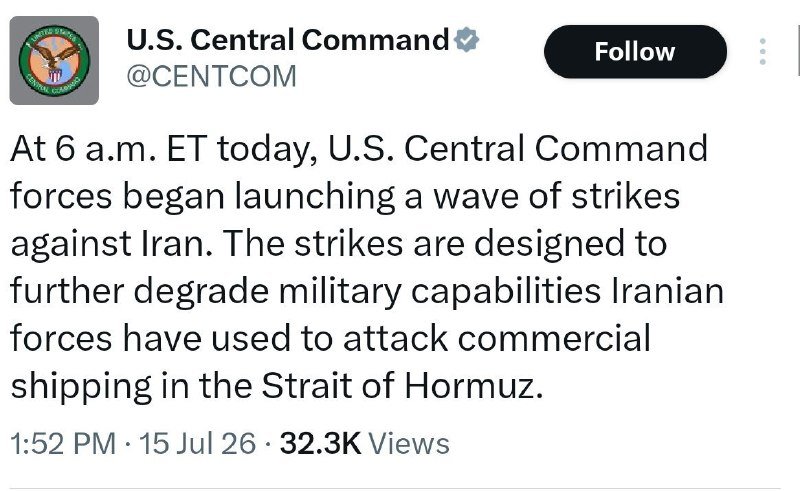
The sources do not specify the scale of damage to the Aq-Tekeh Khan bridge, nor do they confirm casualties. Fars's confirmation, cited by War Footage Witnesses, establishes that the strike occurred; the operational and humanitarian footprint of that strike is, as of 09:58 UTC on 9 July 2026, still being assessed. There is also no indication in the available reporting of an Iranian retaliatory action, an official US statement, or a Turkmen response — the silence from Ashgabat is itself notable, given that the bridge sits within reach of its border.
The dominant framing — that the strike signals a shift toward corridor targeting — is structurally plausible but not yet corroborated by a wider pattern. One bridge is a data point, not a doctrine. The next forty-eight hours will determine whether Aq-Tekeh Khan is the start of a campaign or an outlier within it.
Desk note: the wire cycle is currently leading on the strike as an event; Monexus is leading with the geography — what it means that the target is in Golestan rather than in Khuzestan or Isfahan. The corridor frame is the analysis; the strike itself is the news.
Wire provenance
This editorial synthesis draws on the following public wire/social posts:
- https://t.me/FotrosResistancee
- https://t.me/englishabuali
- https://t.me/wfwitness