A killing in Dartmoor, and the public stage Ann Widdecombe long occupied
A former Conservative minister is dead in Devon, a 26-year-old man is in custody, and the commentary class is already reaching for the era she came to define.
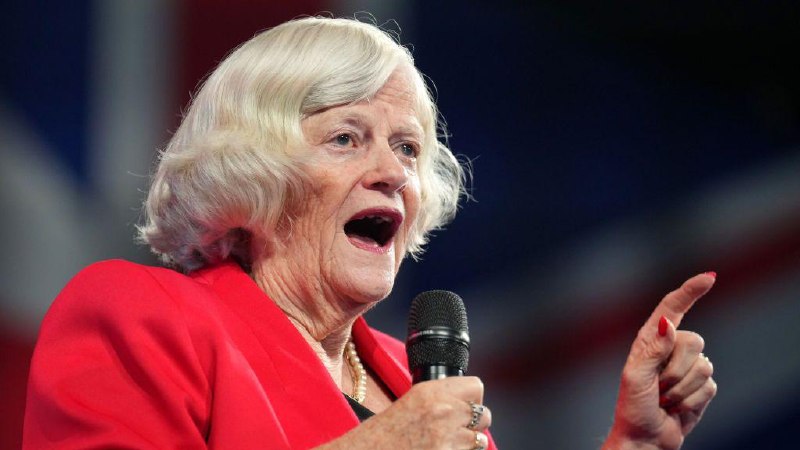
Devon and Cornwall Police have launched a murder investigation into the death of Ann Widdecombe, a 78-year-old former Conservative minister, found with serious injuries at her home in Haytor on the edge of Dartmoor on 9 July 2026. A 26-year-old British man has been arrested on suspicion of murder, according to Sky News reporting carried into public circulation by the open-source channel Open Source Intel on 10 July. The force has not named the suspect; the case is in its earliest hours, and the published details are thin.
Widdecombe spent two decades in the Commons, served as a minister across three Conservative governments, and became one of the more polarising figures in late-twentieth-century British politics. The manner of her death, and the speed with which the commentariat has begun to fold it into the cultural argument she once embodied, is itself the story.
What we know, and the order in which we know it
The first public statement came from Devon and Cornwall Police confirming a murder investigation. Open Source Intel, monitoring UK wire output, recorded the force's announcement at roughly 16:51 UTC on 10 July 2026, noting Widdecombe's age and the Dartmoor location; a separate post at 17:21 UTC recorded the arrest of the 26-year-old, citing Sky News video. The arc is conventional for the first hours of a serious crime: a senior regional force goes public, the national broadcaster confirms the arrest, and the rest of the press takes its cue from those two.
What is not yet in the public record: the suspect's relationship, if any, to the victim; the cause of death; whether the home was secured on arrival of the first officers; the timeline between the injury and the call that brought police to the address. The force has given a location — Haytor, on the eastern edge of Dartmoor — and an age. That is the entirety of the verified factual perimeter.
The Widdecombe question the commentariat cannot resist
Within minutes of the Sky bulletin, the predictable industry of memory was underway: clips of her Commons rows, her reality-television appearances, her Brexit-era commentary, her earlier social-conservative positions reshaped for a younger audience that only knew her as a talking head. The reflex is familiar. When a public figure dies violently, the production line that monetises their image — archives, podcasts, cable-news panels — switches on, and the dead woman becomes a prop for arguments she did not pick.
There is a defensible journalistic reason to revisit her career. Widdecombe crossed the Commons in 1987 and stayed until 2010, voting through Maastricht, Northern Ireland's ceasefires, devolution, the Iraq inquiry era, and the financial crisis. She was a minister under Thatcher, Major, and Hague, and her signature battles — over Section 28, over the Maastricht rebellion, over Catholic moral teaching inside a Westminster majority — were the political culture of her moment. To the extent that culture shaped the present Conservative Party, she is part of its archaeology.
The less defensible version is the one already trending online: a reduction of a long, internally contradictory career to a single caricature, then the use of her death as a cudgel in arguments about immigration, crime, or the cultural right. That is the path of least resistance, and it ought to be resisted. A 78-year-old woman is dead in Devon. The public interest is in what happened, who is responsible, and whether anything could have prevented it. The rest is commentary.
The structural pattern, stated plainly
Public deaths in Britain now travel through a recognisable pipeline. A force statement goes up; Sky or the BBC confirms the central facts; within the hour, partisan accounts on both sides have the case slotted into their preferred narrative — rising violent crime, falling violent crime, a rural idyll violated, a rural idyll that never existed. The pipeline moves faster than the investigation. By the time detectives brief the press properly, the framing is already fixed in millions of feeds.
This is not new. It is the cost of a media system in which the marginal cost of publishing is zero, the marginal cost of being wrong is negligible, and the reward for being first is large. The Haytor case will be no exception: expect a week of speculation shaped less by Devon and Cornwall's investigative pace than by whatever cultural argument needs a peg on 10 July.
What to watch over the next seventy-two hours
The first scheduled press briefing from Devon and Cornwall will set the contours. Watch for: confirmation of the suspect's identity and any prior contact with the victim; whether the force treats the address as a crime scene in the standard forensic sense; whether firearms or a knife is named as the instrument of injury, or whether the force withholds that detail pending post-mortem. Watch also for whether the suspect is charged, remanded in custody, or bailed — that single decision will telegraph what the Crown Prosecution Service thinks it has.
Beyond the procedural, the more telling question is whether the national press treats the case with the restraint the early hours demand, or whether it does what the pipeline always does: imports a regional tragedy into the Westminster argument before Devon and Cornwall have finished their house-to-house work. The family of a dead former minister, like any family, is owed the space in which facts can outrun interpretation.
The Monexus desk framed this as a developing criminal investigation first, and as a political-media story second — inverting the order the wire cycle has already imposed on it.
Wire provenance
This editorial synthesis draws on the following public wire/social posts:
- https://twitter.com/Osint613/status/2075628126093124085/video/1
- https://t.me/s/osintlive