Damascus bombings during Macron visit expose a fragile counter-terror balance
A cell described as affiliated with ISIS has been blamed for a string of Damascus bombings timed to coincide with President Macron's visit, exposing how thin Syria's post-Assad security architecture still is.
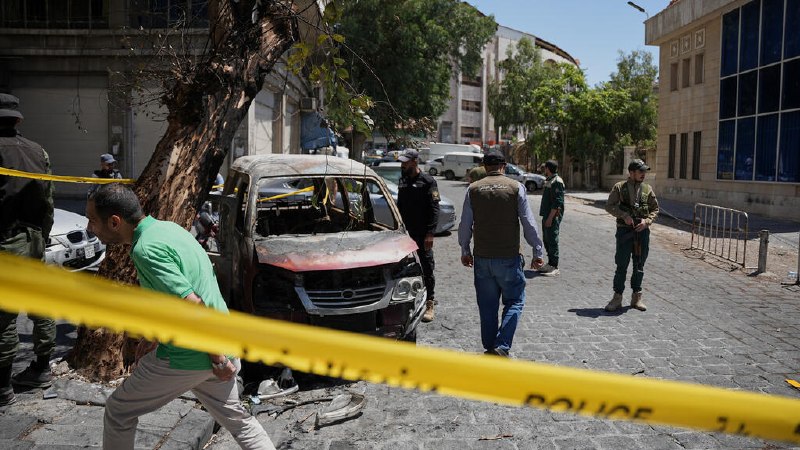
On Thursday 9 July 2026, Syrian authorities said they had detained several suspects accused of carrying out a string of bombings in Damascus, including attacks that coincided with a working visit by French President Emmanuel Macron. The interior ministry in Damascus described the network as a cell "affiliated with ISIS," in the formulation carried by France 24's Arabic service and repeated in the English-language report by the same broadcaster. France 24's English dispatch, timestamped 2026-07-09T23:00 UTC, frames the arrests as a security operation conducted under the eyes of a Western head of state whose presence in the Syrian capital had become, by design, a symbolic marker of normalisation between Paris and the post-Assad government.
The bombings matter less for their tactical novelty than for what they reveal about the seams in Syria's counter-terror architecture fourteen months after the central government in Damascus changed hands. A European presidency can land in the city, lay a wreath, hold a joint press conference, and still find that the streets around him remain contestable. The arrests are a demonstration of capability; the bombings that preceded them are a demonstration of the opposite.
What Syrian authorities have said
According to France 24's English and Arabic reports, the Syrian interior ministry on Thursday announced the arrest of what it described as those responsible for the two bomb attacks, and labelled the cell one "affiliated with ISIS." The ministry did not, in the wire material available, give a specific operational breakdown of the devices, the targets, or the casualty count beyond the initial French reporting that flagged a "series of bombings" in the capital. The framing — ISIS-affiliated, pre-emptive arrests, no group-claim broadcast by the attackers themselves — is consistent with the way Damascus has handled other foiled plots since the transition of power: name the network, attribute the cell, leave the operational detail to subsequent court processes.
This pattern of disclosure carries its own politics. An arrest narrative that closes the file in 24 hours tells Western visitors, foreign intelligence partners, and the domestic Syrian public three things at once: the state can detect, the state can reach, and the state does not need outside boots to do either. Each of those claims is being tested by events, and the Syrian government has an interest in the test resolving in its favour.
Why the timing of the visit mattered
Macron's trip to Damascus was not a routine stop. The visit functioned as the public face of a longer European re-engagement with a Syrian government whose legitimacy had been contested for more than a decade, and whose recent change of leadership opened a narrow diplomatic window. A successful bombing during such a visit would have done more than kill people; it would have punctured the argument, made in Paris and other Western capitals, that pragmatic engagement with the new Damascus is a defensible security policy.
France 24's Arabic dispatch notes that the bombings were reported "during" the French president's visit, a wording that draws the reader's eye to the temporal overlap without committing the wire to a claim of intentional targeting. That careful phrasing — "during," not "targeted at" — is itself the point. The factual record, as carried by the available wire reporting, is that the attacks happened while Macron was in the capital. Attribution of intent to the cell, or to the broader ISIS brand, rests on the Syrian interior ministry's own characterisation.
The counter-narrative: how thin the attribution really is
A cell described by Damascus as "affiliated with ISIS" is, at this stage of reporting, exactly that — a cell described by Damascus as affiliated with ISIS. The label performs useful work for the Syrian state. It places the violence inside a recognised counter-terror taxonomy, which is the vocabulary Western security services and ministries are most comfortable processing. It also limits the diplomatic damage: a foiled ISIS cell is a story about policing, not about governance failure.
There are at least two readings of the events that the available reporting does not yet foreclose. The first is that the cell genuinely was an ISIS franchise or a self-radicalised local group that re-adopted the brand, and that the Syrian interior ministry's attribution is accurate. The second is that the label has been applied quickly for political reasons, and that the underlying network may have different affiliations — criminal, sectarian, opposition-aligned, or some mixture — that the ministry prefers to fold into a single recognisable threat category. The wire material available does not include an independent confirmation from a Western intelligence service, from the UN, or from an opposition monitor. The reader is, for now, working from the Syrian state's own account.
What the episode exposes structurally
Three structural pressures sit underneath this story. The first is the asymmetry of counter-terror capacity across Syria's provinces: Damascus city, where foreign dignitaries are hosted, is the most heavily surveilled square kilometre in the country, and yet it remained penetrable enough for a multi-site bombing during a presidential visit. If the capital can be hit, the second- and third-tier cities — where the foreign-camera presence is thinner and the intelligence liaison weaker — are more exposed.
The second is the diplomatic economy of the visit itself. Macron did not come to Damascus to endorse the Syrian government in unqualified terms. He came because the alternative — a Syria that talks only to Moscow and Tehran and a handful of Gulf capitals — is worse for European interests in migration, counter-terror, and the regional balance. That is the same calculation that has drawn other European leaders into a slow, partial re-engagement. A successful bombing on his watch would not have ended the policy, but it would have raised its domestic political cost inside France sharply.
The third is the unreliability of brand-based threat assessment. ISIS as a territorial project collapsed years ago. What remains is a brand that local actors invoke for fundraising, recruitment, or the simple reason that claiming an attack in its name buys media coverage. Western agencies have spent the better part of a decade arguing, in public, that "ISIS" is not a single organisation but a permission slip. The Syrian interior ministry's use of that label, in a politically charged setting, is the same permission-slip dynamic running in reverse.
What we verified, and what we could not
Verified from the available wire material: Syrian authorities announced the arrests on Thursday 9 July 2026; the suspects are accused of bombings in Damascus during Emmanuel Macron's visit; the network is described by Damascus as affiliated with ISIS. Both the English and Arabic France 24 dispatches carry the substance of these claims, with the Arabic version adding the explicit "affiliated with ISIS" formulation in quotation marks.
Not verified in the available wire material: the exact number of suspects detained; the number of devices used; the specific targets struck; any casualty figures; any independent confirmation from French intelligence, the UN, or a Western-allied monitoring body; any claim of responsibility issued under the ISIS brand from an external channel. The wire reporting available to Monexus as of 2026-07-10 is the Syrian interior ministry's account, as relayed by France 24's two services. It is a starting point, not a conclusion.
The stakes if the trajectory continues
If the Syrian interior ministry's framing holds up — operational cell, ISIS affiliation, arrests before further attacks — the political effect is to consolidate the diplomatic opening that Macron's visit represents. Paris will be able to argue that engagement bought real security cooperation, and that the European re-engagement track is paying dividends in the language of intelligence services and interior ministries.
If the framing does not hold — if subsequent reporting attributes the cell to a different network, or if the casualty record turns out to be heavier than the initial accounts suggest, or if the timing of the visit is shown to have been deliberately targeted — the cost lands inside French domestic politics first and European Syria policy second. A failed security operation during a presidential visit is a story that does not stay inside the region. It travels.
For Damascus, the trajectory that matters is credibility with European interior ministries, not press coverage. The arrests are a deposit in that account. Whether they clear depends on what is in the cell — and on what, in the days ahead, independent reporting can confirm.
Desk note: Monexus has carried the Syrian interior ministry's framing as given by France 24, and flagged the attribution as the Syrian state's own characterisation rather than an independently verified conclusion. Subsequent reporting on casualty figures, the identity of the cell, and any claim of responsibility from outside the Syrian government's own account will be incorporated as it becomes available.
Wire provenance
This editorial synthesis draws on the following public wire/social posts:
- https://t.me/france24_en
- https://t.me/france24_fr