DRC's Ebola outbreak is now a surveillance failure, and the numbers won't sit still
Four in five Congo Ebola patients have no known contact — a metric that exposes just how far ahead of the official case count the virus has moved.
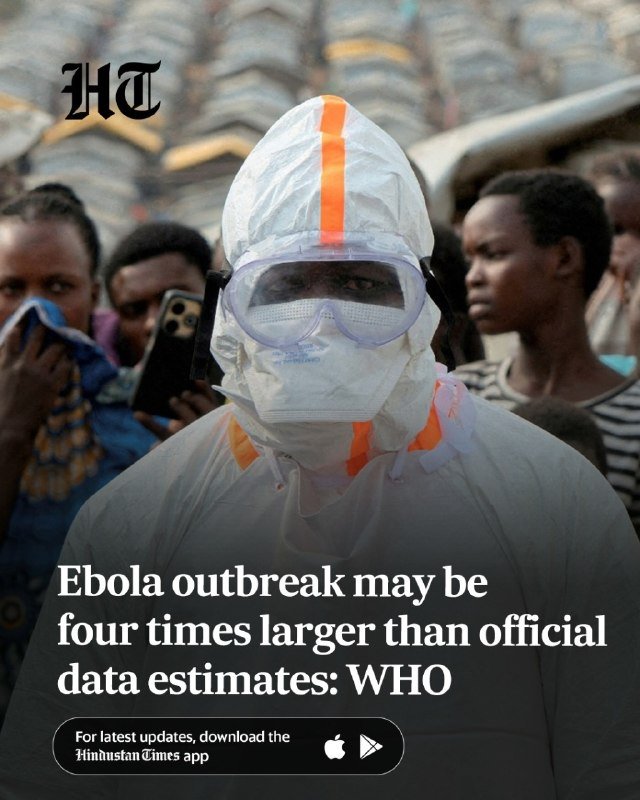
On 10 July 2026, a senior World Health Organization official confirmed what field teams in the Democratic Republic of the Congo have suspected for weeks: the country's ongoing Ebola outbreak is being detected late, and the official case count is almost certainly a fraction of what is actually circulating. Four out of five confirmed patients have no traceable source of infection, and the real caseload could be "two or three times" higher than the reported figures, the official warned on Thursday.
That single metric — the share of patients with no known contact — is the cleanest signal in any outbreak. It tells clinicians that the chain of transmission has already broken past the point their surveillance can follow. Once the majority of new cases cannot be linked back to a previous case, the disease is no longer being tracked; it is being sampled.
The signal in the silence
A normal outbreak has a low proportion of unexplained cases, because contact tracers can tie most infections back to a known patient, a household, a funeral, or a hospital. When the ratio inverts — when the majority of new infections arrive without provenance — the standard playbook loses its anchor. Vaccines cannot be efficiently targeted. Isolation protocols reach only the cases the system already knows about. Community engagement messages chase an outbreak that has outpaced the messaging.
The WHO's read, delivered on Thursday, is the diplomatic version of a more uncomfortable finding: the surveillance apparatus is no longer the limiting factor in this outbreak — it is the bottleneck, and the curve is moving.
What four-in-five actually means on the ground
The 80% share of untraceable patients is not a statistical curiosity. In practical terms, it means the average new case is now generating fewer than one identifiable downstream contact. Localised spread can still be happening inside households or inside health facilities — but because those chains are not being captured in the formal line-list, they are also not driving the response. The response is being calibrated against a denominator that undercounts.
That gap is the difference between an outbreak that can be contained with ring vaccination and contact tracing and one that requires broader geographic vaccination, mass community mobilisation, and aggressive infection-control inside health facilities. Each step up that ladder costs more and arrives later.
A familiar pattern, repeated
This is not the DRC's first encounter with this dynamic. The North Kivu and Ituri outbreaks of 2018-2020 ran for nearly two years and were declared the second-largest Ebola epidemic in history, partly because insecurity and community mistrust pushed a large share of cases outside the surveillance net. The Kasai outbreaks in 2007 and 2008 followed a similar arc. Each time, the international emergency response eventually scaled up — but only after the denominator had drifted well past the official line.
The structural problem is not new. It is the same constraint each time: surveillance in fragile, low-density health-system settings depends on a thin layer of community health workers and a thinner layer of functional laboratories. When the virus moves faster than that layer, the paper count lags the biological count by weeks.
Why the framing matters
The standard Western wire line on any DRC outbreak tends to cast the country as a passive recipient of international response — a place where outbreaks happen and aid arrives. That framing quietly erases two facts: first, that the Congolese health authorities and their field epidemiologists are running the response under brutal conditions, often before the WHO declares anything; and second, that the undercount is partly a measurement failure in Geneva and the donor capitals as much as in the provinces.
A fair read of the current moment is more sober. The WHO is signalling clearly, in plain language, that the surveillance failure is now the dominant problem. The likely policy response — broader geographic vaccination, expanded lab capacity, and a longer horizon — will cost real money and will arrive over weeks rather than days. If the caseload is anywhere near the upper bound of the official's "two or three times" estimate, the curve ahead is steeper than the public numbers suggest.
What remains uncertain
The largest single unknown is the multiplier. "Two or three times" is a range, not a point estimate, and the team in Kinshasa has not published the inputs that would let outside modellers reproduce the calculation. The geographic spread — whether the untraceable cases are clustered in a handful of health zones or scattered across the active outbreak area — is also not yet in the public record. The numbers will become firmer in the coming weeks as the surveillance net is reinforced; until then, the official case count is best read as a lower bound on a moving target, and the WHO's warning should be treated as the most credible current statement of where the lower bound is failing.
This outbreak is not out of control — but it is, as of 10 July 2026, no longer fully observed. That distinction is the one that matters in the days ahead.
Desk note: Monexus framed this around the surveillance gap rather than around the raw case count, because the WHO's own statement makes clear the case count is the figure most likely to be misread.
Wire provenance
This editorial synthesis draws on the following public wire/social posts:
- https://t.me/osintlive