Strait of Hormuz Becomes the New Front Line of US-Iran Escalation
A US demand that Iran halt attacks in the Strait of Hormuz, fresh Treasury sanctions, and rising petrol prices at American pumps point to a confrontation whose economic blowback is now landing inside the United States itself.
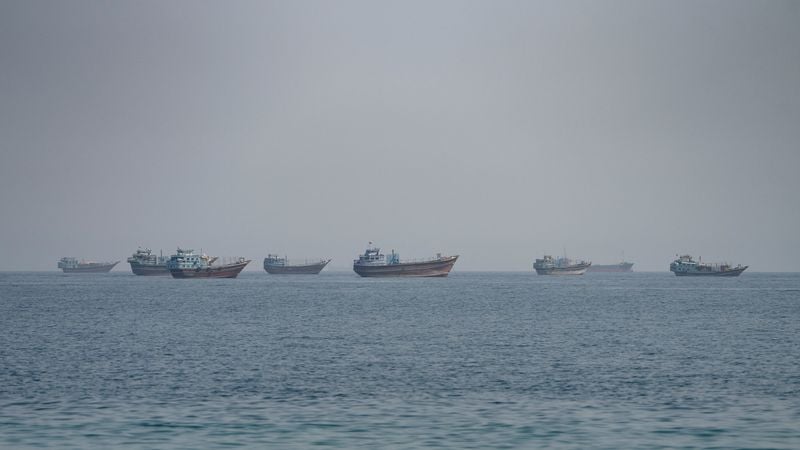
On the evening of 10 July 2026, Reuters reported that US officials had communicated a direct demand to Tehran: Iran must commit to halting attacks on commercial shipping in the Strait of Hormuz. The same news cycle carried Treasury's announcement of a fresh sanctions package, and a second Reuters dispatch confirming that American drivers were paying more at the pump after renewed US-Iran fighting lifted crude prices. Three threads, one day, the same story.
What had been a slow-motion confrontation over the world's most important oil chokepoint is now visibly tightening into an economic pincer. The escalation is being measured, for the moment, not in casualties but in cents per gallon, in the cost of insuring a tanker, and in the political exposure of a White House that wanted cheap energy and is getting the opposite. The pattern is familiar enough to be worth naming: when the United States tries to coerce Iran through sanctions and naval pressure, the choke point that gives Iran its leverage is the same waterway that the United States and its Gulf allies depend on for export revenue. The economic costs of that contradiction are now arriving inside American politics faster than either capital can ignore.
A demand Tehran has heard before
The Hormuz demand, as reported by Reuters on 10 July 2026 citing US officials, is the latest iteration of a recurring American ask: that Iran refrain from harassing or striking commercial tankers transiting the strait that connects the Persian Gulf to the Gulf of Oman. Roughly a fifth of the world's seaborne oil moves through that corridor on any given day. The ask is not new. What is new is the context. The Reuters dispatch on US fuel prices, filed later the same day, noted that renewed fighting had lifted crude prices, with the cost translating directly into higher pump prices in the United States. The two data points, read together, describe a coercive strategy whose costs are now bouncing back onto the constituency that voted for the policy.
Tehran's incentive structure is straightforward. Iran has spent years building asymmetric capabilities — fast-attack craft, anti-ship missiles along its coastline, mining capability, and the political cover provided by allied militias in Iraq, Syria, Lebanon and Yemen. Hormuz is the leverage that compensates for a conventional military inferiority. Demands that Tehran unilaterally disarm in that corridor are, from Iran's perspective, demands that it surrender its principal deterrent without receiving anything in return. That is the framing the Iranian state media apparatus will project; it is also the framing that several Iranian negotiators have, in earlier rounds, made to European intermediaries in plain enough terms. Whether or not the current Iranian leadership accepts that framing is a separate question, but the framing itself will not move.
The sanctions layer, widened
The same 10 July 2026 cycle brought a Treasury announcement, relayed through channels including DD Geopolitics and Middle East Spectator, that the United States had expanded sanctions against Iran. The precise scope of the new designations was not detailed in the available wire summaries beyond the expansion itself, but the directional signal is clear: Washington is layering financial pressure onto a security confrontation. The pattern — sanctions escalation paired with a kinetic flashpoint — has been the operating logic of US-Iran policy across two administrations. What tends to be under-reported is how thin the marginal return on additional Iranian sanctions has become. The architecture already in place is severe. Entities that were going to comply have largely complied. The remaining pressure points are humanitarian, not strategic, and tend to harden rather than soften the Iranian government's domestic position.
For Tehran, the sanctions layer also performs a domestic function. A regime under external pressure can rally nationalist sentiment; a regime negotiating under sanctions can present those sanctions as the cost of dignified resistance. The American bet, presumably, is that the economic pain inside Iran eventually forces a negotiating posture more favourable to Washington. The countervailing evidence from inside Iran is that the Islamic Republic has demonstrated an unusual capacity to absorb economic distress and convert it into political cohesion. That capacity is not unlimited, but it has outlasted multiple American presidents.
The pump-price feedback loop
The piece of this story most likely to land politically in Washington is the one Reuters spelled out on the evening of 10 July: US pain at the pump is worsening. Fuel prices had already been an irritant for American consumers through the spring and early summer. Each new bout of US-Iran tit-for-tat pushes crude higher, and the transmission to retail fuel follows within days. This is not a story about American isolationism; it is a story about the speed at which foreign-policy choices are converted into domestic political costs. The White House's room for sustained confrontation in the Gulf is constrained by every additional cent added to a gallon of gasoline in a midterm cycle.
There is also a global dimension that gets flattened in the American domestic framing. Higher crude prices hit the import-dependent economies of South and Southeast Asia, Sub-Saharan Africa, and parts of Latin America before they hit American consumers. India and China, the two largest single buyers of Iranian crude at various points over the last decade, have built relationships with Tehran that allow them to absorb sanctions pressure more readily than smaller importers can. The result is a structural irony: American sanctions architecture designed to isolate Iran has, over time, pushed Iranian oil toward customers less aligned with Washington, and has lifted the global price floor that Iran then benefits from.
What the framing leaves out
The dominant Western framing of this escalation runs through familiar frames: Iranian aggression, Iranian menace to global shipping, the need for a robust American naval posture in the Gulf. That framing has empirical support — Iran-aligned forces have, in recent years, seized tankers and conducted drone attacks on shipping. But it leaves out the other side of the ledger. The United States withdrew from the 2015 nuclear agreement in 2018 and reimposed sweeping sanctions. The assassination of Iran's most senior general in January 2020 removed a figure who had, by most accounts, been a restraining voice inside the Iranian system. Israeli operations against Iranian assets in Syria continued through several American administrations with varying degrees of coordination. Each of those moves was framed in its moment as defensive or limited. Each of them contributed to the strategic environment in which the current escalation is now occurring. A full account of the present confrontation has to hold both the Iranian actions and the cumulative American and Israeli actions that preceded them in the same frame.
That is not a moral equivalence argument. It is a sequencing argument. Iran retains agency and bears responsibility for its decisions; the United States retains agency and bears responsibility for its decisions. But the causal chain that produced the current situation runs through both capitals, and any policy that pretends otherwise will misread what the other side is actually signalling.
The stakes, narrowly and broadly
The narrow stakes are economic and immediate: how high crude goes, how long the spike lasts, whether insurance underwriters reroute Hormuz traffic around the Cape of Good Hope and add ten to fifteen days to delivery. The broader stakes are about the architecture of the global energy system and the credibility of sanctions as a coercive tool. If the current round ends with Iran continuing to export oil to non-Western customers at elevated prices, the sanctions regime's prestige erodes further. If it ends with a kinetic confrontation that draws in the United States militarily, the political cost inside the United States will be substantial and the regional cost will be worse. If it ends in some negotiated arrangement, the question will be whether that arrangement resembles the 2015 framework or something thinner — and whether the United States has the domestic political patience to honour it.
The most plausible near-term outcome is a continuation of the present pattern: episodic escalation, episodic de-escalation, higher baseline prices, and a sanctions architecture that grows wider without becoming more effective. That outcome suits almost no one except the oil futures market. The least likely outcome is a clean resolution in either direction — a durable deal or a decisive military resolution. Most of the actors at the table have an interest in a managed crisis rather than a resolved one. The cost of that managed crisis is paid at the pump in Texas and California, in the foreign-exchange reserves of fuel-importing governments in Africa and South Asia, and in the patience of Iranian citizens whose daily lives are the substrate on which the entire standoff is conducted.
What remains uncertain
The available reporting on 10 July 2026 leaves several questions open. The exact scope of the Treasury sanctions announced that day was not detailed in the wire summaries that reached this publication; the size and targeting of the package will become clearer as OFAC's official release is parsed. The precise nature of Iran's response to the Hormuz demand — whether through formal diplomatic channels, militia proxies, or naval harassment — is not yet known. The duration of the oil-price spike will depend on whether the current fighting represents a discrete episode or the opening of a longer campaign. And the question of whether any third-party mediation, from Oman, Qatar, China, or others, can carve out space for negotiation is genuinely open. The sources do not settle any of these. They do, collectively, confirm that the situation has moved from managed tension into something more kinetic, more costly, and more visible to constituencies that had not previously been paying attention.
This piece approached the US-Iran confrontation through the same economic lens the Reuters dispatches emphasised: that the policy's domestic costs are now arriving faster than its strategic benefits. The structural argument — that sanctions layered onto a security confrontation in a chokepoint waterway produce predictable price feedback — is editorial synthesis, not wire reporting. Monexus cited Iranian agency and Israeli-American action sequencing alongside Tehran's, in line with the publication's standing commitment to two-sided conflict coverage.
Wire provenance
This editorial synthesis draws on the following public wire/social posts:
- http://reut.rs/44VJmIF
- http://reut.rs/4vtqFaj
- https://t.me/FirstpostIndia
- https://t.me/DDGeopolitics
- https://t.me/Middle_East_Spectator