Kathy Butterly's ceramic creatures won't sit still
A new exhibition of Kathy Butterly's quasi-vessels — folded, dimpled, furtive little bodies — argues that ceramic sculpture has outgrown its decorative inheritance.
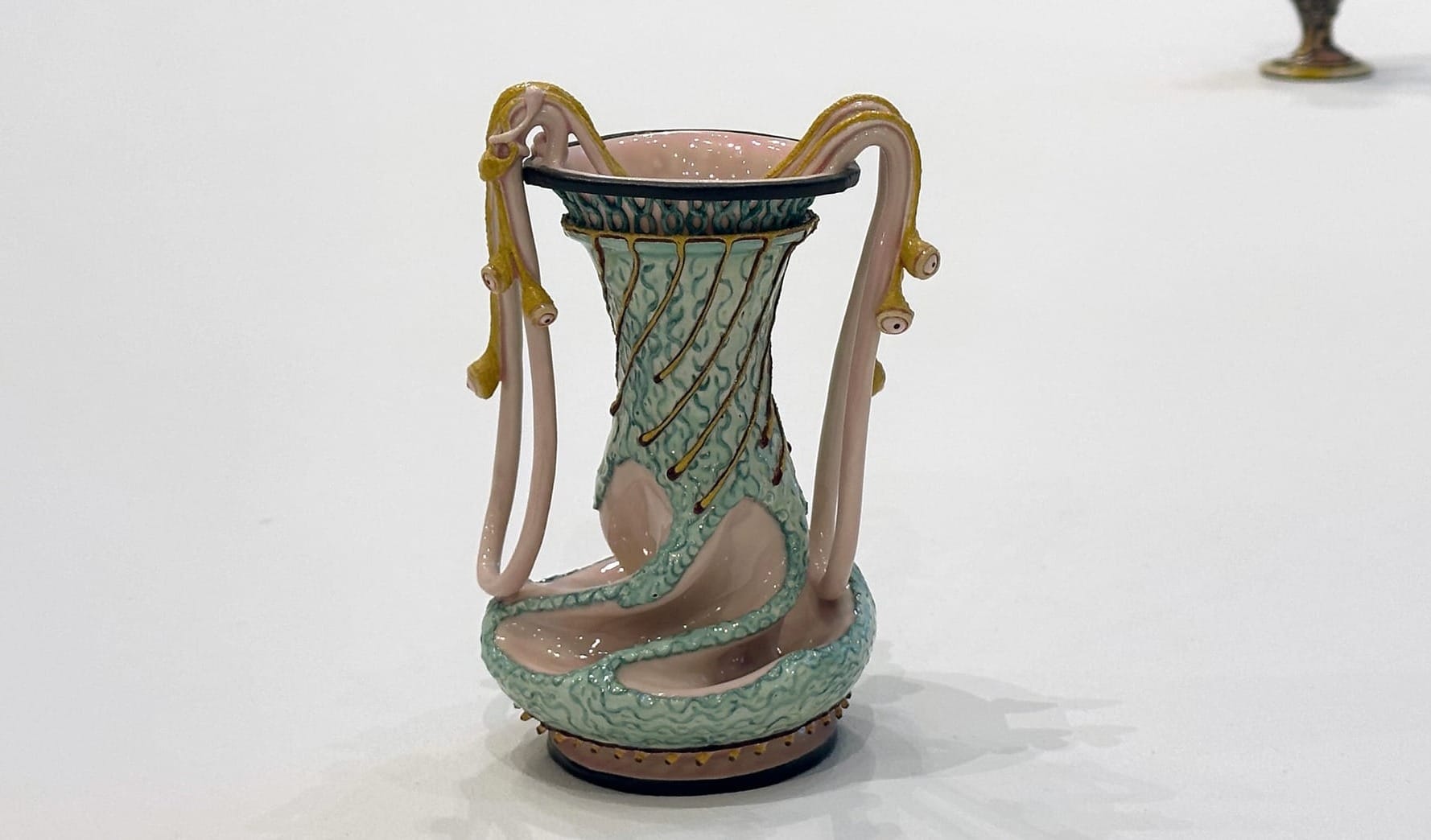
On 10 July 2026, Hyperallergic published a feature on Kathy Butterly's ceramic practice that doubles as a quiet argument for the seriousness of small sculpture. The piece, "The Unruly Ceramic Beings of Kathy Butterly," runs through the artist's quasi-vessels — pinched, dimpled, hollowed objects that the reviewer describes as "beings" rather than containers, on the grounds that their folds, indentations, apertures and coverts read less as decoration than as suggestion of bodies, organs, hiding places.
The reading is straightforward and worth taking seriously. For most of the last century, the Western museum treated ceramics as a craft adjunct to "real" sculpture — vessel as utility, glaze as craft, scale as confession. Butterly's work, as the feature frames it, exploits that inherited suspicion. The pieces are small. They sit on shelves. They look, at first, like unusually anxious pots. The longer the viewer stays, the more the surface stops behaving like a surface: a fold turns into a lip, a dimple into a socket, an aperture into a mouth mid-syllable. The reviewer's wager is that this slippage — between object and organism — is the point.
What the surface does
Hyperallergic treats the formal vocabulary first. The quasi-vessels "incorporate folds, indentations, apertures, and coverts," each a category of mark that does particular work. A fold implies interiority — a crease only makes sense if there is something on one side of it. An indentation implies pressure, a previous touch. An aperture implies exchange with whatever is on the other side of the wall. A covert — the most charged of the four — implies concealment: a place where a small creature could go to be unseen.
Read together, the vocabulary is less an inventory of shapes than an inventory of behaviours. The reviewer is alert to this: the works don't sit still in the eye. They suggest animals, fruits, internal organs, geological folds, the soft architecture of a body under clothing. The ceramic tradition has long flirted with this territory — Picasso's clay heads, the Surrealists' biomorphic vessels, the funk and grotesque currents out of 1950s California — but Butterly's syntax is her own. The marks accumulate without resolving into a single referent. The viewer keeps adjusting.
Against the decorative reflex
The second register of the feature is curatorial. Ceramics, as a medium, carries an old alibi: it can always be called decorative, and the calling is enough to dismiss it. The Hyperallergic piece pushes back on this reflex without belabouring it. The quasi-vessel, the reviewer argues, is precisely the form that resists the decorative label, because it refuses to settle into either pure utility (a vessel that holds) or pure surface (a glaze that pleases). It keeps leaning toward something it isn't.
There is a wider argument sitting just below the surface of the feature, and the reviewer is careful not to overstate it. For decades, the institutional gatekeeping of the museum has treated scale as a proxy for seriousness: bigger sculpture, more serious; small sculpture, less. Butterly's practice — pieces that fit in the hand and reward a long, close look — quietly breaks that proxy. The reviewer doesn't make a polemic of this. They let the work do it.
Counter-read: where the framing strains
The feature is persuasive, but two counter-reads are worth registering. The first is that the "beings" reading is generous, and the works themselves may not always earn it. Some pieces in the lineage of biomorphic ceramic sculpture have been criticised for trading on a kind of cuteness — the vessel as plush toy, the aperture as a wink. The Hyperallergic feature is alive to this risk in its vocabulary ("unruly," "quasi-"), and stops short of claiming the beings are persons. But a sceptical reader could note that the leap from "small object with a dimple" to "being" is a generous leap, and that generosity is doing real work in the review's verdict.
The second counter-read is institutional. The reviewer's framing leans on the long historical exclusion of ceramics from the major-sculpture conversation. That exclusion is real. But it has also been weakening for at least two decades — the Studio Museum's ceramics programming, the clay-heavy turn in postgraduate sculpture programmes, the rise of artists like Sterling Ruby and Rebecca Manson working explicitly in the medium at museum scale. The argument that Butterly's work is "unruly" partly because it sits in a marginalised medium is slightly out of date. The more interesting case for the work is that it is good — formally restless, technically exact, generous to a long look — regardless of the medium's marginal status. The feature gestures at this but doesn't quite land it.
Stakes for the medium
What a piece like this does, beyond its immediate descriptive work, is sketch a small claim about the present moment in ceramic sculpture. The medium has been professionalising and museumising for years; the old craft-versus-fine-art binary has been eroding in practice long before it has been settled in criticism. Butterly's quasi-vessels are a useful test case because they are neither declarative nor monumental. They require a viewer willing to lean in. The Hyperallergic feature treats that requirement as a feature, not a bug.
The remaining uncertainty is whether the wider critical apparatus will follow. Reviews that read small sculpture at this level of formal attention are still rarer than reviews of large sculpture at any level of attention. Whether Butterly's particular vocabulary — folds, indentations, apertures, coverts — becomes a shared critical vocabulary, or stays local to her studio and a small readership, will say something about how seriously the contemporary art world is willing to take the medium on its own terms.
This piece frames Butterly's practice through Hyperallergic's formal vocabulary rather than through biography or market position, on the view that the work's claims are best tested at the level of the surface.