Iran buries Khamenei at Mashhad as succession question moves to the front of the room
State media released images of Khamenei's tomb at the Imam Reza shrine on 10 July, and the absence of a named successor is now the political story.
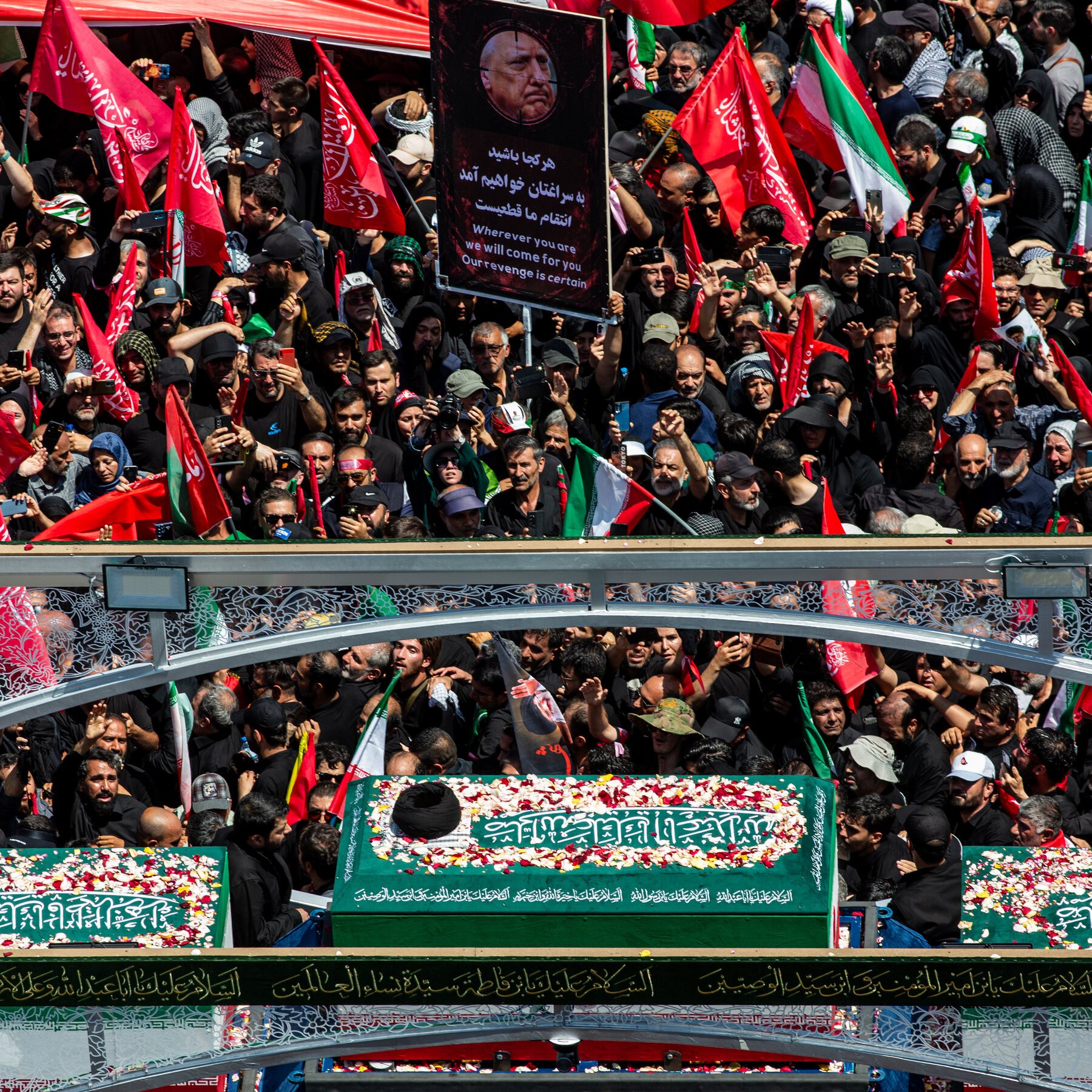
At 12:51 UTC on 10 July 2026, the official Khamenei.ir account released video of a marble tomb set inside a vaulted hall, hung with black-bordered portraits, the air thick with incense haze. Two minutes later, PressTV began circulating still photographs of the same site. By 13:08 UTC, Tasnim had matched them with its own first image, and by 13:40 UTC the official account had layered in a fresh cut — a symbolic funeral procession in Kargil, in Indian-administered Ladakh. Iran's Supreme Leader, Ayatollah Ali Khamenei, had been buried at the shrine of Imam Reza in Mashhad, Iran's holiest city. The body of messaging was controlled; the body politic was not.
The choreography of death in the Islamic Republic is rarely neutral. Mashhad matters because Twelver Shiism locates the eighth imam at that shrine, and burial beside him carries the weight of religious legitimacy that the post-1979 state apparatus has spent four and a half decades converting into political capital. The choice of site, the date, the digital sequence — all of it is now in the public domain. What is not, anywhere in the materials circulated by state outlets on 10 July, is the name of the man or institution who runs Iran tomorrow.
The visual record
PressTV and Tasnim, both running the #MartyrKhamenei hashtag, posted near-identical material on 10 July: the tomb positioned inside the Dar al-Dhikr portico of the Imam Reza shrine, framed by mirrored tilework and a black banner identifying the deceased as "the Martyr Leader of the Islamic Revolution." Khamenei.ir, the office's own outlet, released what it called "exclusive footage" and "exclusive image" at 12:51 and 13:12 UTC, then followed up at 13:40 with the Kargil procession — a small but deliberate piece of geographic signalling. A symbolic procession in Indian-administered Ladakh, where Iran has historically cultivated Shia clerical ties, is not a routine item. It is a reminder that the projection of Khamenei's moral authority was always transnational.
What the visual record conspicuously omits is any image of a successor at prayer beside the new grave. In Iranian practice, the photograph of the next Supreme Leader prostrating himself at the tomb of his predecessor is the first ritual signal that the assembly of clerics — the Assembly of Experts — has concluded its business. That photograph has not, as of 13:40 UTC on 10 July, surfaced on any of the three official feeds.
The institutional vacuum
The constitution vests final authority over the selection of the Supreme Leader in the Assembly of Experts, an 88-member body of senior clerics theoretically answerable to the public. The assembly's current speaker is the cleric who has chaired sessions since 2024; none of the state-media items circulated on 10 July reference a session, a communiqué, or even a procedural timetable. PressTV, Khamenei.ir and Tasnim — three outlets that have spent decades broadcasting as a coordinated chorus — are, in these first hours, silent on the question that will define the next decade of Iranian politics.
This silence is itself the story. Iran's information system has not traditionally tolerated ambiguity at moments of succession: the 1989 transition from Ayatollah Khomeini to Khamenei was telegraphed days in advance through state outlets before the formal announcement. The absence of an equivalent telegraph on 10 July — the failure even to publish a procedural note from the assembly — suggests either an unfinished negotiation or a deliberate choice to manage public attention in stages. Either reading is destabilising for a system whose legitimacy rests on the appearance of institutional continuity.
Reading the framing
There are two ways to read the editorial choice at Khamenei.ir and its state-aligned peers. The first is charitable: the outlets are letting the visual material carry the mourning frame, and will release political material when the assembly is ready. The second is structural. State media in Iran functions as an arm of clerical authority; an editorial decision to withhold a successor's identity from the public record, even for hours, is itself a piece of politics. It tells allies and rivals — inside Iran and across the regional axis of resistance — that the answer is not yet a settled fact.
The sympathetic Western framing of this moment — much of which will be written from Washington, Tel Aviv and Riyadh — will read the silence as paralysis: a regime in the kind of fracture that produces factional leaks, parliamentary manoeuvres, or, in extremis, a Revolutionary Guard intervention. The structural counter-reading is more cautious. The Islamic Republic has survived succession once before, under war-time conditions, and the institutions designed to manage the transition — the Assembly of Experts, the Guardian Council, the Supreme National Security Council — were built precisely for this contingency. Silence on day one is not, on its own, evidence of collapse; it is, however, evidence that the file is still open.
What the next seventy-two hours will tell
Three dates will be worth watching. First, the first statement from the Assembly of Experts, when it comes, will indicate whether the body has a working consensus or is bargaining. Second, the first Friday prayers in Mashhad and Tehran after the burial will produce the visual proof of who carries clerical authority in public — the photograph of a senior cleric leading the supplication at the new tomb will name the front-runner by gesture, if not yet by decree. Third, the first communiqués from the foreign-affairs apparatus and the Islamic Revolutionary Guard Corps, which will indicate whether the succession is being read as an internal clerical matter or as a national-security event.
What the 10 July materials do not settle — and what no Western wire, in the first hours after the burial, was in a position to settle either — is whether the Kargil procession and the Mashhad imagery constitute the closing image of one era, or the opening frame of a contested one. State media has chosen, for now, to publish only grief. The politics of what comes next is being negotiated somewhere the cameras have not yet been admitted.
How Monexus framed this vs the wire: The international wires, where they have moved at all on 10 July, have treated the burial as a ceremonial event. This piece treats the silence on succession as the substantive story and reads the state-media editorial choices as themselves a form of political communication.
Wire provenance
This editorial synthesis draws on the following public wire/social posts:
- https://t.me/Khamenei_en
- https://t.me/tasnimnews_en
- https://t.me/presstv
- https://t.me/Khamenei_en
- https://t.me/presstv
