Russia's doorbell-camera hack, Iran's rebuilt sites, and a sitting US president briefing journalists on his own assassination contingency — three threads on the same afternoon
Three Telegram wires in ninety minutes on 10 July 2026 — a NATO-base surveillance breach, fresh imagery of Iranian reconstruction, and a US president outlining his own retaliation plan — sketch a security picture that is wider than any single one of them.
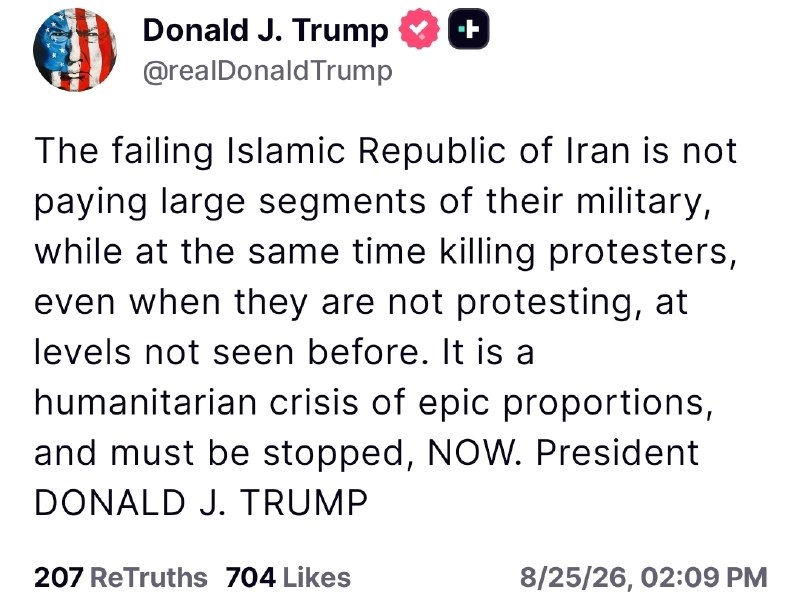
At 19:02 UTC on 10 July 2026, the BRICS News wire carried a Telegraph report that Russian state-linked hackers had compromised domestic doorbell and CCTV cameras to map activity around NATO military bases. Forty-eight minutes earlier, at 18:30 UTC, the same channel moved a CNN item on satellite imagery that, in the network's reading, shows Iran attempting to rebuild facilities struck during the June fighting. At 17:20 UTC, an even earlier bulletin had logged President Donald Trump's statement that he has left instructions, should Iran move to assassinate him, to "bomb Iran like they've never seen before."
Read in isolation each is a discrete story. Read in sequence, on the same calendar day, they describe a security environment in which the instruments of surveillance, the instruments of mass destruction, and the rhetorical escalator are all being touched at once — by adversaries and by the man who holds the world's largest arsenal. The connecting tissue is not a conspiracy but a calendar.
The doorbell problem
The Telegraph reporting summarised in the 19:02 UTC Telegram bulletin describes a campaign in which consumer-grade internet-connected cameras — the kind sold at hardware chains and bolted above suburban garages — have been co-opted into a passive intelligence network pointed at NATO installations. The exploitation method is not novel in principle: default passwords, unpatched firmware, and the long tail of devices never receiving a security update have been a known vulnerability class for the better part of a decade. What the reporting puts on the table is the targeting — that the resulting feeds are being stitched into a pattern-of-life picture for foreign military planners.
The counter-narrative, which the Telegram wire does not carry but which the underlying Telegraph reporting gestures at, is that consumer surveillance equipment has been a Western intelligence asset for years. The Snowden disclosures of 2013 documented comparable collection against allied and adversary targets alike; the novelty here is the location of the camera, not the existence of the technique. That symmetry, however, is not an alibi. A NATO member whose perimeter is partly observed through devices it does not control is operating from a degraded baseline, regardless of who else has done the same thing to whom.
The Iranian rebuild question
The CNN item moved by BRICS News at 18:30 UTC is more cautious in its language than the wire's "may be attempting to rebuild" suggests, but the underlying claim is structurally significant. Commercial and government satellite operators have been tracking the post-June landscape at Natanz, Fordow and Isfahan since the ceasefire; the reported imagery, according to the CNN summary carried on Telegram, shows earthworks, fresh vehicle tracks, and the re-covering of structures that had been exposed by earlier strikes.
Two readings sit in tension. The first, which will be the default in Western commentary, is that Iran is racing to reconstitute capabilities that were deliberately degraded, in defiance of the spirit of any ceasefire. The second — and the one this publication treats as structurally serious, because it carries weight in Tehran, Beijing and Moscow — is that Iran, having absorbed a strike on its own soil, has both the right and the incentive under any reading of self-defence to harden and restore the deterrent that was attacked. Both readings describe the same physical activity. The policy disagreement is about whether restoration is provocation or prudence. The Iranian foreign ministry line, which the wire does not carry but which would be the natural rebuttal, is that a country whose facilities were bombed cannot be lectured about what it does next on those sites.
The escalation floor, lowered in public
The 17:20 UTC bulletin logs the most unsettling of the three items by a wide margin, because it is not a report about someone else's decision — it is a sitting head of state, on the record, describing a contingent plan of maximum violence against a country of roughly ninety million people. The framing — "if Iran assassinates me" — is itself a foreign-policy artefact: an assassination threat against a US president would be an act of war by any reading, but stating the retaliation plan in advance reshapes the deterrent calculation in ways that professionalise restraint is supposed to resist.
The counter-read is that nuclear-armed states have always maintained contingency strike plans and that saying so openly is a form of deterrence signalling rather than a drift toward use. That is the defence one would expect from a realist foreign-policy shop. It does not, however, explain why the signalling has to happen in those specific words, on that specific day, while satellite imagery of an Iranian rebuild is already in circulation. The two items are not coordinated, but they are mutually legible: one says we will hit you again, the other says we are getting ready to be hit again. Each makes the other slightly easier to read as prelude.
What the day's wire is actually telling us
None of the three items, taken alone, shifts the strategic picture. Taken together, on a single afternoon, they sketch an environment in which the seams between routine espionage, active nuclear reconstruction, and rhetorical escalation have become unusually thin. The doorbell-camera story is a tactical intrusion by one nuclear-armed state against the perimeter of a Western alliance. The Iranian rebuild story is the predictable response of a struck nuclear-armed state to having been struck. The Trump statement is the leader of the third nuclear-armed state publicly pre-committing a level of force that, under most readings of international law, would constitute a war crime if the underlying premise — an Iranian assassination of a sitting US president — were ever to materialise, and which is destabilising whether or not it does.
The through-line is not that war is imminent on 10 July 2026. It is that the floor of public escalation language has dropped, in Washington as in the field of view around NATO bases, and that the institutions which once absorbed such moves in private are now absorbing them in headlines. What remains genuinely uncertain is whether the three wires describe a coordinated posture or merely a coincident one. The sources do not resolve that question, and any reader who claims to know is reading past the evidence.
The Monexus staff desk carried this as a wire-cluster piece rather than three separate stories because the three items circulated within ninety minutes of each other and frame one another. Where wire reporting carried hedging — CNN's "may be attempting to rebuild," the Telegraph's attribution framework — that hedging is preserved in the prose above.
Wire provenance
This editorial synthesis draws on the following public wire/social posts:
- https://t.me/s/bricsnews
- https://t.me/s/bricsnews
- https://t.me/s/bricsnews
- https://en.wikipedia.org/wiki/2010s_Stuxnet