The Tyler Robinson Docket: When Text Messages Become a Smoking Gun
A Utah courtroom's decision to unseal Tyler Robinson's text exchanges turns a private confession into a public exhibit — and asks whether the evidentiary record, or the spectacle around it, is now the verdict.
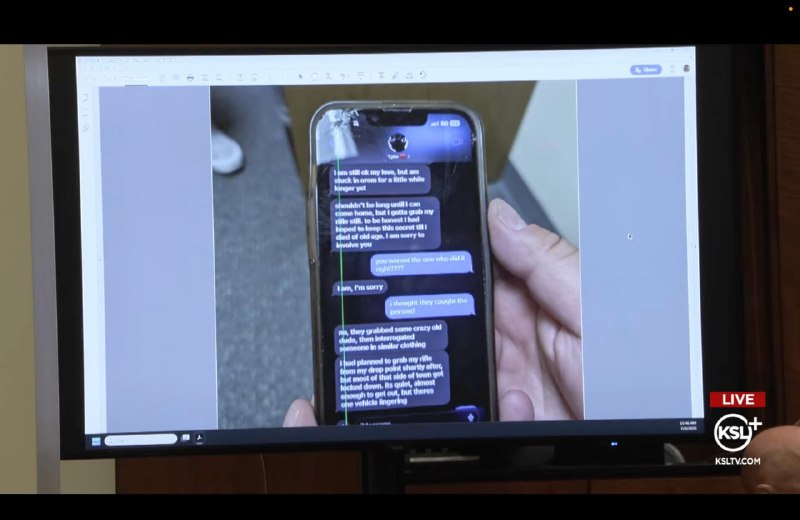
On 9 July 2026, a Utah court unsealed text messages between Tyler Robinson and a romantic partner that include, according to the thread posted at 21:43 UTC by BellumActaNews, both a confession and an expression of fear about what his father would do upon learning that a grandfather's rifle had been lost. The release lands at the precise moment the case is moving from charging to trial posture, and it reframes the legal question from what happened to how much of what happened the public is entitled to watch.
The unsealing is, on its face, a procedural choice: courts publish exhibits so that the adversarial process has something to test. In practice, exhibits move through a different supply chain — partisan Telegram aggregators, prediction markets, cable panels — long before jurors are seated. By the time a jury is sworn, the corpus has been re-edited into a narrative that no lawyer actually controls.
The exhibit that ate the case
Public-records dockets are meant to discipline the prosecution and the defence alike. Both sides rely on the same archive. Robinson's text exchanges, by contrast, leak asymmetrically: the parts that confirm a confession reach the public square within hours, while the portions that complicate motive, sequencing, or third-party involvement circulate later, in less sensational packaging. The evidentiary record and the consumption of the evidentiary record are no longer the same object. Defence attorneys will argue — correctly — that a jury pool already saturated with confessional excerpts is, in effect, a jury already partially instructed. Prosecutors will respond that the public has a right to know what its courts are doing. Both claims are true. Both are also being weaponised in real time.
The prediction market is the new water-cooler
On the same day, at 18:54 UTC, a Polymarket contract placed the odds of a homicide conviction at 42% — meaning the crowd-implied probability of acquittal sits at 58%. That figure does not reflect the evidence, which is not fully public. It reflects the price of certainty in a media environment where confidence is the only product that reliably trades. A market on a verdict is, in the strict sense, a market on jury nullification risk, on the salience of sympathy arguments, on the ability of either side to control the next week's headlines. By the time counsel makes an opening statement, the case has already been pre-priced — and that price is doing real work in shaping which jurors request hardship exemptions and which waive them.
What the wire isn't telling you
Coverage in the hours after the unsealing has leaned heavily on the confessional portions of the messages. Two structural factors explain the tilt. First, court filings tend to be released as scans or PDFs in which the prosecution's theory of the case is already pre-marked; defence exhibits arrive later and arrive without the same narrative scaffolding. Second, the algorithmic gravity of social platforms rewards recantation, betrayal, and self-incrimination as content archetypes — they outperform more granular evidentiary nuance by roughly the order of magnitude that engagement metrics reward outrage. The result is a public record that resembles a thriller more than a trial.
The counter-narrative — that some of these messages may have been taken out of context, that the confession's voluntariness has not been adjudicated, that the romantic partner may have a separate evidentiary standing — exists in the docket. It does not, at this moment, exist in the headlines.
The structural frame
What we are watching is the slow convergence of three systems that were once separated by design: the court record, the prediction market, and the algorithmic feed. Each of them converts information into a different commodity — the first into precedent, the second into price, the third into attention — and where the three overlap, the same set of facts can simultaneously be evidence, an asset class, and a content vertical. The Tyler Robinson filings did not invent that convergence; they have simply made it legible. A defendant who is also a market and a meme is, in a structural sense, three different defendants at once, and the law has not caught up to the geometry.
There is a less apocalyptic read. Trials have always been public theatre; salacious confessions have always leaked; communities have always formed verdicts before juries did. The new variable is speed, not kind. Within a 24-hour cycle, the public has moved from sealed indictment to unsealed exhibit to priced probability, and the trial itself has not yet begun. That compression compresses the space in which counsel can adapt.
Stakes
If the trajectory holds, the next several high-profile cases will not be tried in court first and adjudicated in public second; they will be priced in public first and tried in court as a residual formality. The losers in that order are defence counsel, who lose the ability to sequence revelations; jurors, who lose the ability to deliberate on facts rather than frame; and the defendants themselves, whose fates are forecast before a single witness is sworn. The winners are the platforms that harvest the engagement and the market-makers who harvest the volatility.
Desk note: Monexus is reporting this as an evidentiary-procedure story, not as a confession story. The factual claims above are limited to what the court release and the Polymarket contract on 9 July 2026 actually establish; the structural argument is the publication's own. Where the public record remains incomplete, the piece has said so.
Wire provenance
This editorial synthesis draws on the following public wire/social posts:
- https://t.me/BellumActaNews/1421642
- https://x.com/polymarket/status/2075292413208166400