Strait talk: US presses Iran to halt Hormuz attacks as sanctions tighten and pump prices climb
Washington is demanding Tehran commit to ending attacks on shipping in the Strait of Hormuz as new Treasury sanctions bite and US gasoline prices climb on renewed fighting.
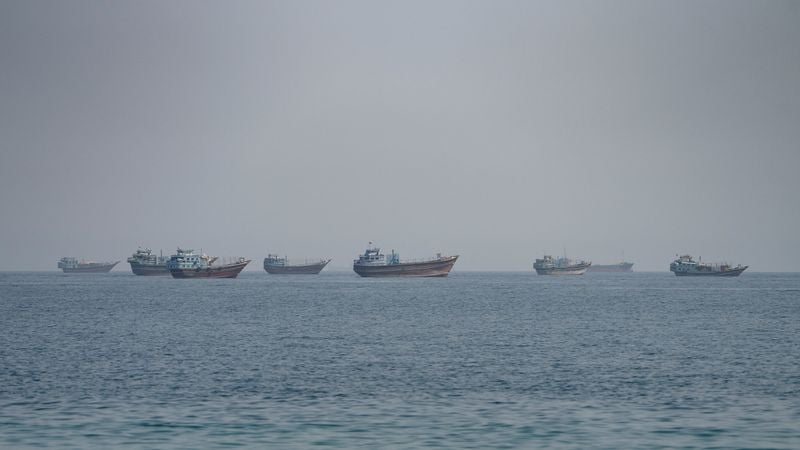
At 21:10 UTC on 10 July 2026, Reuters reported that US officials are pressing Iran to commit, in writing, to halting attacks on commercial shipping in the Strait of Hormuz — a demand the Biden-administration-turned-Trump-administration has refused to soften even as fuel costs for American consumers climb for a fourth straight week. The diplomatic demand and the economic pain are not separate stories. They are the same negotiation, observed from two ends of a fuel nozzle.
The Strait of Hormuz is the narrowest chokepoint on the global oil map, threading roughly a fifth of the world's crude between Iran to the north and Oman to the south. When it is calm, the price of gasoline in California, diesel in Rotterdam and jet fuel in Singapore moves within a familiar band. When it is not calm, the same band widens fast — and the widening now falls on a US consumer already paying more than they were a year ago. Reuters reported at 21:01 UTC on 10 July that "US pain at the pump worsens after more US-Iran fighting lifts oil prices," the second confirmation in a single news cycle that the military and the macroeconomic story are running on parallel tracks.
What Washington is actually asking for
The demand, as described by US officials to Reuters, is unusually explicit: Tehran must commit to stopping attacks on vessels in the strait — not as a vague assurance inside a broader nuclear conversation, but as a discrete, verifiable pledge that survives the next IRGC fast-boat sortie or anti-ship cruise-missile drill. The framing matters. By asking for a stand-alone commitment on the waterway, the US is trying to bifurcate a sanctions-and-nuclear negotiation that has, for two decades, fused every Iranian behaviour into a single contested package.
If the demand holds, the practical effect would be measurable within days. Maritime insurers, who have been quietly widening the war-risk premia on tankers transiting the strait since the latest spate of seizures, would re-price the route. Insurance, not combat, is often the binding constraint on Gulf shipping — a 0.1 percentage-point move in hull premia can reroute a fleet. Whether Tehran agrees is a separate question, and one the sources do not resolve.
The sanctions layer, narrowed but sharpened
At 20:08 UTC, the Telegram channel DDGeopolitics reported that the United States had "expanded sanctions against Iran," and a minute or so later Middle East Spectator carried a more specific Treasury-flavored line: "The U.S. Treasury has imposed new sanctions against Iran." Treasury designations of this kind typically travel in two waves — a primary action under OFAC, and a network of secondary actions against shipping firms, front companies and individual skippers who keep the shadow fleet moving. The Reuters report on the strait and the Treasury action are sequenced within a single hour. That sequencing is itself the signal: economic statecraft as a pressure tool, calibrated to land while the diplomatic ask is still on the table.
There is a counter-narrative worth marking. Sanctions designed to choke Iran's export capacity tend to lift global crude prices in the short run, because Iranian barrels leave the market faster than alternative supply can replace them. Saudi Arabia, the UAE and to a lesser extent Iraq have the latent capacity to backfill, but pipeline and spare-capacity politics in Riyadh have rarely lined up with Washington's wishlist. The result is the familiar paradox: every new designation that bites Iran's exports is also, ceteris paribus, a small upward push on the pump price the same American consumers are protesting about.
The structural frame, in plain language
A hegemon's currency buys a lot of things. One thing it is buying in the Gulf right now is the privilege of dictating the terms under which the world's oil moves. That is the deeper architecture the surface story is sitting inside. The US is not merely trying to keep tanker traffic safe; it is trying to keep the insurance market, the pricing benchmark and the routing logic of seaborne crude denominated in dollars and clearing through US-correspondent banks. The Strait of Hormuz is the most concentrated expression of that system. When the chokepoint wobbles, the question on every treasury desk in London, Singapore and New York is the same one: can this oil still be priced and paid for inside the architecture we built after 1944, or is the next incident the one that pushes a major buyer into a yuan-denominated escrow or a rupee-settled bilateral contract?
That is the frame most consumers do not see when they fill up. They see a price. The price is the residue of a contest over who sets the terms of the trade — and for how much longer.
The pump-price feedback loop
The political cost in the United States is now doing what political cost in the United States does: it is being priced into electoral arithmetic. A third consecutive week of rising national-average gasoline prices is, in US domestic-politics terms, a measurable variable. It is the kind of number that moves congressional majorities and reshuffles committee chairmanships. The Reuters report at 21:01 UTC is explicit that the latest leg up is "after more US-Iran fighting," which ties the military and the macroeconomic in a way the administration will struggle to decouple. The demand on Iran to halt strait attacks, in other words, is not just a security demand. It is a request for a release valve.
Whether Tehran has any incentive to give Washington that valve is the open question. Iranian decision-making in 2026 is shaped by a sanctions environment that has been widening for decades, a leadership that has learned to absorb pain in tranches, and a calculation about which concessions are reversible. The sources do not specify Tehran's response. That silence is itself a reading: this is a demand, not a deal.
What is still contested
Two ambiguities deserve flagging. First, the Reuters report attributes the US position to "officials" without naming them, and the Treasury sanctions line as relayed by Telegram channels has not yet been cross-confirmed against an OFAC press release visible in the thread; the primary OFAC document is the next thing to check before treating the specific scope of the designation as fixed. Second, the causal link between "US-Iran fighting" and the latest move higher in pump prices is reported, not adjudicated — part of the move is consistent with a global inventory draw, with refinery maintenance and with European demand, none of which the source material parses. Monexus treats the Reuters attribution as the working framing; readers should too, with the caveat that the price story is multi-causal.
What is not contested is the sequence: a written US demand on strait attacks, a Treasury sanctions action, and a fourth-straight-week pump-price move higher, all inside a single evening of news. The next data point that will tell us whether the US is winning the negotiating clock is the price print on Monday. Watch the war-risk premia before the spot price. Insurance is faster than crude.
— Monexus framed this story as one transaction observed from two ends — a diplomatic demand and a Treasury action — rather than as two parallel news beats. The wire story treats them as related; we treat them as the same event.
Wire provenance
This editorial synthesis draws on the following public wire/social posts:
- http://reut.rs/44VJmIF
- http://reut.rs/4vtqFaj
- https://t.me/DDGeopolitics
- https://t.me/Middle_East_Spectator