Iran's armed forces on watch: what Baghaei's tribute does and does not say
Tehran's foreign ministry has publicly saluted soldiers on alert across the country. The ritual is familiar, but the timing, in a tense regional summer, is not.
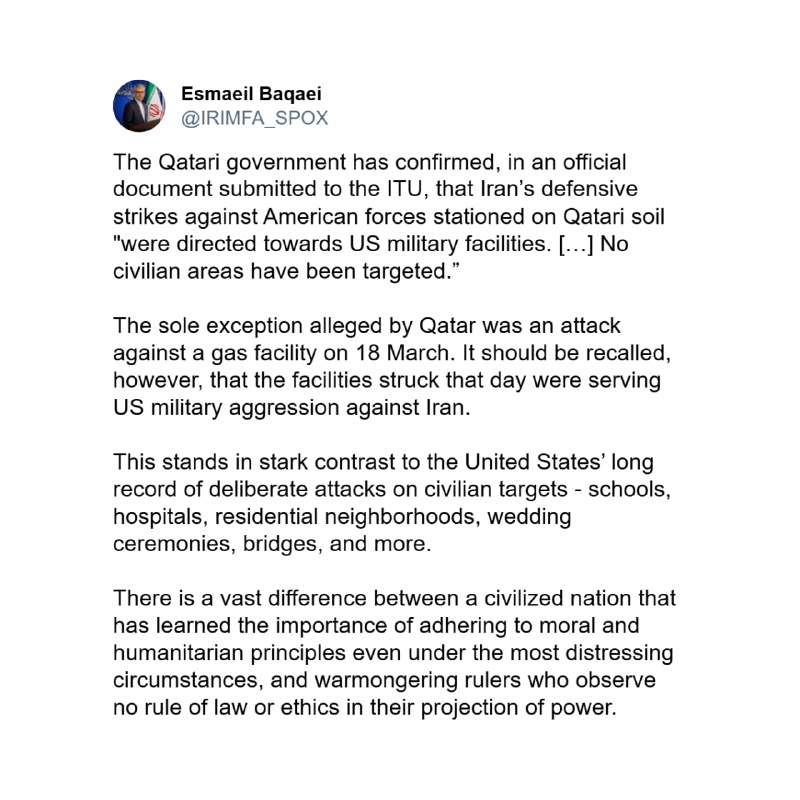
On 11 July 2026, at roughly 08:16 UTC, Iran's state news agency IRNA carried a brief and pointed line from foreign ministry spokesperson Esmaeil Baqaei: the country's armed forces, he said, remain on high alert and are closely monitoring enemy activities. Forty-five minutes later, the Beirut-based outlet The Cradle amplified a longer tribute in which Baghaei commended personnel stationed across the country for "keeping the watch." Two releases, one drumbeat: Iran wants it known, in two registers and in two languages, that its military is awake.
The statement is a gesture before it is a policy. It is also, by Iranian standards, a low-cost one. Tributes to the armed forces from the foreign ministry podium are a familiar cadence, an annual habit around national days, martyrs' week, and moments of regional friction. What distinguishes this one is the pairing: a routine tribute married to a specific, present-tense assertion that the forces are monitoring an enemy. The combined effect is diplomatic choreography, signalling both to a domestic audience that the state remains in control of the security file and to outside listeners that Tehran reads the threat picture as live.
The line between routine and signal
Iranian messaging of this kind works on two layers. The first is institutional. Baghaei is the foreign ministry's principal public voice. When he speaks about the armed forces from that podium, the statement carries the weight of civilian oversight of the military, a useful counter-image to the West's preoccupation with the IRGC's role in the security state. The framing presents the foreign ministry, not the general staff, as the public narrator of the armed forces' posture. That is, on its own, unremarkable.
The second layer is operational. A spokesperson saying, in present tense, that forces are "on high alert" and "monitoring enemy activities" places a marker on the calendar. It tells diplomats in neighbouring capitals, and the attachés reading open sources in Washington, Tel Aviv, and the Gulf, that Iran is choosing to advertise vigilance rather than absorb an event in silence. The decision to advertise is itself the news. State outlets that typically reserve this vocabulary for the supreme national security council or the general staff have, in this case, allowed the foreign ministry to deliver it. That tells you something about the audience Tehran wants to reach, and the political distance it is willing to put between itself and the message.
What the language does not say
The familiar Western wire reading of any such statement is to translate it as a provocation. The Iran International diaspora line leans hawk; Israeli English-language outlets, led by the Times of Israel and the Jerusalem Post, tend to read Iranian military statements through the lens of last week's incident, whether a strike in Syria, a missile test, or a drone interception. That reading is not wrong, but it is incomplete. Baghaei's tribute names an enemy without naming one. The release does not specify a country, does not accuse a counterpart, and does not claim an imminent operation. It is calibrated precisely to be readable across multiple threat pictures without committing Tehran to any one of them.
There is also a regional audience the statement flatters. In Baghdad, Damascus, Beirut, and Sanaa, Iran's partners and clients read the same IRNA line as reassurance: the patron is awake, and the patron's posture has not softened. In Riyadh, Abu Dhabi, and Doha, where quiet channels with Tehran have been the subject of months of patient reporting, the statement is read the other way around, as a reminder that quiet channels do not equal demilitarised language. Both readings can be true at once, and the statement is designed so that they are.
Counter-narrative: why this is also domestic politics
The risk in reading an Iranian foreign ministry line as primarily a signal to foreign capitals is missing the audience at home. Iran's armed forces enjoy a domestic political position unlike any institution in the country. They are the foundational unit of the post-republican state, the heir to a long martial memory, and the most consistently popular institution in polling, when such polling is available. A tribute from the foreign ministry is also a tribute to that consensus. It costs the spokesperson nothing and buys goodwill at home, where the news cycle has been heavy with economic complaint and where the leadership has been managing expectations about a recovery that is uneven at best.
It is also worth noting what the release does not do. It does not announce a deployment, a rotation, a war game, or a specific intelligence finding. It does not claim a successful operation, nor does it promise retaliation for any specific incident. The most aggressive claim in the text is that the forces are monitoring. Monitoring is a baseline activity. The decision to put monitoring in a headline is a public-relations choice, not a posture change.
The structural frame: a regional order under quiet stress
Read across the summer of 2026, Baghaei's statement is one data point in a longer pattern. The regional order that absorbed the shock of late-2024 and early-2025 has settled into a tense equilibrium rather than a hot one. Iran, Israel, the Gulf states, and the United States have, in their various bilateral channels, been negotiating the terms of that equilibrium, with ceasefire arithmetic in Gaza and a careful non-rhetoric about Hezbollah's posture to the north. Into that equilibrium, Iran's armed forces have been the institution that holds the line on language. They are the actors who can say "monitoring" and have it understood as a real-world capability rather than a press release.
The structural risk in this pattern is not that the language is escalatory. It is that the language has been normalised. When every month brings a fresh tribute, a fresh deployment notice, a fresh intelligence claim, the price of any of them being real goes up. The signal-to-noise ratio degrades, and the next genuine operational alert has to work harder to be heard. That is a problem Tehran's adversaries share with Tehran. Both sides are, in their different vocabularies, working through the same arithmetic of credibility.
Stakes, in concrete terms
If the current pattern holds, the regional equilibrium survives the summer without a kinetic shock but with a slow accumulation of alert statements, of which Baghaei's is the latest. The audience for those statements grows, and the cost of being seen to ignore one rises. A market that prices oil on the assumption of an uneasy peace will continue to price in that assumption. A diplomatic community that has built quiet channels across the Gulf will keep them open, with the understanding that public language in Tehran and Washington is a separate channel that does not always reflect the working one.
The risk case is narrower. A specific incident, whether a strike in Syria, an attack on a shipping lane, a missile test that crosses a red line, would convert the current calibrated language into a posture that the same foreign ministry would then have to explain. At that point, the cost of the present statement is what it always is in this kind of choreography: a marker on the calendar that any later escalation can be made to rhyme with. The statement is designed to be useful if escalation comes and harmless if it does not. That is the quiet skill of Iranian state messaging, and the reason the wire that covers it well is the one that treats each release as evidence of calibration, not as evidence of intent.
The part that remains genuinely uncertain is the operational picture behind the language. Open-source reporting cannot tell you, on the basis of a foreign ministry tribute, whether the forces are in fact at a higher state of readiness than the seasonal baseline. The release names an enemy without naming one, monitors without disclosing what, and stays on alert without saying for how long. The honest reading is the disciplined one: the statement is real, the signal is deliberate, and the gap between language and posture is the story.
Desk note: the wire treatment of Baghaei's 11 July release, including IRNA's terse English line and The Cradle's longer reproduction, frames the statement as a political signal rather than a military one. Monexus reads it the same way, with the additional caution that an alert-statement cadence, repeated often enough, becomes the baseline against which the next genuine alert is judged.
Wire provenance
This editorial synthesis draws on the following public wire/social posts:
- https://t.me/Irna_en
- https://t.me/thecradlemedia
- https://t.me/TheCradleMedia
- https://en.wikipedia.org/wiki/Ministry_of_Foreign_Affairs_of_Iran
- https://en.wikipedia.org/wiki/Armed_Forces_of_the_Islamic_Republic_of_Iran
- https://en.wikipedia.org/wiki/IRNA