Live Wire
09:10ZFIRSTPOSTITheater of geopolitics and war09:10ZINTELSLAVAIranian media releases satellite images of alleged Iranian missile strikes on Jordan09:09ZFOTROSRESIIranian ballistic missiles strike US Muwaffaq Salti Air Base, damaging at least 2 hangars09:09ZBRICSNEWSUS gives Iran 24 hours to announce Strait of Hormuz is open09:08ZTHECRADLEMIran releases satellite images of alleged strike on Jordanian Air Force09:08ZTHECRADLEMIranian Media Release Satellite Images of Alleged Strikes on Jordanian Air Base09:08ZTASNIMNEWSPilgrims queue at Razavi shrine in Mashhad to visit shrine complex09:08ZPALESTINECMural in Gaza ruins features Egypt coach Hossam Hassan as solidarity symbol
Markets
S&P 500754.95 0.43%Nasdaq26,282 0.29%Nasdaq 10029,825 0.33%Dow525.78 0.30%Nikkei94.55 1.10%China 5033.48 0.21%Europe88.57 0.18%DAX41.49 0.12%BTC$64,210 0.09%ETH$1,800 1.03%BNB$578.49 0.66%XRP$1.11 0.28%SOL$78.18 1.18%TRX$0.3292 0.39%HYPE$66.69 2.79%DOGE$0.0742 0.06%RAIN$0.0144 0.13%LEO$9.52 0.48%QQQ$725.51 0.31%VOO$693.86 0.46%VTI$372.69 0.33%IWM$295.99 0.42%ARKK$80.25 1.58%HYG$79.71 0.05%Gold$377.01 0.31%Silver$53.95 0.35%WTI Crude$108.7 0.28%Brent$42.15 0.05%Nat Gas$10.6 2.12%Copper$37.99 0.64%EUR/USD1.1430 0.00%GBP/USD1.3423 0.00%USD/JPY161.87 0.00%USD/CNY6.7745 0.00%
CLOSEDNYSEopens in 2d 4h 17m
The Monexus
Vol. I · No. 192
Saturday, 11 July 2026
Saturday Ed.
Updated 09:12 UTC
  • UTC09:12
  • EDT05:12
  • GMT10:12
  • CET11:12
  • JST18:12
  • HKT17:12
← The MonexusGeopolitics

Israeli warplanes violate Lebanese airspace over Nabatieh and Tuffah, Tehran-aligned outlets report

Three Iranian state-affiliated newsrooms reported overnight that Israeli aircraft crossed into Lebanese airspace over Nabatieh and Tuffah, in the latest routine breach that has marked the post-November ceasefire lull.
Clerics in black robes and turbans sit in a row reading books before a wall adorned with intricate Islamic tilework. @tasnimplus · Telegram

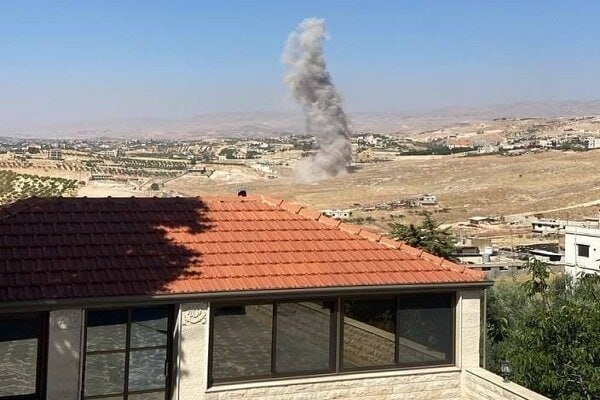
Lebanese media reported in the early hours of 11 July 2026 that Israeli warplanes entered the airspace above the southern Lebanese districts of Nabatieh and Tuffah, according to three Iranian state-affiliated outlets that republished the Lebanese accounts within minutes of one another. The first notice appeared on the Tasnim News English wire at 03:22 UTC; a parallel Arabic item followed on the Tasnim Plus channel roughly ninety minutes later; and the Farsi-language Jahan Tasnim feed carried an equivalent line at 03:21 UTC. None of the three wires specified the duration of the overflight, the aircraft type, or whether ordnance was released. The reports describe a transit, not a strike.

Theatre-wide reporting from the past several weeks has framed such flights as a near-daily feature of the post-ceasefire environment along the Lebanon-Israel frontier, in which Israeli jets and drones enter Lebanese airspace on routine patrol and intelligence-gathering tracks without a corresponding exchange of fire. That baseline matters: each individual report is small, and the analytical weight sits less in any one flight than in the cumulative pattern they describe.

What the wires actually say

The three Tasnim channels are not independent observers. They are the English, Arabic and Farsi desks of an Iranian state-aligned news agency, and each of the overnight items carries the same boilerplate: that Lebanese media reported an Israeli overflight, without naming the Lebanese outlet, the town witnesses, or the timeframe. The composite picture is therefore a single claim, repeated three times across language verticals and republished within a roughly ninety-minute window.

That structure is the story. A Western reader who only saw the English Tasnim headline would assume a discrete new event; the cluster of identical items, in three languages, is closer to a coordinated amplification of a Lebanese report than to three independent confirmations. None of the wires cites an Israeli spokesperson, an IDF briefing, or a UN Interim Force in Lebanon (UNIFIL) log. The claim rests entirely on the original Lebanese sourcing, which the wires do not name.

The baseline of routine violations

Israel's overflights of southern Lebanon have been a documented feature of the border theatre since well before the November 2024 ceasefire that suspended large-scale hostilities between Israel and Hezbollah. UNIFIL has repeatedly logged Israeli air activity over Lebanese territory in its periodic reports to the UN Security Council; the Lebanese state has routinely filed complaints through its permanent mission in New York. By the standard reporting of both Lebanese and Israeli outlets, the flights have continued at a relatively steady cadence through 2025 and into 2026.

The 11 July items do not, on their face, change that picture. They describe the same kind of activity — a violation of sovereign airspace, in Lebanese government framing — that has been logged on a near-weekly basis for the better part of two years. The news value is therefore less in the flight itself than in its repetition as a public event: each overnight report restates a long-running pattern of contestation over Lebanese airspace that has become the quiet furniture of the border.

Why Tehran-aligned wires lead the line

The choice of Tasnim's three desks as the wire of record for this report is itself revealing of the information ecosystem along the Israel-Lebanon frontier. Iranian state-aligned media have, since the November ceasefire, been the most consistent non-Lebanese amplifiers of southern Lebanese airspace reports, partly because the Iranian state's strategic interest in Hezbollah's position makes the flights a recurring item of regional coverage, and partly because Western wires treat routine airspace incidents as below the threshold for standalone filing unless ordnance is released or a casualty occurs.

The result is an information asymmetry that Israeli readers, Lebanese readers, and Iranian readers each receive a different version of the same morning. An Israeli reader scanning Hebrew-language outlets sees no story; a Lebanese reader sees the same Lebanese reports Tasnim is republishing; an Iranian reader sees the same material reframed through Tasnim's editorial voice. The headline is, in a real sense, the act of publication, not the flight itself.

What the sources do not settle

The overnight wires leave the most consequential questions unanswered. They do not state whether the Israeli aircraft crossed at altitude into Lebanese airspace only, or whether they loitered over Nabatieh and Tuffah at lower levels consistent with a targeting run. They do not identify the Lebanese media outlet whose report is being amplified — a critical missing link for verification. They do not give a duration. And they do not say whether the overflight was followed by any ground activity, any Hezbollah response, or any comment from the Lebanese Armed Forces.

For a reader trying to assess whether 11 July was a routine patrol or the precursor to a wider operation, those gaps are decisive. The Tasnim cluster establishes that a claim of an overflight exists, and that it was widely republished in three languages by 04:58 UTC. It does not establish, on its own, the scale, intent, or operational character of the flight.


Desk note: Monexus reported the overnight wire cluster on its own terms rather than the wire's. The Tasnim three-desk framing positions the overflight as a discrete Israeli provocation; Monexus frames it as the latest in a documented two-year pattern of routine Israeli airspace operations over southern Lebanon, and flags the cluster's structural feature — a single Lebanese report amplified in three languages within ninety minutes — as the actual news.

Wire provenance

This editorial synthesis draws on the following public wire/social posts:

  • https://t.me/tasnimplus
  • https://t.me/tasnimnews_en
  • https://t.me/JahanTasnim
  • https://en.wikipedia.org/wiki/Israel%E2%80%93Hezbollah_ceasefire_(November_2024)
  • https://en.wikipedia.org/wiki/United_Nations_Interim_Force_in_Lebanon
  • https://en.wikipedia.org/wiki/Nabatieh_District
© 2026 Monexus Media · reported from the wire