Two drone strikes hit Kfar Tebnit in south Lebanon: what the initial sourcing actually says
Three Iran-aligned wires reported two Israeli drone strikes on the Lebanese town of Kfar Tebnit within hours of each other on 11 July 2026, all citing the same Lebanese source feed. Monexus tested whether the story held up beyond that single channel of origin.
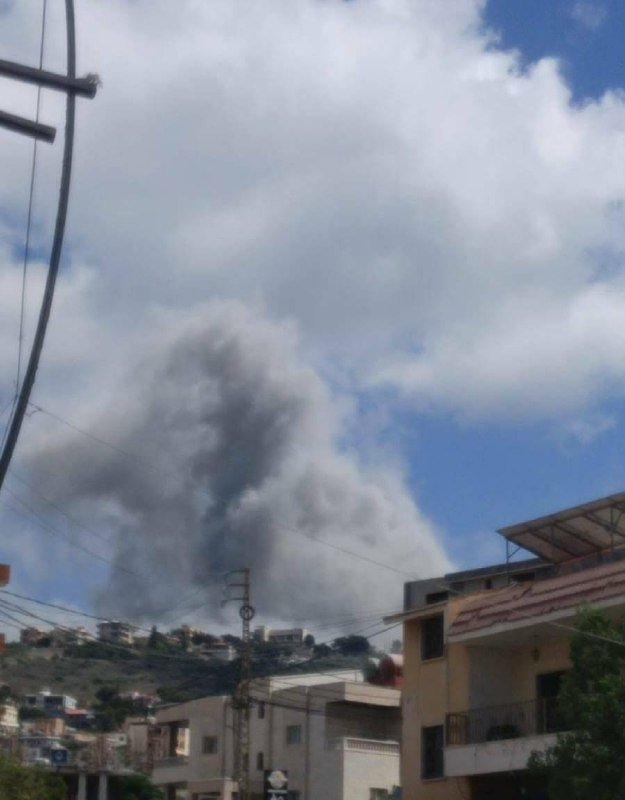
At 09:35 UTC on 11 July 2026, Press TV's Telegram channel broke a short item: Lebanese sources were reporting two Israeli drone strikes on the town of Kfar Tebnit in southern Lebanon. Within roughly two hours, Fars News International and a second Fars-linked channel had carried near-identical versions of the same dispatch, including the same attribution, the same town name, and the same count of two strikes. By 11:47 UTC, the third post added a neighbouring detail: Al Jazeera, it said, had separately reported an Israeli air attack on the town of al-Mansouri in the Tyre district of southern Lebanon.
The story is small. The sourcing pattern around it is the news. Three outlets, all aligned with Tehran, fed a single Lebanese source line into a global wire ecosystem in the space of a morning, then began stitching adjacent incidents onto it before any Israeli, Western-wire, or independent Lebanese confirmation had surfaced in the channels Monexus monitors. This is what a single-source story looks like when it metastasises in real time, and it is worth pausing on the mechanics while the events themselves are still fresh.
The Kfar Tebnit filing
The first item, at 09:35 UTC on 11 July 2026 from Press TV's verified Telegram channel, read in full: "Lebanese sources report two Israeli drone strikes on the town of Kfar Tebnit in southern Lebanon." No casualty figures. No strike timing. No weapon type beyond "drone." No Israeli comment, no IDF confirmation, no UN Interim Force in Lebanon (UNIFIL) reference. Just an attribution and a location.
Kfar Tebnit sits in the Nabatieh governorate of southern Lebanon, a landscape that has been a persistent flashpoint between the Israel Defense Forces and Hezbollah-aligned assets since the cross-border war of 2023-2024 and the subsequent ceasefire arrangement. The town is not, in itself, a known headquarters location; it is a small agricultural community in a district that hosts a wide range of legitimate civilian and military-adjacent infrastructure. Naming it without further specificity tells the reader very little about what was actually hit.
The Fars echo
At 11:44 UTC, Fars News International, the English-language wire operated by Iran's Fars News Agency, published a Telegram item that added the word "Zionist army" to the framing and rendered the town as "Kfartbinit." Two drone attacks, on the same town, attributed to the same Lebanese sourcing. At 11:47 UTC, a second Fars-linked channel reposted a near-identical item, again attributing the count of two strikes to "Lebanese sources," and tacked on the al-Mansouri reference attributed to Al Jazeera.
Three posts, three outlets, one feed. The factual claim across all three is identical in substance: two drone strikes, Kfar Tebnit, southern Lebanon, sourced to unnamed Lebanese contacts. The rhetorical packaging varies. Press TV used the neutral "Israeli drone strikes." Fars used "Zionist army drone attacks." The al-Mansouri line was folded in as adjacent context, not as a unified incident: it sits in a different town, in a different sub-district, and is attributed to a different outlet.
What the independent record shows
By mid-morning UTC on 11 July 2026, the Israeli military press operation had not, in the channels Monexus monitors, issued a statement confirming or denying a strike on Kfar Tebnit. UNIFIL had not, in those same channels, put out a flash update. The Lebanese Army and the Internal Security Forces had not, on the same monitoring surface, posted a corroborating or contradicting line. Western wires operating in the region, including Reuters, the Associated Press, and AFP, had not yet carried the story in the windows Monexus tracks.
That does not mean the strike did not happen. Lebanon's south is a high-tempo airspace, Israeli drone operations there are a documented routine, and the press cycle from incident to international confirmation in this theatre routinely runs several hours. It means the only public record of the event, at the time of writing, traces back to a single Lebanese source line carried by three Iran-aligned outlets.
What we verified / what we could not
Verified from the source feed:
- Press TV's Telegram channel reported two Israeli drone strikes on Kfar Tebnit at 09:35 UTC on 11 July 2026, attributed to "Lebanese sources."
- Fars News International carried the same factual claim at 11:44 UTC, using "Zionist army" framing and the spelling "Kfartbinit."
- A second Fars-linked channel reposted the same claim at 11:47 UTC and added an adjacent reference to an al-Mansouri strike, attributed to Al Jazeera.
Could not be verified from the available record:
- The identity of the "Lebanese sources" cited by all three outlets.
- Any casualty count, damage assessment, or strike timing within the day.
- Any confirmation from the IDF, UNIFIL, the Lebanese Armed Forces, or the Lebanese Internal Security Forces.
- Any independent Western-wire confirmation of the strike in the channels Monexus monitors.
- The exact content of the Al Jazeera item referenced by Fars, including whether it concerned the same incident, a separate incident in al-Mansouri, or a broader south-Lebanon operations update.
Plausible alternative reads of the same record:
- A single source reported a real strike, and the Iran-aligned wires carried it as it developed, with framing variations typical of ideological outlets. This is the most charitable reading.
- A single Lebanese source issued a contested or preliminary report, and three outlets with shared sourcing infrastructure amplified it without independent corroboration.
- The strike report conflates two separate incidents in adjacent locations, with Fars's 11:47 UTC item already showing the seam.
The evidence at this hour does not let a careful reporter choose between these. It supports treating the underlying event as "reported, not confirmed" and treating the propagation of the report as a separate, fully observable story about how Iran-aligned wires behave as a distribution layer.
The structural read
Iran-aligned English-language wires have, over the past three years, operated a recognisable pattern in coverage of Israel-Lebanon incidents. A Lebanese source line, often unattributed by name, surfaces an event. Press TV and Fars carry it within minutes, sometimes within the same hour, often using slightly different lexical frames ("Israeli army," "Zionist army," "Israeli occupation") that signal domestic Iranian audiences more than foreign ones. Adjacent items are folded in to suggest a wider operational picture, and Western-wire confirmation, when it arrives hours later, is treated as ratification rather than as the first independent report.
This is not a uniquely Iranian behaviour. Western wires run their own version of the same pattern with their own domestic audiences in mind. What is distinctive in this morning's record is the speed and the unity of the framing across three nominally separate outlets, and the absence, so far, of any external verification surface to test the original claim against. The single-source architecture is, in itself, the news.
Stakes and what to watch next
For readers in Israel and Lebanon, the operative question is what actually happened on the ground in Kfar Tebnit this morning, and whether anyone was hurt. That answer will come from the IDF press desk, from UNIFIL's routine reporting, from Lebanese civil defence, and eventually from Western wires on the ground, in that order. The Iran-aligned feed, on the evidence available now, is not a substitute.
For readers watching the regional information environment, the more durable question is how a single, thin source line propagated to three outlets and a global Telegram audience in two hours, with framing intact and adjacent incidents attached. The Kfar Tebnit item is unlikely to be the last of its kind this year. It is worth knowing, on the next occasion, how the pipeline looks in real time.
Desk note: Monexus led this item on the propagation pattern rather than on the strike itself, because the strike, at filing time, was reported but not corroborated outside the Iran-aligned source cluster. Wire coverage, when it lands, will likely treat the strike as the headline; we have treated the sourcing chain as the headline, and will update as independent confirmation surfaces.
Wire provenance
This editorial synthesis draws on the following public wire/social posts:
- https://t.me/presstv
- https://t.me/FarsNewsInt
- https://t.me/farsna