Qatar's air defence intercepts Iranian missile barrage as Trump warns of "complete decimation"
Doha's ministry of defence says it brought down an Iranian missile attack, hours before Donald Trump warned Tehran would be "completely decimated" if he were assassinated.
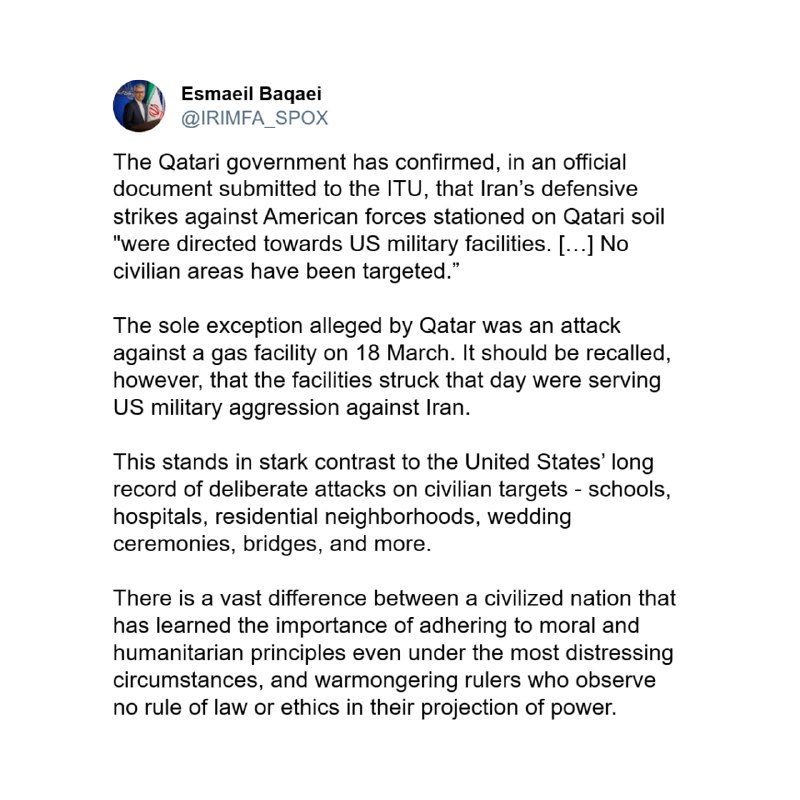
Doha's ministry of defence said on 12 July 2026 that a Qatari air defence system intercepted a missile attack originating from Iran, in the first confirmed use of Gulf state interceptors against Tehran's forces during the present crisis. The statement, relayed by the Telegram channel GeoPWatch at 03:11 UTC, offered no immediate casualty figure or damage assessment, and it did not say how many missiles were launched or which variant was used. The ministry framed the engagement as a successful defensive operation, language that places responsibility for the escalation squarely on the Iranian side of the Persian Gulf.
The intercept lands inside a diplomatic window that, by the morning of 11 July 2026, was already rated by prediction markets as a coin-flip. Polymarket had put the probability of a new round of US-Iran talks taking place in July 2026 at 45%, a figure that reflects how thin the negotiating track has become after repeated exchanges of fire between Washington and Tehran. The Qatari interception does not necessarily foreclose that track, but it raises the cost of any climbdown for both sides. Iran now has to answer for a missile that landed in a third country's airspace, and the United States now has to decide whether to treat Doha's defence as a joint operation or as a sovereign act by a Gulf ally that acted on its own authority.
What Doha said, and what it didn't
The Qatari statement is short on detail by design. Defence ministries in the Gulf rarely disclose interceptor counts, missile types, or debris recovery locations in real time; doing so would give a hostile intelligence service a clean read on radar coverage and engagement doctrine. The more important omission is political. The ministry did not say whether the launch came from Iranian military assets, from Iranian-backed Iraqi militias operating west of the country, or from Houthi forces in Yemen firing a longer-range system. Each attribution produces a different escalation ladder, and a Gulf government that names the wrong one publicly would be committing itself to a retaliation it may not want to carry out. The cautious wording, in other words, is the policy.
Trump's warning, measured in megatones
Hours after the Qatari intercept, Donald Trump posted on his social media account on 11 July 2026 that if he were assassinated, Iran would be "completely decimated," a statement relayed by the X account Unusual Whales at 05:41 UTC. The post is the first direct public comment from Trump since the latest exchange of fire with Tehran, according to a separate item from the Telegram channel AMK Mapping timestamped 12 July 2026 at 03:34 UTC, which framed the message as "Trump's first post since the exchange of fire with Iran." Read as deterrence signalling, the statement raises the cost of any Iranian decision to move against US personnel or the US president personally. Read as a negotiating posture, it is the kind of red line that makes a face-saving off-ramp harder to build. The Trump administration's record on Iran suggests both readings are intended at once.
Why Qatar, and why now
Qatar is the unusual player in this crisis. It hosts Al Udeid Air Base, the largest US military facility in the Middle East and the forward headquarters of United States Central Command's air operations. It also keeps one of the few independent diplomatic channels into Tehran, having mediated the January-February 2025 talks that produced, briefly, a partial understanding on nuclear constraints. Being both a US basing host and an Iranian interlocutor gives Doha a structural interest in any confrontation ending before it draws US fire onto Qatari territory. The ministry's choice to take public credit for the intercept, rather than to describe it as a US-led engagement, is consistent with that posture: Doha wants to demonstrate that it can defend its own airspace, which is the precondition for any neutral-broker role in a future round of talks.
The structural frame, in plain language
The pattern in the Gulf over the past eighteen months has been the slow collapse of the distinction between a US-Iran standoff and a regional missile crisis. Every previous episode since 2019 has followed the same shape: an Iranian-aligned strike, a US carrier group movement, a back-channel negotiation, a partial de-escalation, and then a new round. The Qatari intercept breaks that pattern in one important way. For the first time, a Gulf state that is neither Israel nor Iraq has publicly fired on an Iranian missile inbound, rather than absorbing the strike or relying on US Navy destroyers in the Gulf of Oman to do the shooting. The question now is whether Doha's act is the opening move of a Gulf-wide air defence doctrine, with Saudi Arabia and the UAE following suit, or whether it is a one-off, calibrated to allow the diplomatic track to continue. The Polymarket reading of a 45% chance of talks this month suggests traders are split.
What remains uncertain
The sources do not specify the type or number of Iranian missiles fired, the damage assessment on the ground, or whether any Iranian drones accompanied the salvo. They do not record an Iranian official response to either the Qatari intercept or the Trump warning. The Polymarket price is a useful summary of informed expectation, but it is not a forecast. Until Tehran issues a public statement and Qatar publishes a more detailed readout, the size of the attack, the intended target, and the identity of the launch authority are all matters of inference rather than fact. The diplomatic track is more alive than it was 48 hours ago, but it is also more brittle, and the Qatari intercept is the hinge on which it now turns.
Wire provenance
This editorial synthesis draws on the following public wire/social posts:
- https://t.me/GeoPWatch
- https://t.me/AMK_Mapping