Tehran publishes damage imagery as US-Iran memorandum enters 'crisis phase'
Iranian channels released satellite imagery of damage at Al-Udeid air base in Qatar hours before Washington said its blockade would extend to every flag, and Tehran declared a bilateral memorandum of understanding to be in crisis.
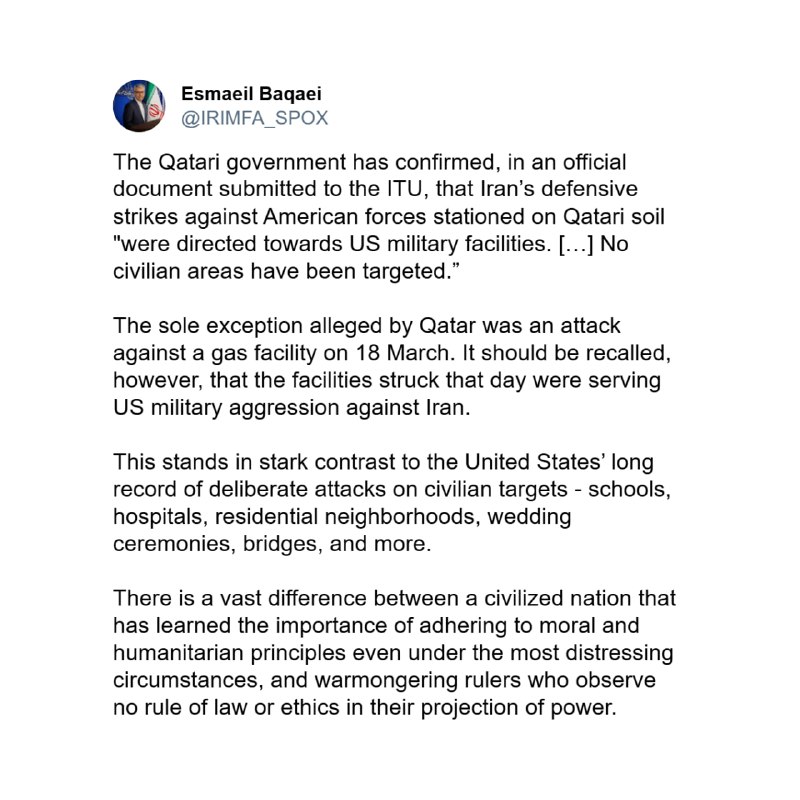
At 18:03 UTC on 14 July 2026, an Iranian-aligned channel published satellite imagery purporting to show an Iranian missile and drone strike on a fighter-aircraft maintenance centre at the US Al-Udeid air base in Qatar. The release came roughly twenty-two hours after Washington announced that its blockade of Iran would apply to every vessel entering or leaving Iranian ports, regardless of flag, and just over twenty-four hours after Tehran said a US-Iran memorandum of understanding had entered a "crisis phase." Three signals, three platforms, one escalation arc: the imagery as proof-of-strike, the blockade as proof-of-leverage, and the "crisis" label as proof that diplomacy is no longer doing the work both sides once claimed it was.
The pattern matters more than any single frame. A naval blockade is a tool of last resort, not first; releasing satellite imagery of damage to a host-state base is an information operation, not a military one; and a "crisis phase" designation is the diplomatic vocabulary of managed collapse. Read together, they describe a relationship that has stopped pretending to be in repair. The questions now are not whether the framework survives, but who acts first, who escalates by omission, and what the blockade does to insurance markets, tanker routes and Gulf state politics while the diplomats keep talking.
Three signals, three days
The blockade announcement landed on 13 July at 19:52 UTC via an account reporting US maritime policy. The framing, "regardless of flag," is the operative clause: it closes the loophole that flagged vessels under third-country registry would have used to neutralise the measure. In maritime law, that universality is what separates a sanction regime from a true blockade, and it is what makes the move politically expensive. Third-party flags mean third-party interests, and a blockade that ignores them sets up collision courses at sea.
The memorandum news, four hours earlier at 17:57 UTC the same day, carried Tehran's own framing: a US-Iran understanding, brokered in a previous round, was now in "crisis phase." Iranian officials have used that phrase in the past to signal that a channel remains technically open while being substantively stalled. The diplomatic utility is that it preserves the option of reactivation without committing to it.
Then the satellite imagery, published via an Iranian-aligned channel, naming Al-Udeid specifically and describing damage to a fighter-aircraft maintenance centre. The targeting of a maintenance facility rather than a flight line or housing area is consistent with calibrated signalling: degrade recovery capacity, do not produce Gulf-host casualties. That is consistent with how Iran has framed previous episodes aimed at US regional posture, in which the message to Gulf partners is that American bases on their soil are liabilities, not shields.
What a blockade actually does
A blockade is not a rhetorical instrument. It changes the calculus for shipowners, charterers, insurers and flag states in days. Premiums on Persian Gulf transits move first; reroutings and delays follow; commodity buyers in Asia start pricing a longer, more expensive barrel. The source material does not enumerate those market effects, but the chain from a flag-blind blockade to a Lloyd's Listed Area advisory to a tanker re-routing around the Cape of Good Hope is a familiar one, and the participants in this escalation are the same set of actors who have moved through it before.
The blockade announcement also raises the cost of third-country neutrality. Chinese and Indian refiners, the largest customers for Iranian crude outside domestic channels, will have to choose between compliance, evasion through ship-to-ship transfers in the Gulf of Oman, or a drawdown in Iranian imports. European refiners have less exposure but face the same legal architecture: a US blockade extended to all flags puts European-flagged tankers in the position of having to choose between US secondary sanctions and the freedom of navigation their own governments publicly defend. That tension is not new, but it has been dormant, and announcements like the one on 13 July bring it back to life.
The information layer
The satellite imagery is not the story; the question of who it is for is. Iranian-aligned channels distributing high-resolution, dated, location-tagged imagery of an attack on a Gulf-host base is an exercise in three audiences simultaneously. The first is domestic: a domestic audience that needs to see that strikes against US assets are not abstract. The second is Gulf-state: a message to Doha that the American umbrella is not preventing the base from being struck, and that the political price of hosting it will keep rising. The third is US-domestic: a US political audience that reads damage imagery through an electoral lens, in which any visible degradation of a forward base becomes a question about commitment.
The frame matters because Western wire coverage of damage at Al-Udeid has historically lagged the on-the-ground release, and Iranian channels have used that lag to set the visual record. The release on 14 July fits that pattern: an Iranian-aligned outlet moves first, naming the facility and the damage category, before any US Central Command confirmation can compete with the imagery itself.
What remains uncertain
The sources do not specify the scale of the damage, the weapons used, or whether US forces have acknowledged the strike. The satellite frames circulated by the Iranian-aligned channel are not corroborated in the available material by US military or Qatari government statements, and the maintenance-centre framing is consistent with the channel's preferred message rather than independently confirmed. The blockade announcement is similarly one-sided: it appears via a market-data account reporting the US position, without naming the issuing US agency or quoting a US official on the record. The "crisis phase" designation is a Tehran-side label whose meaning depends on whether Tehran's interlocutors accept the framing.
What this publication can say with confidence is that three escalatory signals have appeared within a thirty-hour window, on three different platforms, from actors with different audiences, and that the simplest reading is also the most uncomfortable: the diplomatic scaffolding between Washington and Tehran is being deliberately allowed to fail in public, with the operational and information layers taking over the work that talks used to do.
Wire provenance
This editorial synthesis draws on the following public wire/social posts:
- https://t.me/s/FotrosResistancee
- https://x.com/polymarket/status/
- https://x.com/unusual_whales/status/
- https://t.me/s/FotrosResistancee/2