Satellite images, a southern accent, and the limits of an air defence: reading Iran's Tuesday of projection
On 15 July 2026 Iranian state-linked channels broadcast satellite imagery of a strike on American-linked sheds in Kuwait alongside softer cultural signalling. The contrast is the point: where hard power runs out, projection fills the gap.
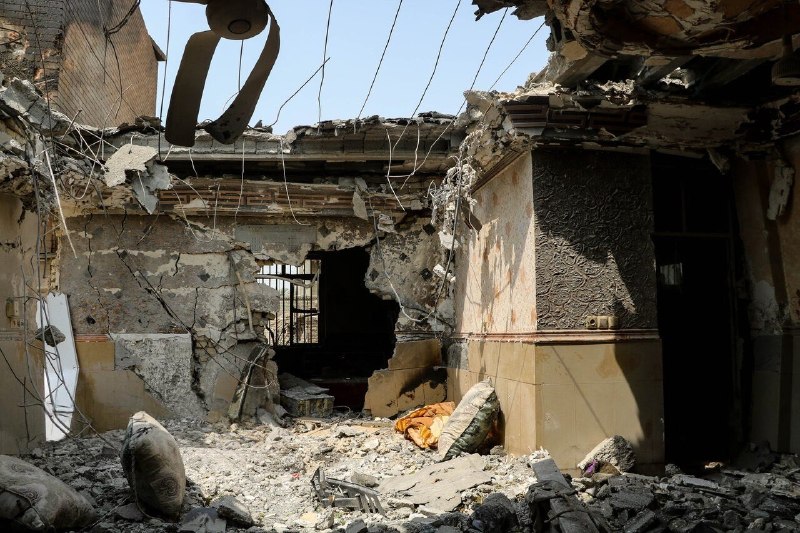
At 13:25 UTC on 15 July 2026, Iran's Tasnim Plus channel posted a frame of satellite imagery under a banner announcing that the Islamic Revolutionary Guard Corps had destroyed sheds belonging to a company identified in the chyron as KGL at the American base complex in Mina Abdullah, Kuwait. Just under a hundred minutes earlier, the same channel had opened its flagship broadcast with a flourish that had nothing to do with Kuwait at all: the host, normally anchored to Tehran's neutral broadcast Persian, signed on in a southern accent, a stylistic register its producers framed on-air as deference to southern audiences. The pairing is the story.
Iran's state-linked media apparatus spent Tuesday constructing two layered messages at once. One was a hard-power claim, mediated through imagery supplied by the channel itself: a strike attributed to the IRGC against infrastructure at a facility that sits at the intersection of the US logistics footprint in the Gulf and Kuwait's domestic industrial zone. The other was a softer piece of nation-building, aimed inward at Iranian viewers who happen to live in the country's south: an accent, a tonal concession, the small theatre of recognition that is part of how a state in protracted tension with the United States keeps its own house in order. The two messages are usually reported as separate stories. Read together, against the backdrop of what is and isn't verifiable about what actually happened in Mina Abdullah, they tell us more about Iranian strategic communication than either does alone.
The strike that the imagery does not, on its own, prove
What Tasnim Plus circulated at 13:25 UTC is a single satellite frame described in the post as showing destruction at American facilities in Mina Abdullah. The chyron credits KGL with ownership of the damaged sheds, and attributes the operation to the IRGC in an announcement that the post references as going out "this morning," without giving a local time. The location matters: Mina Abdullah sits south of Kuwait City, inside a port and logistics cluster that has, in past reporting, hosted US military staging infrastructure as part of US Central Command's regional posture, and Kuwaiti commercial activity as part of the broader Shuaiba industrial area.
What the post does not contain is a date for the imagery, the source of the imagery, the platform from which it was acquired, or any independent corroboration of damage from satellite imagery operated by Planet, Maxar, or the commercial Earth-observation vendors whose products are normally cited as verifiable references in open-source investigations of strikes. The post's typology matches the format Iran-aligned outlets used in their coverage of the Khorramshahr strike package on 15 March 2026, where chyron-attributed satellite clips eventually converged with timelines reported by Reuters and the wire services several hours after the first claims.
Kuwait has historically been a careful host. It hosts coalition forces under bilateral frameworks that include long-standing US arrangements, but its public posture in moments of regional spillover has been to insist on sovereignty over its own territory and over what may be launched from it. An IRGC strike on a shed inside a Kuwaiti industrial zone operated by a company the post names as KGL is, on the channel's own framing, an attack on a third country's soil that contains critical US logistics infrastructure. The political content of that act in Kuwait is different from its political content in Isfahan. Neither the post, nor any of the three items filed from the Tasnim Plus thread on Tuesday, addresses that distinction.
The accent that says what the air defence cannot
The 11:54 UTC item from the same thread is, on its face, a small piece of broadcasting trivia. The flagship host, a fixture of the evening slot on the channel's main bulletin, opened his program in a register associated with the southern provinces, including Bushehr, Hormozgan, and parts of Khuzestan. The post's own framing frames the choice as deference: a recognition by a Tehran-anchored host that an audience exists beyond Tehran, and that the way one speaks matters in the currency of legitimacy.
Read through the long lens of Iranian political communication, this is not trivial. Tehran's broadcast culture has historically preferred a homogenised standard Persian, and any visible accommodation to regional accents is treated inside Iran as a political signal. The signal here is consistent with a state that has spent several years reaching toward its southern periphery: the development of Chabahar, the LNG build-out at Iran's southern ports, and the framing of the Persian Gulf littoral as Iran's "southern front" in official discourse. The accent does the work that a more visible act of policy cannot, because it signals membership in a national audience rather than a transactional relationship with a strategic corridor.
The deeper implication is that the same state that, in the afternoon, broadcast a strike at Mina Abdullah also depends on domestic audiences who are not persuaded by satellite chyrons alone. On Tuesday, the channel ran both registers: a hard external claim and a soft internal concession, inside the same daily cycle. That is not a contradiction. It is a portfolio.
Structural frame: where the strike package runs out of evidence
The structural pattern Iran-aligned outlets have used to publicise strikes inside US logistics infrastructure in the Gulf and across the wider region over the past several quarters is consistent. A claim is made in the morning, sourced either to the IRGC or to a paramilitary organisation allied with it. Satellite footage, usually a single frame, is published via Tasnim or one of its sibling channels. Western wire confirmation, where it follows at all, tends to appear several hours later, and typically carries more modest framing: a strike on a US position adjacent to a port complex, property damage, no acknowledgement of responsibility from the United States.
What is missing from the standard package is the corroborating infrastructure that an open-source investigation would normally assemble: a second satellite vendor frame, a constellation of timestamped photographs, geolocation of craters, identification of the platform that launched the munition and the route it took. In the Khorramshahr episode of March 2026, that bridging work was done by Reuters and the wires post-facto. In the Mina Abdullah post of 15 July 2026, the bridging has not yet been done, by Tasnim's own post or by any item this publication has access to in the present thread. The infrastructure that would let a reader verify the strike on its merits is absent from the post itself, and the post does not point the reader anywhere it can be found.
The structural implication is that the strike, as a piece of reporting, is a single-source claim at the moment of broadcast, regardless of what subsequent reporting may eventually establish. That is normal in wartime and in proxy conflict: claims come out fast, and verification follows. But it shapes what a reader should take from the broadcast. The chyron and the accent are signals of intent: that Iran intends the strike to have been read as a strike, and that its domestic audience is intended to feel included in that intent. The actual blast-effect, the engineering question of what was destroyed and to what effect, is a separate piece of journalism that the post does not perform.
The framing that survives: a nightmare of attrition
The third Tasnim Plus item of the day, posted at 13:28 UTC, condenses the larger argument the channel has spent the past several days constructing across its feed. Rendered in English as a slogan-style line, "A nightmare that no American weapon can solve," the post is the editorial frame around the strike and the accent at once: a state at war, in its telling, with an adversary whose platforms are expensive and whose doctrine has run out of answers, and a domestic audience that can be addressed in its own register while the larger argument is made on its behalf.
The frame is not new to Iranian-aligned media. It has antecedents in the way the channel covered strikes that have, in subsequent reporting, been borne out by wire services, and it has antecedents in the way Tehran's satellite channels framed earlier rounds of escalation. What is notable on Tuesday is the pairing: the hard strike package broadcast against the softer concession broadcast, in the same daily news cycle, on the same channel, with the same house style. The combination suggests a media operation that has been calibrated, over several quarters, to deliver two messages at once: that Iran can reach its adversary's logistics footprint where it sits, and that Iran can still sound like home to its own periphery. Each message is, on its own terms, a constraint on the other. Together they describe a state whose projection depends on holding both claims at once, because losing either one would unbalance the other.
What remains uncertain and what to watch
Three things are open as of 15:25 UTC on 15 July 2026. First, the satellite imagery itself: a second, independently sourced frame would corroborate damage at the specific shed complex Tasnim attributes to KGL. None is cited in the thread. Second, the operational claim: which munition, which route, which unit. The post credits the IRGC and references an announcement "this morning," but does not publish the announcement or link to an order of battle that would let an outside reader identify what was used. Third, the political consequences inside Kuwait: a strike on a Kuwaiti industrial zone that contains US-linked logistics infrastructure is, on the face of it, an event in which Kuwait is not a party to the underlying conflict and on whose territory a strike has nevertheless occurred. The post does not address whether Kuwaiti authorities were notified, whether there is a Kuwaiti statement, or how Kuwaiti domestic politics will read the imagery.
The cleanest forward markers are the standard ones: a subsequent wire-service item with on-the-ground sourcing, a Kuwaiti government statement via KUNA, and a second satellite frame from a non-Iranian vendor. Until any of those appears, the strike is a single-source claim, the accent is a verified piece of broadcasting craft, and the larger argument is unfinished.
How Monexus framed this vs the wire: The Western wire line on Iran-aligned strike claims, when it engages at all, is to wait for corroboration and to attribute the claim to the channel that made it. This article runs the claim and the cultural-concession broadcast together as a single portfolio, on the working assumption that Iran's projection on any given Tuesday is the most legible when both registers are read at once, and that doing so is more honest than treating them as two unrelated items.
Wire provenance
This editorial synthesis draws on the following public wire/social posts:
- https://t.me/tasnimplus
- https://t.me/tasnimplus
- https://t.me/tasnimplus
- https://t.me/tasnimplus
- https://en.wikipedia.org/wiki/Mina_Abdullah
- https://en.wikipedia.org/wiki/Mina_Al-Ahmadi_Refinery
- https://en.wikipedia.org/wiki/Khorramshahr_missile
- https://en.wikipedia.org/wiki/Islamic_Revolutionary_Guard_Corps
- https://t.me/tasnimplus
- https://t.me/tasnimplus
- https://t.me/tasnimplus
- https://t.me/tasnimplus
- https://en.wikipedia.org/wiki/Mina_Abdullah
- https://en.wikipedia.org/wiki/Mina_Al-Ahmadi_Refinery
- https://en.wikipedia.org/wiki/Khorramshahr_missile
- https://en.wikipedia.org/wiki/Islamic_Revolutionary_Guard_Corps