Iranian strike on Jordan base puts US troops and de-escalation arithmetic on the line
US officials say Iranian missiles struck a Jordan airbase housing American personnel, with satellite imagery showing fires at the billeting site and unverified footage circulating from inside the base.
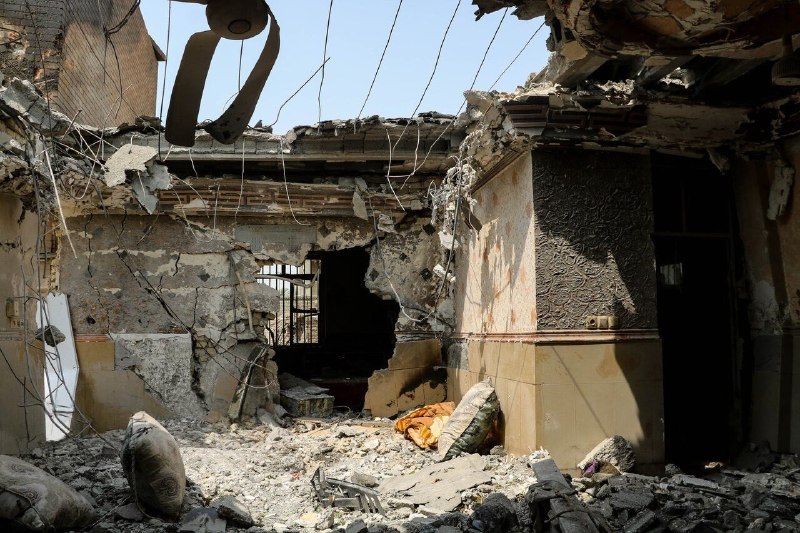
Fire returned to the desert east of Amman on 18 July 2026. The New York Times reported that several helicopters were damaged in an Iranian strike on a US position in Jordan, and US officials told the paper that as many as 20 American soldiers were injured at Muwaffaq Salti Airbase roughly 48 hours before the story crossed wires. NASA FIRMS thermal data, geolocated and shared by the open-source channel RANE Worldview, showed the fire expanding across the part of the base that houses US military personnel, rather than the flight line or runway. Video purporting to show an incoming missile over the base circulated on X from an account identifying itself as an American soldier stationed there.
The strike lands on a Jordanian host who has spent two decades sheltering US air power from his territory, and on an American footprint that has tried, since the start of the air campaign over Iran, to keep its forward bases out of the visual frame. Both calculations now look harder to sustain. Iran's mission at the United Nations, which routinely denies responsibility for strikes in third countries when it chooses to comment at all, had not been quoted in the immediate aftermath. Neither had the US Central Command press desk, beyond the officials speaking to the Times on background. The information war around the strike is moving faster than the diplomatic one.
What the footage does and does not show
The most widely circulated clip, posted by @sprinterpress on X at 20:24 UTC on 18 July, is filmed from ground level inside the perimeter of an unidentified installation. A bright object descends at a steep angle, the horizon flashes, and the camera ducks. The user describes themselves as an American soldier at the base. The footage is consistent with a short-range ballistic missile impact and with the Times's reporting, but it is not independently verified as to time, location, or the operator who fired it. Al-Alam Arabic's breaking-news push, citing the same Times piece, gave a more specific casualty figure: 20 American soldiers wounded, attributed to "American officials" via the paper. RANE Worldview's thermal overlay places the burn scar on the billeting block of Muwaffaq Salti, which is the housing rather than the aviation side of the base, suggesting the strike was aimed at personnel rather than aircraft even though the Times reports helicopters were damaged.
The open-source picture is therefore coherent in shape but soft on specifics. Two questions are unresolved. First, the timeline: the Al-Alam brief says 48 hours before publication, which would put impact on 16 July; the FIRMS data is from 18 July, which is when the fire was still burning or reigniting, not necessarily when it started. Second, the count: "several" helicopters, in the Times's wording, and 20 injured, in Al-Alam's, are different kinds of numbers and the relationship between them is not yet on the public record. Until CENTCOM or a uniformed US spokesman confirms the basic envelope of the strike, the headline numbers should be read as the upper bound of early reporting, not the floor.
Why Muwaffaq Salti, and not somewhere louder
Muwaffaq Salti is a Royal Jordanian Air Force base at Azraq, in the country's eastern desert. It hosts US and coalition aircraft and personnel under a long-standing status-of-forces arrangement. Its footprint is small relative to the Gulf forward bases that have dominated coverage of US posture in the region, and the choice of Muwaffaq Salti over, say, Al Udeid in Qatar or the main cluster around the Gulf, is itself a piece of information. A strike that hits a base hosting US troops but not the symbolic heart of the US central command architecture is calibrated to wound, not to escalate. The same logic explains the choice of billeting over flight line. Iran has the technical capacity, well documented in assessments of its missile and drone forces, to do worse than this if the goal were to force a war.
The implied audience is Washington, not Amman. The implied message is that the cost of any further operation can be redistributed across the thin line of US basing in Jordan, Iraq, and the Gulf, where the rules of engagement still treat host-country airspace as something to be negotiated rather than as sanctuary. That is the bet Iran has made before, against US forces in Iraq and against Saudi infrastructure through the Houthis, and it is a bet that works only if the response stays symbolic.
What is genuinely contested
Three things remain genuinely in dispute on the public record. One, responsibility. No Iranian state outlet has claimed the strike as of the timestamps in the source thread, and Iranian outlets reporting on the incident frame it as a response to US posture rather than as a unilateral escalation. Two, the US political reaction. President Trump's public schedule for 18 July, as reported across wires, made no mention of Iran or Jordan; the White House has not, in the materials available, characterised the strike. Three, the host-country line. Jordan's state-aligned outlets have not, in the immediate thread, carried the strike on the front of their English-language feeds in the way they have for past incidents, which is a tell that Amman is buying time to coordinate its own message with Washington and Tehran rather than react on its own clock.
A fourth, more structural uncertainty is whether the strike changes the cost calculus of the air campaign at all. Two decades of US basing posture in Jordan have been built on the assumption that Iran would treat the kingdom as off-limits. That assumption held even during the worst of the regional proxy wars. Its erosion would, over a horizon of months rather than days, push the US either to thicken its defence footprint (which is politically expensive in Amman) or to thin it out (which is strategically expensive in Washington). Neither decision is the kind that gets made in a single news cycle.
Stakes and what to watch next
The honest reading is that this is a message strike, not a campaign opener. The damage described is real: helicopters and personnel, on a base that hosts Americans, in a country that has worked hard to keep its name out of the firing line. But the targeting pattern, the billeting rather than the flight line, and the choice of a Jordanian host rather than a Gulf one, point to an actor trying to raise the price tag of the ongoing US campaign without forcing a wider war. That is the same bet Iran has run against Saudi oil infrastructure and against US positions in Iraq, and the historical read is that such bets tend to compound: each round raises the cost of the next, and the line between messaging and escalation is policed by the side that miscalculates first, not by the side that strikes first.
Watch, in order, for a CENTCOM confirmation with numbers, a Jordanian official statement from Amman, and any read-out from the UN Security Council's 19 July schedule. The shape of the response in those three venues will tell the reader whether Washington is treating this as a probe to absorb or as a line to enforce. Until then, the headline numbers belong to the early hours of an event that is still being assembled, not to the policy turn it will eventually drive.
How Monexus framed this: the wire pushed casualty and damage figures from official background briefings within hours of impact, before any uniformed confirmation. Monexus treats the headline numbers as the upper bound of early reporting, separates the open-source thermal and video material from the unnamed-official figures, and reads the choice of target and host as a deliberate calibration rather than an escalation. Where the Western wire line and the regional read diverge on intent, both are carried.
Wire provenance
This editorial synthesis draws on the following public wire/social posts:
- https://t.me/sprinterpress
- https://t.me/osintlive
- https://t.me/alalamarabic
- https://t.me/rnintel
- https://x.com/sprinterpress/status/2078590239728115712