A campaign named after the lie, and a barrier that rewrites the map
On 16 July activists launched "They Lied to You" to keep Gaza in the frame. Five days later AP published satellite imagery of an earthen barrier that may redraw the enclave's geography.
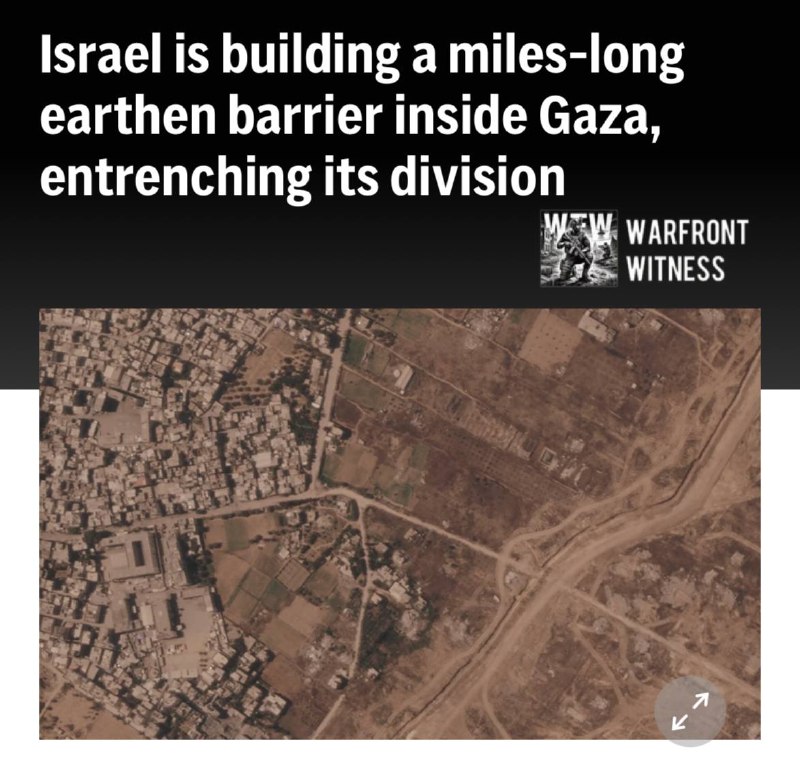
On 16 July 2026, a coalition of activists went live with a digital campaign called "They Lied to You," an explicit rebuke to the messaging that, in their telling, has let the world look away from Gaza. Five days later, on 21 July, the Associated Press published satellite imagery reviewed by researchers showing Israel building a large earthen barrier inside Gaza, a structure that, once finished, could divide the enclave and lock in Israeli control of more than half its territory. Read in sequence, the two items sketch the same argument from opposite ends: a communications offensive aimed at the headlines, and a physical offensive aimed at the ground.
The activists' premise is straightforward. Coverage of Gaza has been throttled by access restrictions, the attrition of foreign press, and the steady drip of official framing that treats each new phase of the war as an isolated event rather than a continuous operation. "They Lied to You" is built to puncture that arc, returning the camera to the civilian cost that, the campaign organisers argue, has been progressively editorialised out of the story. Whether or not one accepts the campaign's framing in full, the launch date matters: it lands a year and nine months after the October 2023 attacks, in a news cycle already crowded with other theatres.
The campaign and the counter-narrative
"They Lied to You" is not the first attempt to weaponise the gap between official language and visible reality. Earlier rounds of digital organising around Gaza leaned on user-generated video and the platform reach of eyewitness accounts. This iteration is more deliberately retrospective. The activists are naming specific prior claims, from civilian-casualty thresholds to the geography of any future "day after," and asking audiences to compare them against what the same sources now describe as the on-the-ground record. The implied audience is twofold: foreign publics whose attention has migrated, and decision-makers whose policy choices have been justified, in part, by the official narrative the campaign is contesting.
The campaign's sponsors are presenting it as a corrective rather than a counter-myth. That distinction is doing real work. A counter-narrative that offers only its own version of events can be dismissed as mirror-image propaganda. A corrective, by contrast, leans on primary documents, satellite imagery, hospital records, and the public statements of officials, then sets them side by side. The campaign lands closer to the second model. Even readers who reject the word "genocide" will find the underlying audit exercise difficult to dismiss without engaging the documents themselves.
The barrier, in plain language
The AP satellite analysis, circulated via the WFWitness wire on 21 July 2026, shows construction of a large earthen berm inside Gaza. The structure runs across a significant portion of the enclave, and researchers quoted in the wire estimate that, on completion, it could consolidate Israeli control of more than 50 percent of Gaza's territory. Two details sharpen the picture. First, this is not the border fence along the 1949 lines; it is an internal feature, which means it functions less as a perimeter defence and more as a partition. Second, berms of this kind are slow to remove. They are not tactical, they are durational. Once consolidated, they reshape the operational map for years, regardless of who is technically sovereign over the soil above them.
Israeli officials have, in previous phases of the war, described such engineering works as temporary security measures tied to the location of tunnel networks and weapons caches. The framing is plausible at the level of any individual kilometre of earthworks. It is less persuasive at the level of a barrier that may, on completion, govern movement between the northern and southern portions of a strip roughly 40 kilometres long and, in places, only a few kilometres wide. A security berm does not need to bisect a territory to control it; it only needs to govern who crosses it, when, and under whose permit.
What the frame is doing
Coverage routinely defers to the language of official spokespeople when describing operations inside Gaza, partly because access is mediated, partly because wire protocols favour attribution over assertion. The result is a vocabulary of "operations," "phases," and "buffer zones" that flattens the difference between a tactical manoeuvre and a structural reorganisation of territory. "They Lied to You" is an attempt to re-import that distinction into the public conversation, and the AP imagery does the heavy lifting by replacing the verbal category with a measurable object on a map.
This is the structural pattern that makes the two stories rhyme. A campaign aimed at the narrative and a barrier aimed at the ground are both exercises in locking in a state of affairs while the legal and political debates about that state of affairs remain unresolved. The narrative lock-in says: by the time the question of what happened in Gaza is settled, the public will have absorbed the official version as common sense. The physical lock-in says: by the time the question of Gaza's political geography is settled, the geography itself will have changed.
Stakes, and what to watch next
The narrow stakes are immediate. Foreign-ministry statements, UN Secretariat briefings, and the next round of aid-coordination negotiations will all have to engage, explicitly or by omission, with the satellite record AP has now published. The wider stakes are about the template. If an internal earthen barrier can be built, justified as security, and consolidated to the point where it governs the daily movement of more than two million people, then the precedent travels. Any future conflict in which a state argues that an enclave within its claimed territory requires a "temporary" internal partition will have a 2026 Gaza case study to cite, or to disavow.
What remains genuinely uncertain is whether the campaign's audit exercise and the imagery audit it now sits beside will land in the same news cycle, or be processed as two unrelated stories. The activists are betting that coupling them will force a single, uncomfortable conclusion: that the longer the official framing holds, the harder the ground becomes to walk back from. The next dated event to watch is any Israeli government statement on the purpose, scope, and timeline of the berm, since that statement, when it comes, will be the first formal test of whether the "They Lied to You" critique has changed the terms of the answer.
This publication treats the Middle East conflict with equal weight on Israeli security concerns, including hostage situations and rocket fire, and on documented Palestinian civilian harm, using UN, Red Cross, and wire service figures rather than partisan ministry releases.
Wire provenance
This editorial synthesis draws on the following public wire/social posts:
- https://t.me/wfwitness