Trump's Gaza Boardroom and the New Architecture of US-Israel Leverage
A weekend of presidential remarks on Israel, Türkiye and the Fed sketches a transactional Middle East policy in which security guarantees, interest rates and ammunition stockpiles are priced into the same conversation.
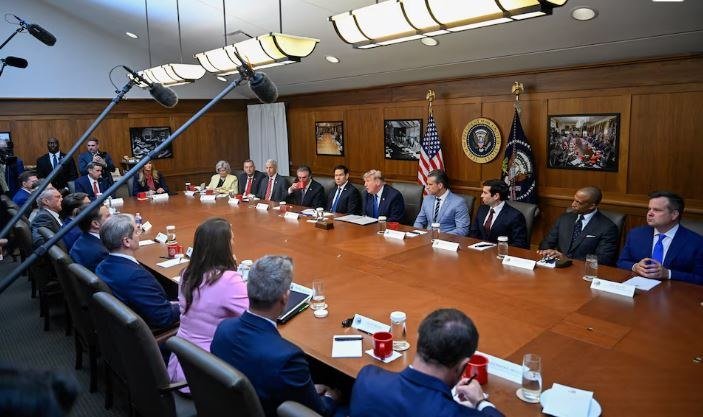
At 17:33 UTC on 27 July 2026, President Donald Trump told reporters that Türkiye is "not a big fan of Israel," "not a big fan of Bibi," but has nevertheless been "great for me" personally, calling Türkiye a "very powerful country." Within the same 24-hour news cycle the president declared that Israel "wouldn't survive without the US," told the Federal Reserve it should run the world's lowest interest rate, and claimed US ammunition stockpiles exceed anything the country could ever use. Read in isolation these are bar-room asides. Read together, Monexus assessment: they read as parts of a single bargaining posture, with Israel, Türkiye and the Gulf all expected to price themselves in accordingly.
The transactional cast of Trump's framing matters less than the underlying architecture it reveals. When a sitting president tells one foreign capital that US backing is existential, then turns to the Fed to argue for cheaper money, then boasts about a domestic ammunition surplus no adversary could match, the through-line is leverage pricing. Monexus analysis: each strand reinforces the others, as the president appears to be treating security guarantees, monetary policy and military inventory as a single instrument of Middle East negotiation. What remains opaque is whether this is a coherent doctrine or a negotiating style that will be tested the first time a counterparty calls the bluff.
A Gaza plan with US fingers on the dial
On 26 July 2026, at 18:00 UTC, Israel approved the entry of a multinational security force into Gaza as part of Trump's proposed peace plan, according to a Polymarket wire. The mechanics are conventional; the politics are not. A multinational deployment legitimised by Israeli cabinet action but choreographed by the White House converts Gaza from an Israeli security file into a US-managed one. The multinational force is, on the evidence available, an outsourced guarantee, a way for Washington to underwrite Israeli red lines without bearing the visible costs of direct occupation.
The leverage, insofar as the source material permits any reading, flows both directions. Israel gains a shield against accusations of sole governance over civilian life in Gaza, and a way to keep pressure on armed factions under a foreign-flag banner. Washington gains a seat at the table in a theatre where it had been locked out for two years, and, on Monexus reading, a precedent for the template that could be redeployed elsewhere. The model reads as corporate rather than diplomatic: the US holds the franchise, allies buy into the brand. Whether that template survives its first contact with Gazan ground conditions is the obvious stress test the wires do not yet resolve.
Türkiye as a reluctant franchisee
Trump's Türkiye remarks are the diagnostic moment. Ankara's longstanding friction with Israel over Gaza, its contacts with Hamas and its role as a mediator in adjacent theatres have long irritated both Jerusalem and Washington. By describing Türkiye as "not a big fan" of Israel and "not a big fan of Bibi" before conceding that the government has been "great for me," Trump is doing two things at once. He is signalling to Israeli listeners that he understands the friction. He is signalling to Ankara that the price of admission to his Middle East is the personal channel, not the institutional one.
The risk sits in what gets priced out. If bilateral accommodation is built on a personal relationship, then a change of occupant in either the White House or the AKP leadership leaves the architecture exposed. The institutional residue, security agreements, intelligence sharing, NATO interoperability, becomes optional. Türkiye's own multipolar instinct, visible in its dialogue with Moscow, its drone exports to a wide range of buyers and its brokering efforts in Ukraine and Ethiopia, will not vanish because one president found the Turkish leadership personally agreeable. The relationship remains structurally fragile even when it is atmospherically warm. Monexus analysis: the personal-channel framing is a feature for Trump and a fragility for everyone downstream.
The ammunition balance sheet and the Fed
Two of Trump's other weekend interventions belong in the same analysis. His claim that the US has more ammunition than it could ever use, relayed at 17:38 UTC on 27 July, reads as an input to the bargaining table rather than a boast about readiness. A country that visibly cannot run out of bullets is, on the available evidence, a country that can sustain a long security presence in the Gulf, the Eastern Mediterranean or the Red Sea without parliamentary revolt. The supply side is being pre-priced. Whether the claim is factually accurate is something the available source items do not specify; the strategic signal is what carries.
His intervention with the Federal Reserve, telling the central bank that the US "should have the world's lowest interest rate," is the demand-side mirror of the same posture. Monexus analysis: a cheaper dollar lowers the carrying cost of any reconstruction financing in Gaza, lowers the cost of servicing Israeli and Gulf sovereign debt denominated in greenbacks, and lowers the price of the multinational force itself, which will be paid in dollars, stationed on dollar-priced fuel and dollar-insured cargo. The president is, on this reading, asking his own central bank to subsidise his Middle East policy. The Fed's institutional independence is the variable most exposed if the request becomes public pressure; the available source items do not specify how the Fed has responded.
What the wire is not telling you
The dominant framing treats this as a string of disconnected remarks: Trump being Trump, the Fed being independent, Israel handling Gaza, Türkiye being difficult. That framing is convenient. It lets each institution disclaim responsibility for the others and lets each headline avoid the through-line. Monexus assessment: the through-line is that Washington is now willing to convert the entire US-Israel relationship, and increasingly the US-Türkiye relationship, into a continuously priced instrument, with security, monetary policy and military inventory as the three adjustment knobs. The source material does not establish that this is happening; it establishes that the president's own language maps onto exactly that logic.
The most natural counter-reading is that this is the normal haggling of a returning president who treats foreign policy as a series of personal deals. There is something to that. But deals of this scale, a multinational Gaza force, an open intervention in Fed policy, an existential framing of US backing for Israel, do not stand or fall on personality alone. They require bureaucratic consent, congressional tolerance and allied acquiescence. Monexus analysis: the acquiescence so far has been forthcoming, and that is the part the wire under-covers.
The stakes for the next 90 days are concrete. Watch whether the Fed's September meeting delivers a cut that can plausibly be linked, even loosely, to financing reconstruction in Gaza. Watch whether Ankara is asked to contribute troops or logistics to the multinational force. Watch whether a second Trump-authored roadmap, for the West Bank or Lebanon, appears before the November US midterm cycle. Each of these would confirm that the architecture sketched in a single weekend of remarks is now load-bearing.
The unresolved piece is the cost. Multinational forces in Gaza will be paid for by someone, and the bill has not been published in the materials available to this article. A cheaper dollar subsidises that bill at home but, on standard macro logic, exports inflation into every fragile state that imports food and fuel priced in greenbacks. Israel gains time but not necessarily a plan that closes the political file. Türkiye gets a personal channel and loses an institutional one. The Fed, if it complies publicly, sets a precedent no future chair will be able to ignore. None of this is in the weekend wire, and that is precisely why the weekend wire is worth reading carefully.
Monexus framed Trump's weekend remarks as one transactional architecture rather than three disconnected stories; the dominant wire treatment treats them as isolated headlines, which understates the leverage convergence between security guarantees, monetary policy and military inventory.
Wire provenance
This editorial synthesis draws on the following public wire/social posts:
- https://t.me/ClashReport/90613
- https://x.com/unusual_whales/status/2081806071522591011
- https://x.com/Polymarket/status/2081796354121019518
- https://x.com/Polymarket/status/2081783752695378035
- https://x.com/Polymarket/status/2081439508248101130