USDT's $4 billion contraction meets a stock market at a record: a hedge is being unwound
Tether's 60-day supply fell $4 billion in two months, per CryptoQuant data cited by Cointelegraph on 5 August 2026, just as the S&P 500 closed at a record and Wells Fargo prepared a tokenised-deposit rollout for autumn.
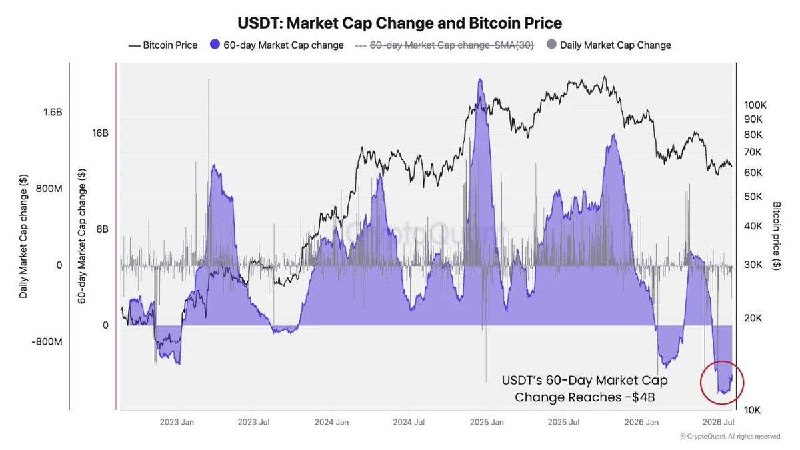
At 09:41 UTC on 5 August 2026, Cointelegraph flagged a number that does not usually make the front of a macro brief: Tether's USDT had shed roughly $4 billion of market capitalisation over the trailing 60 days, the sharpest contraction on record according to blockchain-data provider CryptoQuant. Twenty hours earlier, at 13:55 UTC on 4 August, the same wire had logged that the S&P 500 had closed at a new all-time high. The two prints landed inside the same news cycle, and they tell a coherent story.
A stablecoin is supposed to be the steady instrument in the kit, the dollar-equivalent that lets traders rotate between tokens without leaving the crypto stack. When its supply shrinks at the fastest pace since the instrument was launched, it is not because traders have lost interest in dollars. It is because dollars have moved somewhere else. The Cointelegraph/CryptoQuant reading, paired with the equity record and Wells Fargo's tokenised-deposit announcement on 4 August, suggests that the marginal dollar is rotating back into traditional risk and into bank-issued on-chain instruments, just as the cost of staying inside stablecoins has begun to bite.
Two prints, one rotation
USDT is the largest dollar-pegged token by circulation and the bridge most non-US exchanges rely on for settlement. A $4 billion contraction over 60 days, in CryptoQuant's reading, is unprecedented in the instrument's history. The direction matters more than the absolute size: net issuance is turning negative, which is the on-chain signature of redemptions outpacing minting. Traders are redeeming USDT for actual dollars and then moving those dollars into either bank rails or risk assets.
The equity tape cooperated. Cointelegraph reported at 13:55 UTC on 4 August that the S&P 500 reached a new all-time high. A red-hot equity market that pays a risk premium is the natural destination for capital exiting a yield-free dollar substitute. The convergence is not accidental. When the equity multiple expands and the opportunity cost of sitting in stablecoin form rises, the float drains.
What Burry sees
Into that backdrop stepped Michael Burry. Cointelegraph reported at 21:10 UTC on 4 August that the investor of "The Big Short" fame warned the stock market may be near a major top and said a 1987-style crash was still possible even with the S&P 500 at a record. The framing is conventional contrarianism, but the timing of the call, layered on top of a $4 billion stablecoin contraction, is the more interesting signal. The hedge that was sitting inside USDT is being quietly removed. If Burry is right that the equity top is near, the float leaving USDT is rotating into the very market most exposed to a sudden re-pricing.
Monexus analysis: this is the part that warrants close attention. Stablecoin float is often read as a measure of crypto-native risk appetite. In the present cycle, it functions more accurately as a measure of where idle dollar liquidity is parked. A negative print means the parking lot is emptying. Where the cars are going tells you what the marginal buyer expects to happen next.
Banks move into the lane
The third data point completes the picture. Cointelegraph reported at 11:36 UTC on 4 August that Wells Fargo, with roughly $2.2 trillion of assets, will roll out tokenised deposits for corporate clients this autumn. Tokenised deposits are not stablecoins in the regulatory sense: they sit on a bank's balance sheet as a deposit liability and clear through conventional payment infrastructure. They offer the same on-chain legibility that made USDT useful to corporate treasuries, with a different credit and settlement profile.
If a corporate treasurer can hold a tokenised deposit at Wells Fargo and use it for 24/7 settlement, the rationale for routing working capital through a Cayman-issued stablecoin narrows. The Cointelegraph note frames the rollout as targeted at corporate clients, not retail, but the competitive displacement is the point. US bank-issued tokenised liabilities are not in the same product category as USDT, but they compete for the same use case: programmable dollar balances that move on-chain.
Stakes
A $4 billion contraction over 60 days is, in isolation, a rounding error against the size of US money-market funds. Read against the equity record and the bank-rail expansion, it looks like the early innings of a realignment. Three camps have skin in the game.
Tether, the issuer, faces a shrinking float at exactly the moment its distribution moat is being contested by regulated bank products. Its response, in the available reporting, is not specified; the cited Cointelegraph post does not name a Tether spokesperson or a company statement, and this article has not independently established whether Tether has issued a public response to the CryptoQuant reading.
The major US banks, exemplified by Wells Fargo's autumn rollout, are pulling a use case back inside the regulated perimeter. They win float, settle their own tokenised liabilities, and recapture the revenue that migrated offshore during the 2022-2024 stablecoin expansion.
Crypto-native traders and the exchanges that route through USDT face a narrower lane: less float, tighter redemption conditions, and a competitor with a balance sheet and a regulator behind it.
The market-structure question for the rest of 2026 is whether the CryptoQuant contraction extends for a third month or stabilises. If the equity multiple rolls over from the record Burry is watching, the float that left USDT will not come back; it will sit in money-market funds waiting for the next leg. If the equity multiple holds and Wells Fargo's tokenised deposits clear at scale, the structural case for USDT as the default corporate dollar instrument weakens further. Either path is bad for the stablecoin's share of the on-chain dollar business, and good for the banks that have spent two years building the substitute.
Desk note: Monexus treated Cointelegraph's three Telegram wires (USDT contraction, S&P record, Wells Fargo tokenised deposits) as a single cluster and read Burry's warning as the counter-narrative within that cluster. The primary data point is CryptoQuant's; the equity record and the bank-rail announcement supply the structural context. No Tether response is in the cited material, and the absence is noted rather than inferred.
Wire provenance
This editorial synthesis draws on the following public wire/social posts:
- https://t.me/Cointelegraph/71446
- https://t.me/Cointelegraph/71427
- https://t.me/Cointelegraph/71434
- https://t.me/Cointelegraph/71424