Colombia's new president takes office pledging a tougher line on crime and drug trafficking
Abelardo de La Espriella was sworn in as Colombia's president on 8 August 2026, pledging tougher policies on security, drug trafficking and the economy, with the new government's posture already being summed up by market trackers as a fight against the country's 'cocaine armies.'
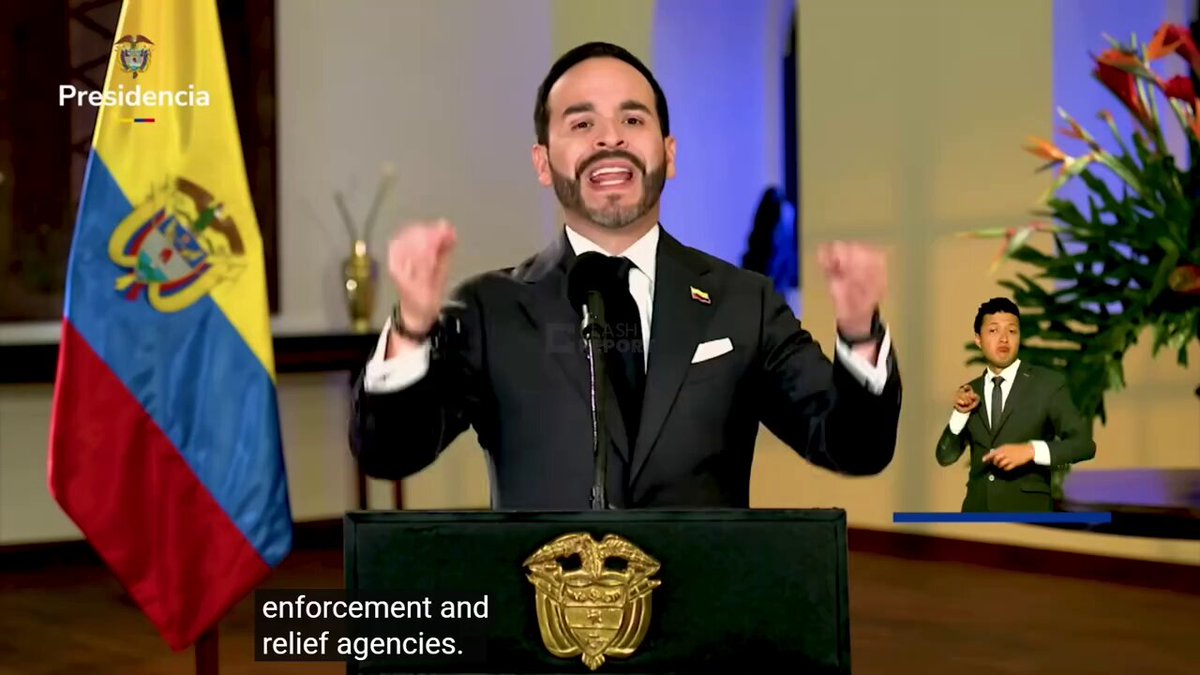
Abelardo de La Espriella was sworn in as president of Colombia on 8 August 2026, pledging tougher policies on security, drug trafficking and the economy, according to a Reuters video dispatched the same day. The Polymarket account covering political risk summed up the new government's posture in blunt terms in a post on 7 August 2026 at 23:51 UTC, writing that De La Espriella "officially takes office, pledging a crackdown on the country's 'cocaine armies.'"
The framing matters because it is the incoming government's own register, not a wire paraphrase. Three source items, from Reuters, LiveMint and Polymarket, all converge on the same point: the new presidency is being introduced to the public through the language of organised-crime warfare rather than the language of negotiated security.
The man and the mandate
The Reuters video introduces De La Espriella as a lawyer who built his public profile in courtrooms and now takes an oath to govern. The LiveMint item, posted to Telegram at 07:09 UTC on the morning of the inauguration, characterises him in its headline as a "rightwing lawyer"; the Polymarket post does not characterise his ideology but does echo the security framing.
In his inaugural address, De La Espriella repeated a pledge, recorded by LiveMint, of a "tough crackdown on crime and insurgency." Reuters's own framing of the inauguration emphasised the same three policy tracks: security, drug trafficking and the economy. Monexus analysis: when Reuters, LiveMint and a market-tracker account all describe a new government in the same three-word triplet ("security, drugs, economy"), the wire consensus has effectively set the policy frame against which the new administration's first hundred days will be measured.
The available source items do not specify which officials the new president has named to the security, justice or foreign portfolios. That is the next filing to watch.
What "cocaine armies" actually signals
The Polymarket post is the only source item that uses the phrase "cocaine armies," and it places it in scare-quotes, treating it as the new government's chosen language rather than as a description supplied by the tracker. Monexus analysis: that distinction is the story. A "cocaine armies" framing recasts organised-crime actors as a single adversary suitable for a military-style campaign. The phrase does the rhetorical work of justifying a security architecture that treats organised-crime prosecutions as counter-insurgency, expands the role of the military in domestic operations, and reframes any negotiated settlement as appeasement rather than peacebuilding.
The risk of that framing, on the reading of the Polymarket post alone, is that it flattens whatever distinctions exist on the ground into a single enemy. Monexus assessment: the three cited items do not describe the composition of the armed actors the new government intends to target, which is why the rhetoric travels further than the underlying threat picture.
Counter-reading: the same framing could be read narrowly as a marketing device for an administration whose actual policy toolkit is unchanged. Colombia has used militarised counter-narcotics vocabulary across multiple governments; the word "armies" is new, the underlying security posture may not be.
The political economy of the pledge
There is a domestic audience calculus behind the choice of language, even if the three source items cited here do not detail it. Reuters and LiveMint both report the inauguration as a security-and-economy event rather than a foreign-policy or institutional event, which is itself an editorial signal about how the new government intends to be judged.
Monexus assessment: the wire consensus that frames this inauguration as a security-and-drugs story, rather than an institutional-reform story, will shape both market expectations and bilateral conversations. A government introduced through the lens of counter-narcotics is being benchmarked against counter-narcotics outputs: interdiction volumes, extradition counts, coca hectarage.
Counter-reading: the three cited items do not address whether the new government has a parallel economic agenda beyond the inauguration speech. Reuters's framing of "the economy" as a separate pledge suggests there is one, but the source items do not specify what it contains.
What the next 90 days will test
Three early indicators will tell readers whether the pledge is a policy or a posture.
The first is a cabinet. Reuters's framing of "tougher policies" implies a security-heavy ministerial team, but the three cited items do not name any cabinet appointments. The next concrete filing from any of these outlets will be the cabinet list, and the names attached to interior, defence and justice portfolios will convert the rhetoric into force structure. Anything weaker signals that the new president intends to govern through existing institutions rather than replace them.
The second is the relationship with external counter-narcotics partners. The three cited items do not address the bilateral track at all. Any subsequent Reuters or LiveMint reporting that names a counterpart government, a certification decision, or an aid-flow figure will be the first material signal that the inauguration has produced a foreign-policy realignment rather than a domestic-policy relaunch.
The third is the drug-economy verdict. The wire will carry the pledges; an independent assessment of coca cultivation will eventually carry the verdict. The three source items do not specify a measurement framework, which means the new government is buying time on the only metric that matters until the next independent survey publishes.
Desk note: Monexus framed this inauguration around the language used by the three cited items ("tougher policies on security, drug trafficking and the economy" in Reuters's words, "tough crackdown on crime and insurgency" in LiveMint's words, "cocaine armies" in Polymarket's words) rather than around any external characterisation of the new president's ideology or campaign record. Context paragraphs on the implications of the "cocaine armies" framing, the wire-consensus effect, and the upcoming indicators are explicitly labelled as Monexus analysis or assessment, and rest on the cited items alone; readers seeking broader context about Colombia's armed actors, US-Colombia relations or the prior government's negotiating record will need to consult reporting beyond these three sources.
Wire provenance
This editorial synthesis draws on the following public wire/social posts:
- https://reut.rs/4xyoQKJ
- https://x.com/Reuters/status/2086092566605201578
- https://www.livemint.com/news/world/rightwing-lawyer-abelardo-de-la-espriella-sworn-in-as-new-colombian-president-all-you-need-to-know-about-him-11786167448968.html
- https://t.me/LiveMint/22111
- https://x.com/Polymarket/status/2085876392101589320
- https://reut.rs/4xyoQKJ
- https://x.com/Reuters/status/2086092566605201578
- https://www.livemint.com/news/world/rightwing-lawyer-abelardo-de-la-espriella-sworn-in-as-new-colombian-president-all-you-need-to-know-about-him-11786167448968.html
- https://t.me/LiveMint/22111
- https://x.com/Polymarket/status/2085876392101589320